THE SHORT ANSWER
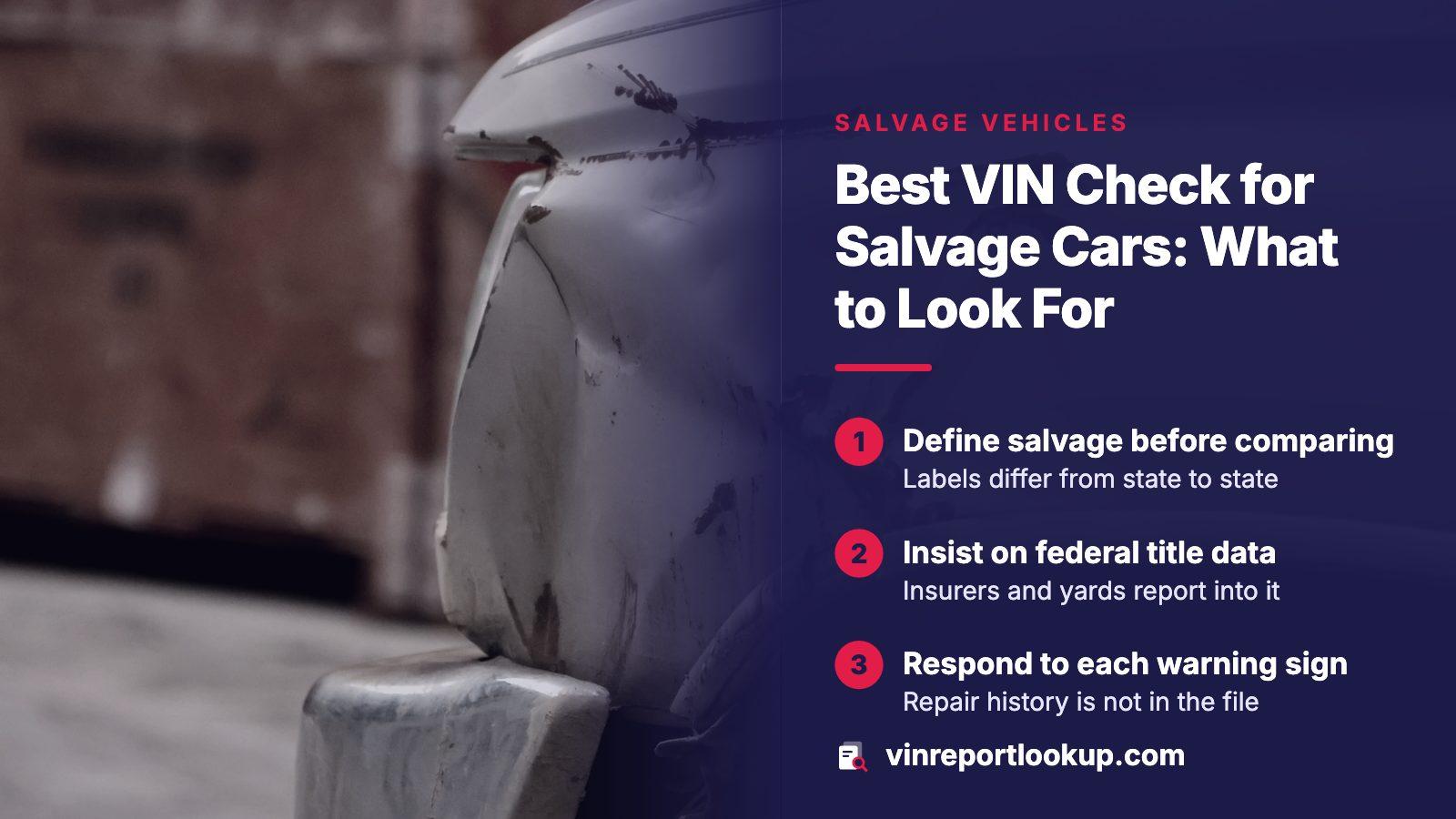
Judge a salvage VIN check on three points. It should draw on the Justice Department's title system, which insurers, salvage yards and states must report into. It should show brand history, total-loss decisions and salvage or auction entries for the VIN you typed. And it should say what is missing, since a car that was never insured or never reported can look clean. Preview first, buy one report for the finalist, then inspect the car.
- Federal reporters
- Insurers, salvage yards, recyclers, state agencies
- Brand record
- Once applied, stays in the federal file
- Gap
- Repair history is not in the federal system
- VINReportLookup
- Free preview, one payment, no subscription
What the word salvage means before you compare reports
A salvage car is one somebody decided was not worth fixing, at least on paper. Federal rules in 28 CFR 25.52 frame it as a vehicle whose salvage value plus the cost of repair would exceed what it was worth before the damage. The same rule sweeps in any car an insurer declares a total loss, even when the owner keeps it and never hands it over.
Junk is a separate label, reserved for a wreck that cannot be driven legally and has value only in pieces. States then apply their own brand names and thresholds on top, so the same wreck can be called different things in different places. A good report lets you see which label a state used and when it was applied, because that date tells you how long ago the car was written off.
Why the definition matters when shopping
A report that only says clean or not clean hides the difference between a hail-dented total loss and a car pulled from a flood. Pick a seller whose results name the brand, the date and the state.
The records a salvage-focused check has to return
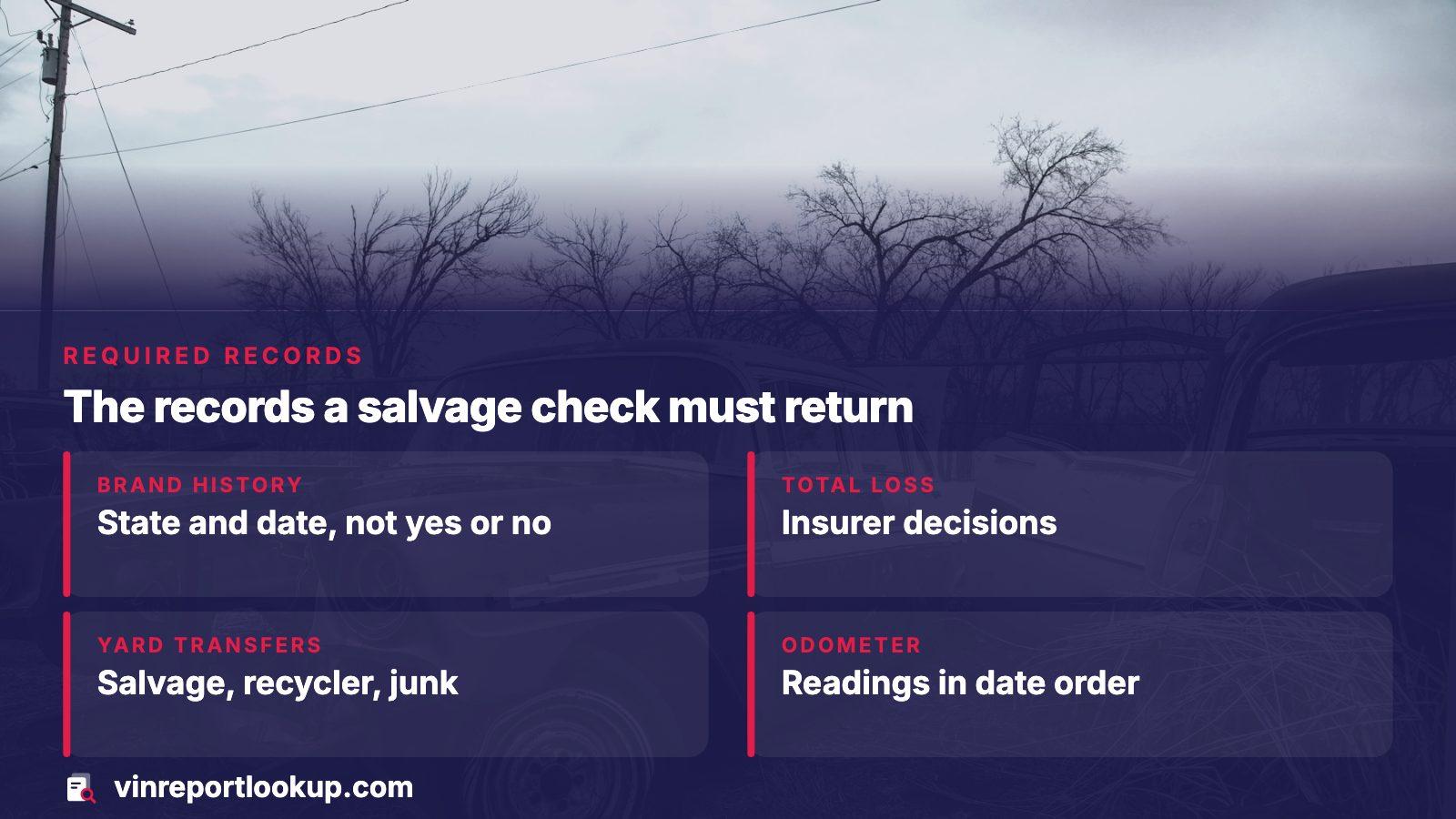
Start with the title trail. You want the state that titled the car now, the date of the last title, and every brand any state ever applied. Next come total-loss decisions by insurers and any record of the car passing to a salvage yard, recycler or junk yard. Odometer readings matter too, because a rebuilt wreck sometimes comes back with a number that does not fit the earlier trail.
Auction entries with photos are the part buyers underrate. A photo set from a salvage sale can show crushed rails, a burned engine bay or waterlines in a way a branded title never will. If a report gives you the dates and the sale record but no pictures, it still helps. If it gives neither, treat the clean result with caution.
- Brand history with state and date, not a single yes or no
- Total-loss and salvage decisions from insurers
- Transfers to salvage yards, recyclers or junk yards
- Odometer readings in date order
- Auction records with damage photos where they exist
Why federal title data is the backbone
The Justice Department oversees a national title database, and federal law makes states, insurers, recyclers, junk yards and salvage yards feed it on a regular basis. That is why it beats a single company's own database: the sources are required to send data, not invited to.
Its main job is stopping brand washing. Retitle a branded car somewhere that never asks the first state, and the new paper can read spotless. The national file holds onto a brand after any state applies it, so a buyer who looks there sees what the paper leaves out.
Ask any report seller whether its title records come from this source. The Justice Department publishes the list of approved providers, with no ranking among them, so you can confirm a name before paying.
What a clean result still cannot tell you
The federal file is deliberately narrow. It does not hold repair history, and the Justice Department says private companies add data it was never designed to carry. States also send updates on different clocks: a few in real time, most on a daily or multi-day delay. A car sold last week might not show its newest event yet.
Coverage has edges as well. Commercial vehicles can be missing where a state keeps their titles in a separate system. And a car damaged badly but never insured, never sent to a yard and never branded by a state leaves nothing to report.
| Situation | What the report can show | What you still need |
|---|---|---|
| Insurer wrote the car off | Total-loss decision, often with a salvage entry | Inspection of how it was repaired |
| Branded in another state | Brand history from the federal file | Copy of the state title record if details matter |
| Damage with no claim or brand | Possibly nothing | Mechanic's inspection, paint and panel check |
| Recent sale or new title | May lag by days | Ask the seller for dates, re-run later |
Running the check on one specific car
Copy the VIN from the advert, then check it against the stamped number on the vehicle and the title papers. If those disagree, walk away before spending anything. Type the VIN into the preview on VINReportLookup to confirm the car decodes and to see whether records exist.
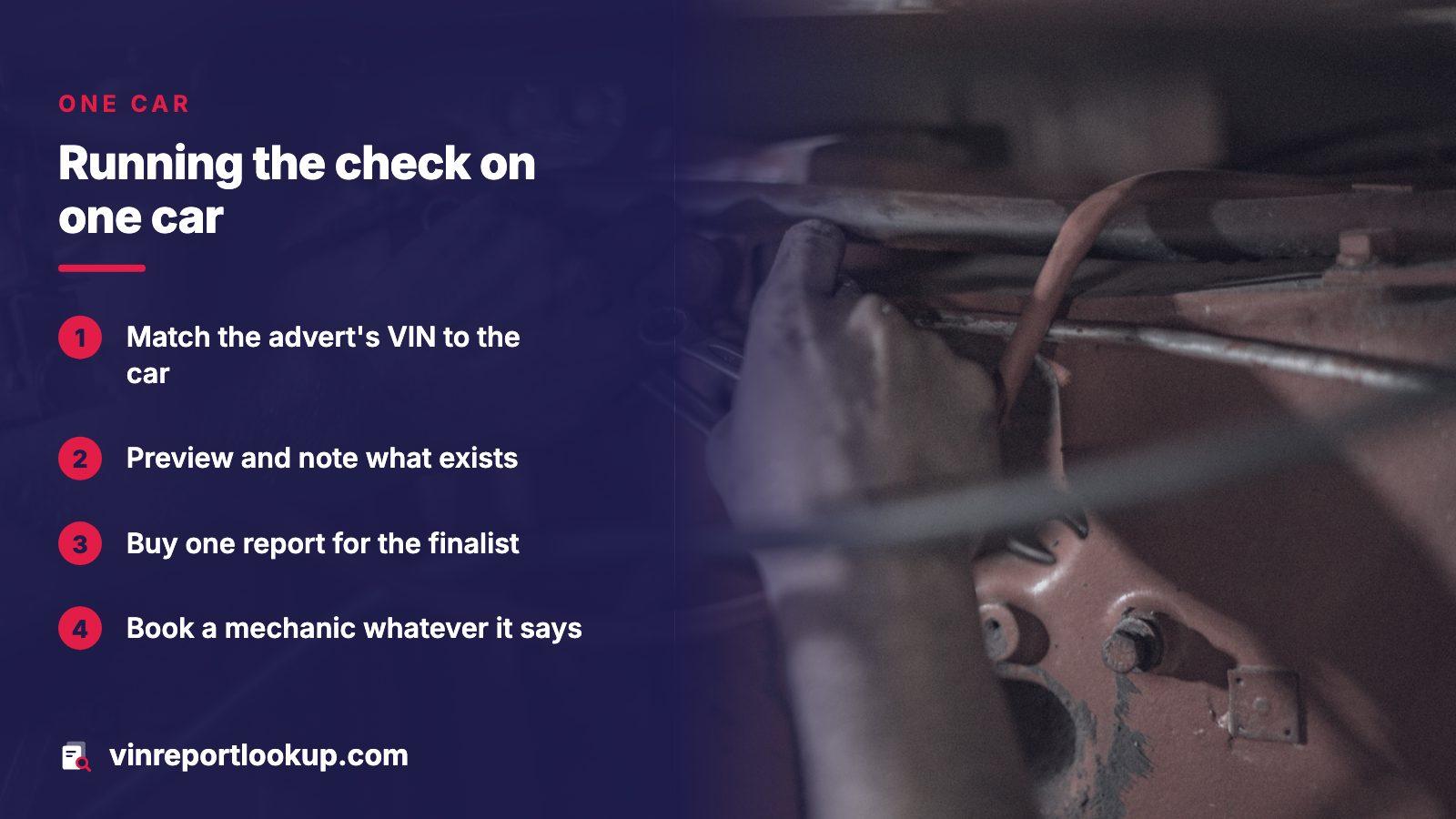
- Write down the VIN from the advert and match it to the car.
- Run the free preview and note what it says exists.
- Buy one report for the finalist only, not for every car on your list.
- Read brand, total-loss and auction entries first, odometer second.
- Book an independent mechanic whatever the result says.
Packs suit shoppers weighing several cars, but only after previews have narrowed the list.
Warning signs in a result, and your response to each
An earlier brand in one state with a spotless title in the next is the pattern the federal system was built to catch. Treat it as a washed brand until the seller proves otherwise with the original state record. A total-loss decision with a recent title date suggests a quick rebuild, so request the repair invoices plus any pictures from mid-repair.
An odometer reading that drops, or barely moves across a long stretch, deserves a direct question to the seller. Sale photos of damage the seller never mentioned are the strongest signal of all. If the story and the record disagree, believe the record and negotiate, or leave.
Branded does not always mean unsafe
Some rebuilt cars are repaired well. The point of the check is price and disclosure: a branded car should cost less, and the seller should say so before you ask.
How to compare report sellers without trusting adverts
Ignore star ratings and page claims. Look at the seller's own pages for what it says a report contains, whether you can preview a VIN first, and whether the payment is a single charge or a recurring one. The federal approved-provider list tells you who may sell title records to the public.
The Justice Department says fees for title reports differ by provider, so read each seller's own price page rather than trusting a figure quoted elsewhere. Here, looking up a VIN shows a preview without charge. Going further means one payment for a report, no recurring billing, at whatever the pricing page currently lists. Never pay a seller that hides the price until after you enter a card.
Cost, next steps and where this check fits
Treat the report as one layer of a buying routine, not the whole routine. The Justice Department itself urges an independent inspection alongside the title record, and it points buyers to the federal trade agency's used car tips. A mechanic who lifts the car catches frame repairs no database can.
If the result shows a salvage or total-loss record and you still want the car, price it as a branded vehicle, ask your insurer whether it will cover it before you pay, and have the repair quality checked.
When you are ready, enter the VIN on the home page and read the preview.
Where this information comes from
- Justice Department: understanding a title report — what the federal report covers and who must report
- Justice Department: consumer page on the title system — brand washing, permanent brands, salvage and yard transfers
- Justice Department: NMVTIS FAQ — fees, update timing, vehicle types, missing repair data
- Justice Department: used car buying tips — inspection advice alongside a title record
- Justice Department: approved NMVTIS providers — who may sell title records to the public
- eCFR: 28 CFR 25.52 definitions — federal meaning of salvage and junk automobile
Sources and photos: Facts checked against the sources above in November 2026. Photos by Everett Pachmann, Nina Mercado and Leo_Visions on Unsplash; diagrams by VINReportLookup.
Keep reading
- Best VIN check: how to choose a report and what each one includesThe general comparison for any vehicle.
- Best VIN check for auction cars: what to run before you bidAuction cars carry their own record risks.
- Rebuilt title inspection cost: state fees and what a buyer paysWhat the inspection step costs on a rebuilt car.
- Carfax vs inspection: what each shows and which to buy firstWhat a report cannot replace.
Frequently asked questions
Can a salvage car show a clean VIN check?
Yes, if nobody reported the damage. A wreck that was never insured, never sold to a yard and never branded by a state leaves no record to find. That is why a clean report should be followed by a mechanic's inspection, especially on a car priced below similar ones.
Are a salvage title and a total loss the same thing?
Not exactly. A total loss is a decision, often by an insurer. A salvage brand is the mark a state adds to the title afterward. Federal rules count both inside their salvage definition, and each state sets its own thresholds and names, so read the exact wording in the result.
Does a rebuilt title mean the car is safe?
No. It means the car passed whatever inspection that state requires after repair. Quality varies widely. Request the repair paperwork, and pay a mechanic to inspect the frame, airbags and wiring before you agree on a price.
How many reports should I buy for a salvage-history shortlist?
Preview every candidate, since that step costs nothing, and pay for a full report only on the one or two you would really buy. A pack of reports can help if you are weighing several, but a single report is enough for one finalist.
Can the report show damage photos?
Where a salvage or auction record exists for the VIN, the report can include its photos. Many cars have none because they never went through a sale. Missing photos prove nothing, so inspect the car yourself.
Now check the car itself
The guide explains what to look for. The report shows what this VIN has on record.