THE SHORT ANSWER
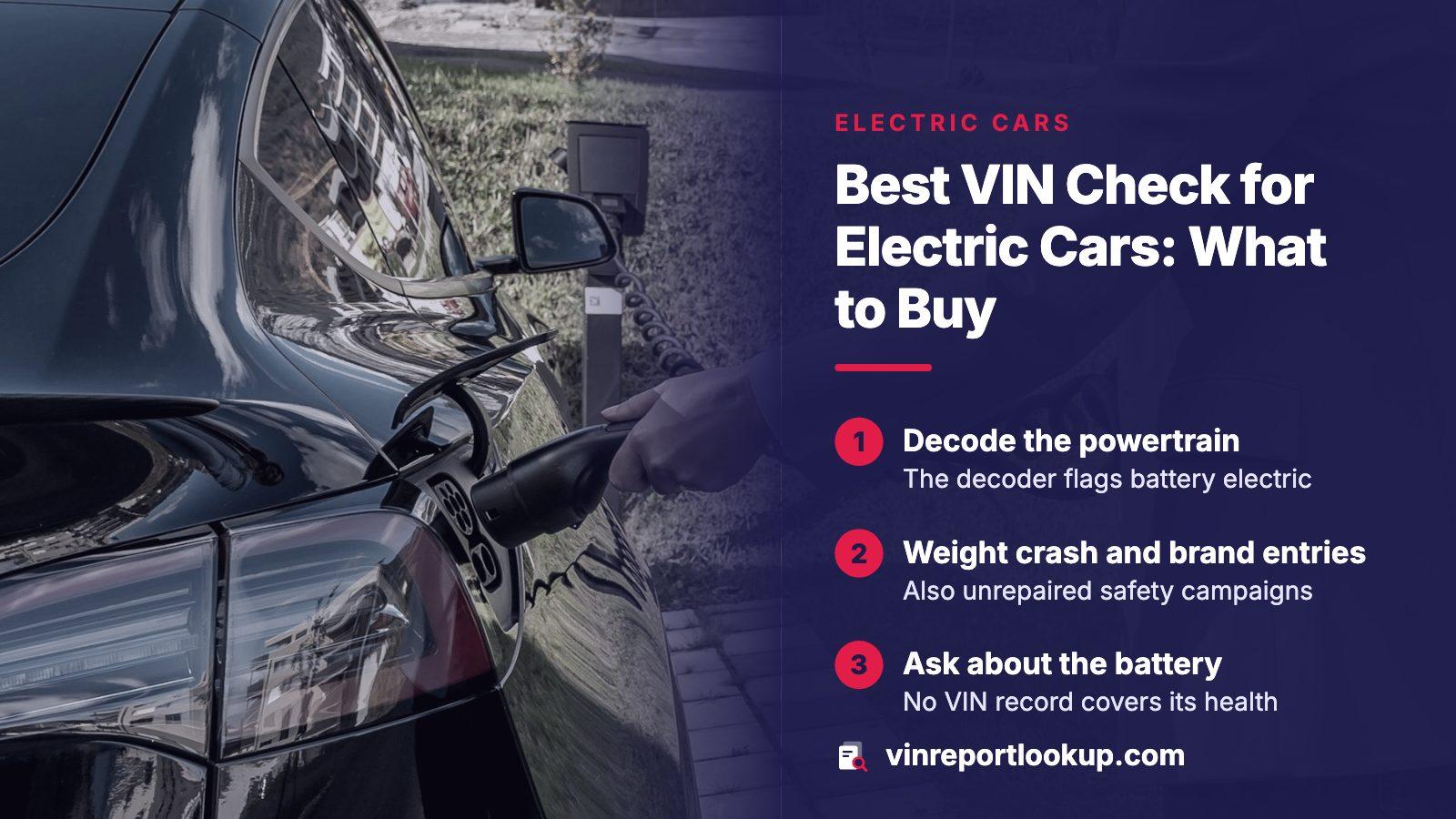
Pick a report that lists title branding, crash and write-off entries, mileage figures and unrepaired safety campaigns, because those are the items a VIN can reveal. Nothing tied to a VIN measures battery health, so add a diagnostic from a dealer or EV specialist. Decode the VIN with NHTSA, preview it, and buy a report only for your finalist.
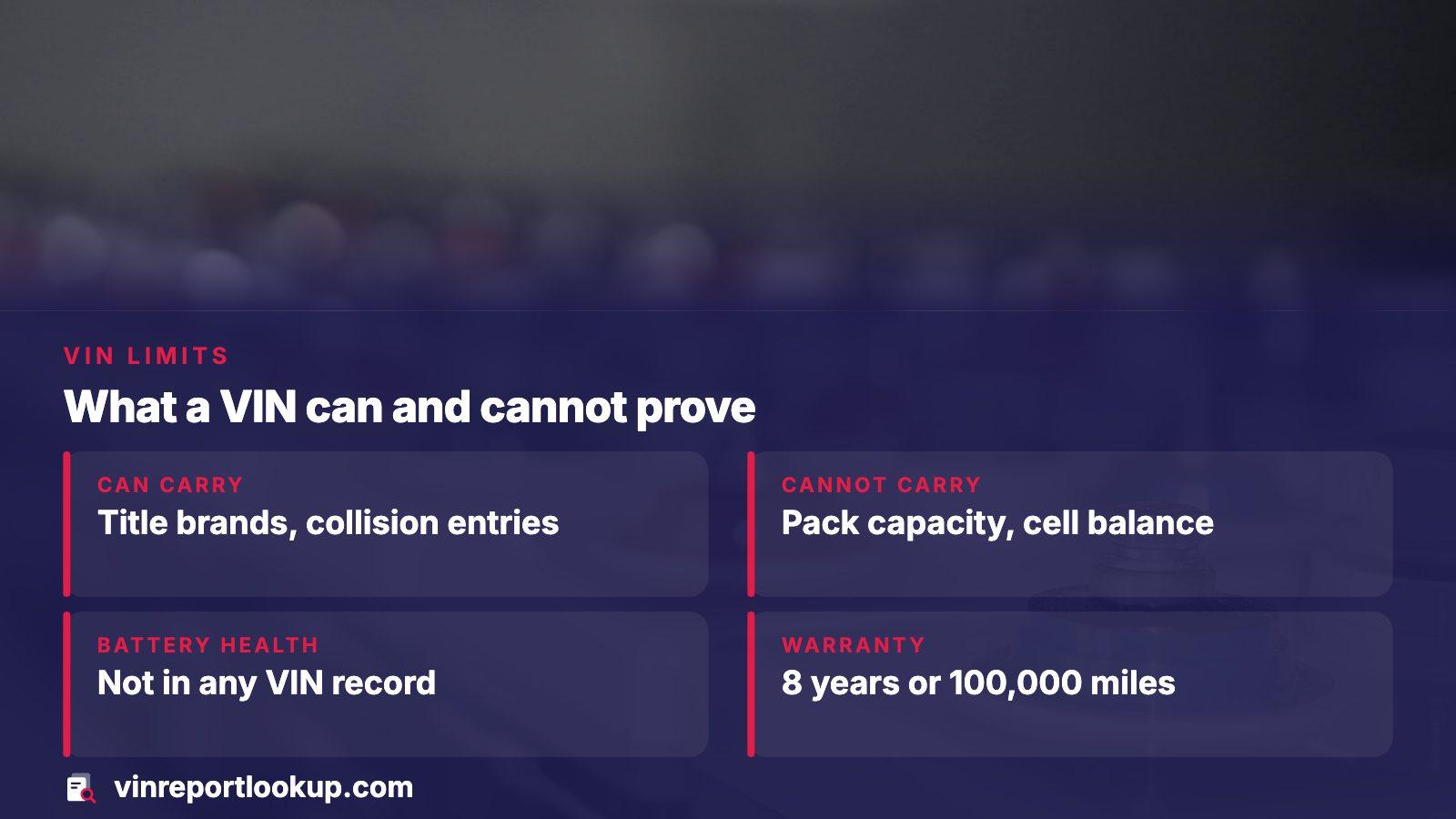
- Battery health
- Not in any VIN record
- Common battery warranty
- 8 years or 100,000 miles
- NHTSA decoder
- Flags a car as battery electric
- This site
- Free preview, one payment, no subscription
What a VIN check can and cannot prove about an EV
A buyer comparing reports for an electric car is really buying answers to three questions. Was the car ever branded, wrecked or written off? Does the mileage trail rise sensibly? Is any safety campaign still waiting for a fix? A VIN-based report can speak to all three, because those records are keyed to the vehicle identification number.
What it cannot do is read the condition of the pack. State of health is measured from the car itself. A seller who says a history report scores battery life is promising something the records do not hold.
- A report can carry: title brands, collision entries, salvage and auction listings, odometer history, open recalls.
- A report cannot carry: pack capacity, cell balance, charging-speed loss, the previous owner's charging habits.
Start with the federal decoder, then add the report
Before paying anyone, run the VIN through NHTSA's vPIC decoder. I tested it with a 2018 Tesla Model 3 VIN whose ninth digit I had deliberately botched. The tool still returned the make and model, listed the primary fuel as Electric, labeled the car a battery electric vehicle with a single motor, and named Fremont as the plant. It also printed an error line saying the check digit failed to calculate. Its battery type and battery capacity fields came back blank.
Use the result to test a listing: if an ad promises a dual-motor trim and the decoder shows one motor, ask why. It reflects the build the maker filed and tells you nothing about the car's past.
A cheap sanity check
A decoder error on the check digit usually means a typo or a doctored VIN. Retype it from the car itself before you read anything into the result.
The records that deserve the most weight on an EV
On a gasoline car a repaired collision is mostly about bodywork and resale. On an electric car the battery sits low in the structure, so a hard hit raises a second question about what happened underneath. Read accident entries, salvage or auction photos and any total-loss branding first. A damage entry on a clean title is a reason to ask for repair paperwork, not to walk away.
Flood entries call for the same care. The federal title system sends notices to its reporting entities after major floods, which tells you water-damaged vehicles do reach the market.
| Record | Why it matters on an electric car |
|---|---|
| Accident and damage | Points to impact near the pack or high voltage components |
| Salvage and auction photos | Show underbody or corner damage the listing never mentions |
| Title brand | Signals an insurer or state declared the car a loss |
| Odometer trail | Backs up the range and wear story the seller tells |
| Open recalls | Shows safety work still owed, including battery campaigns |
Recalls: why the open-recall line is worth reading
The most expensive EV recalls have involved the battery itself. I pulled the recall list for the 2019 Chevrolet Bolt EV from NHTSA and found 6 campaigns. Two of them, 20V701000 and 21V560000, concern a high voltage battery that could catch fire when charged to full or nearly full. The first was superseded by the second, and the maker said cars fixed under the first campaign were owed the newer remedy as well.
A later campaign, 22V930000, covers seat belt pretensioners that could ignite carpet fibers after a crash, and 23V845000 revisits cars repaired incorrectly the first time. A completed recall is not the same as an open one, and the report should show which is which.
From an NHTSA owner complaint
An owner of a 2019 Bolt EV told NHTSA in 2021 that the maker had been slow to fix the battery recall. The family was told to limit use of the car, their only one, and did not feel safe parking it near the house. Check recall status on your VIN so you do not inherit someone else's wait.
What used buyers report once the car is theirs
Most owner complaints concern faults that surface after purchase, not history a report could catch. A report lowers your odds of buying a wrecked or rolled-back car; a test drive and a technician cover the rest.
From an NHTSA owner complaint
A buyer of a preowned 2019 Bolt EV with only 32,166 miles told NHTSA in 2025 that the steering felt stiff and would not straighten after a sharp turn. Low mileage did not mean a trouble-free car. Drive any EV through varied turns and speeds before signing.
Battery questions a report will not answer
The Energy Department's vehicle data center says many makers back EV batteries with an 8-year, 100,000-mile warranty. It also says makers rarely publish pack prices, that paying for a pack after the warranty ends is expected to hurt, and that full failure data does not exist.
EPA reads more kindly: across roughly 15,000 EVs built through model year 2023, battery swaps for failure averaged 2.5 percent outside major recalls, under 0.5 percent from model year 2016 on. Packs still tend to lose some range with age.
- Ask the seller or dealer for the in-car battery health reading or a printout from a diagnostic scan.
- Ask whether the battery warranty transfers to a second owner and when it ends for this VIN.
- Ask for charging habits and any service visits tied to the high voltage system.
How to compare report sellers for an electric car
Ignore any seller that advertises an EV score without explaining it. Judge a report on what it lists, where the data comes from and what you pay. A preview that confirms the VIN before payment is a good sign.
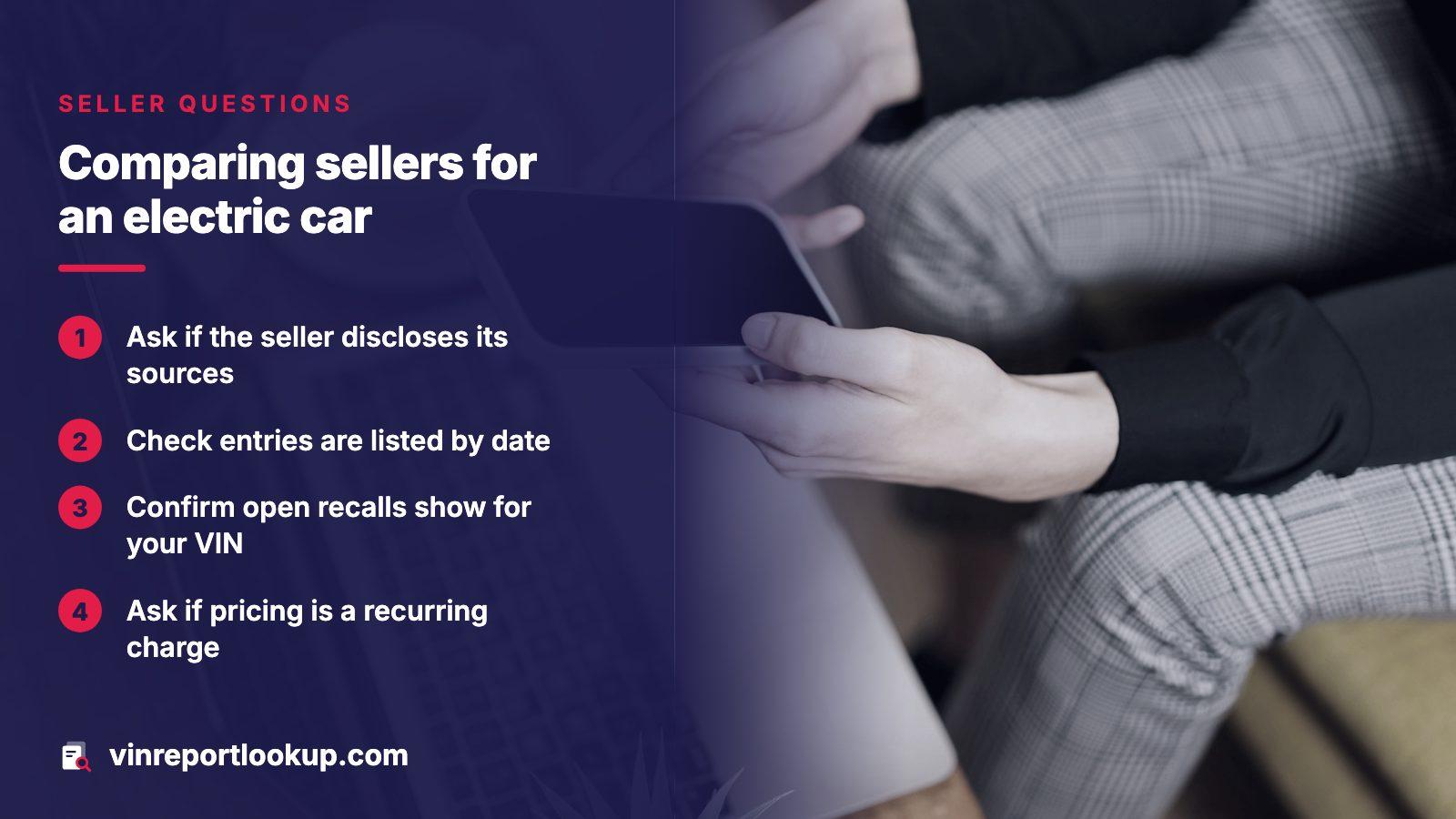
- Does the seller disclose its data sources?
- Are accident, salvage and odometer entries listed by date?
- Are open recalls shown for your VIN?
- Is pricing one payment or a recurring charge?
- If a subscription exists, how do you cancel?
The federal title system was built to keep stolen and unsafe cars from being resold, so a seller that draws on it covers the records that matter most.
Running a check on a car you are weighing
Copy the number from the dash or door jamb of the actual car and compare it with the listing. Run it through the preview here, which confirms the vehicle before any money moves. If the car makes your final two, buy the report for that VIN and read the entries in date order.
Read for gaps as well as events: a long stretch with no mileage entries, a title that crossed several states quickly, or a damage record the seller never mentioned should prompt a question before you negotiate.
Price and the step after the report
Previewing costs nothing. The report itself is one payment rather than a plan that renews, and current amounts sit on the pricing page. Weighing several EVs? A multi-report pack lowers the per-report cost, though you pay up front.
After the report, schedule an inspection with a shop that services electric cars, and ask them to scan the high voltage system. A clean report plus a clean scan makes a stronger case than either alone.
Where this information comes from
- NHTSA: vPIC VIN decoder API — what a decode returns for an electric car
- NHTSA recalls: 2019 Chevrolet Bolt EV — campaign list used in the recall example
- VehicleHistory.gov: NMVTIS — purpose of the federal title system and flood notices
- Energy Department: EV maintenance and batteries — battery warranty norms and replacement cost
- EPA: electric vehicle myths — battery replacement rates from a fleet study
- NHTSA owner complaint 11431282 — owner experience, paraphrased
- NHTSA owner complaint 11654295 — owner experience, paraphrased
Sources and photos: Facts checked against the sources above in November 2026. Photos by smart-me AG, Jakub Żerdzicki and Vanya Smythe on Unsplash; diagrams by VINReportLookup.
Keep reading
- Best VIN check: how to choose a report and what each one includesThe general comparison for any vehicle.
- TSB vs recall: who pays, and which one a VIN report showsSeparates safety recalls from service bulletins.
- Hybrid battery replacement cost: pick the right check before you buyBattery cost context for hybrids.
- Best VIN check for salvage cars: what a report must show before you buyRecords to weigh when a car has been written off.
Frequently asked questions
Does a VIN check show electric car battery health?
No. Battery condition is measured from the car, not stored under the VIN. A history report shows records such as accidents, title brands and recalls. For the pack, ask for a diagnostic reading from a dealer or an EV specialist and check how long the battery warranty runs.
Is the free NHTSA lookup enough for an electric car?
It is a good first step. The decoder confirms the build and fuel type, and the recall search lists campaigns. Neither shows title brands, accident entries or odometer history, so a car you are serious about still needs a history report.
Do electric cars need a different kind of VIN report?
The report runs on the same VIN and draws on the same kinds of records. What changes is how you read it: damage and recall entries matter more because of the battery, and you need a separate battery check that no report supplies.
What should I look for in an EV recall result?
Look at whether a campaign is open or completed for your VIN, what the remedy is and whether the car was repaired under an earlier campaign that was later replaced. Battery campaigns and crash-related campaigns deserve a closer look.
How much does the report cost?
Previewing a VIN costs nothing. The report is bought once, with no renewal, and packs of several reports exist if you are comparing more than one car. Current amounts are on the pricing page.
Now check the car itself
The guide explains what to look for. The report shows what this VIN has on record.