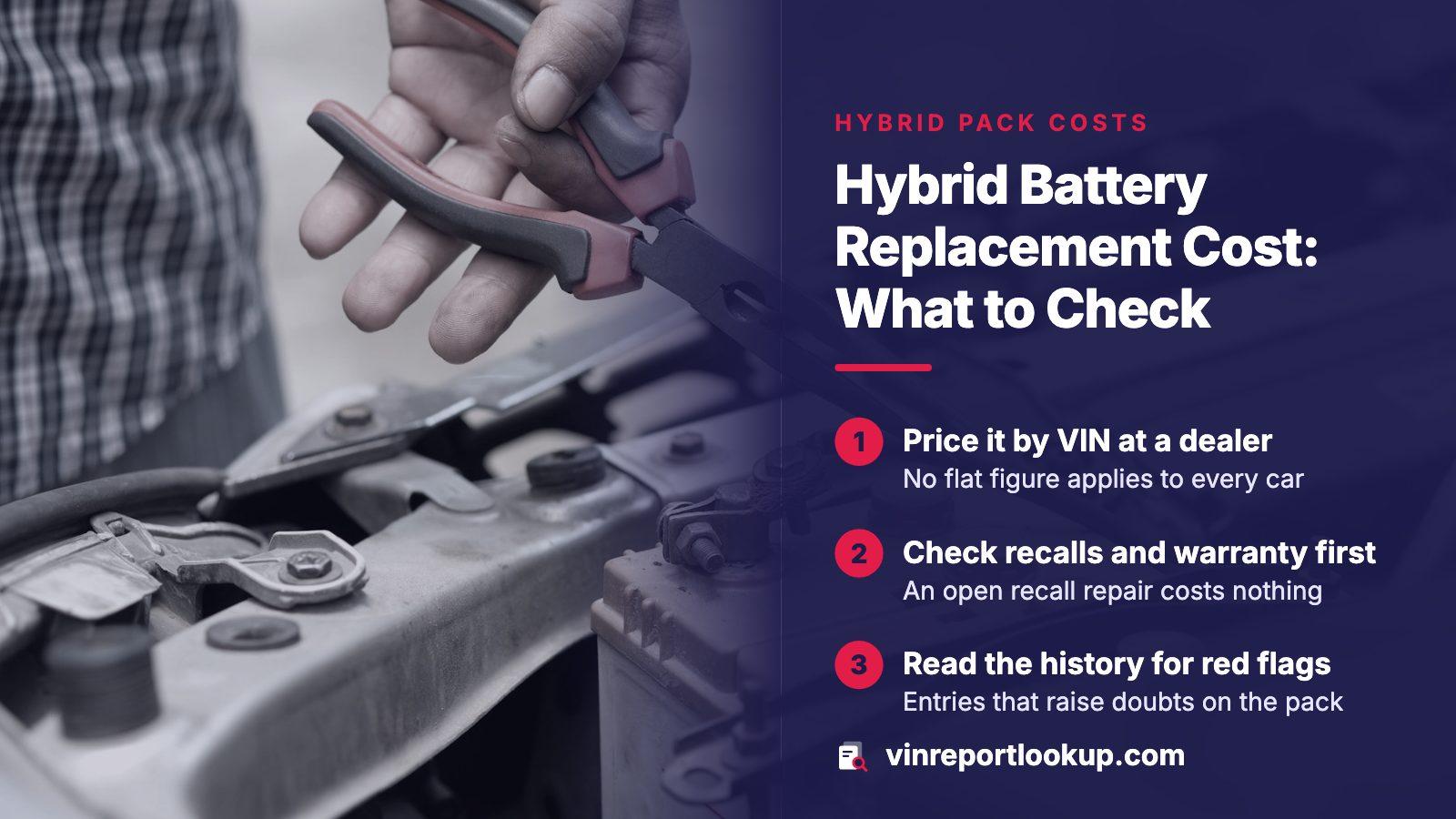
THE SHORT ANSWER
No honest flat figure exists for a hybrid battery, so price the specific car through a dealer parts desk using its VIN. Before that call, find out who might owe the repair: an open recall costs you nothing, and a manufacturer or state warranty may still be running. A VIN report cannot read battery health or warranty status, but its damage, odometer and recall records point to risk.
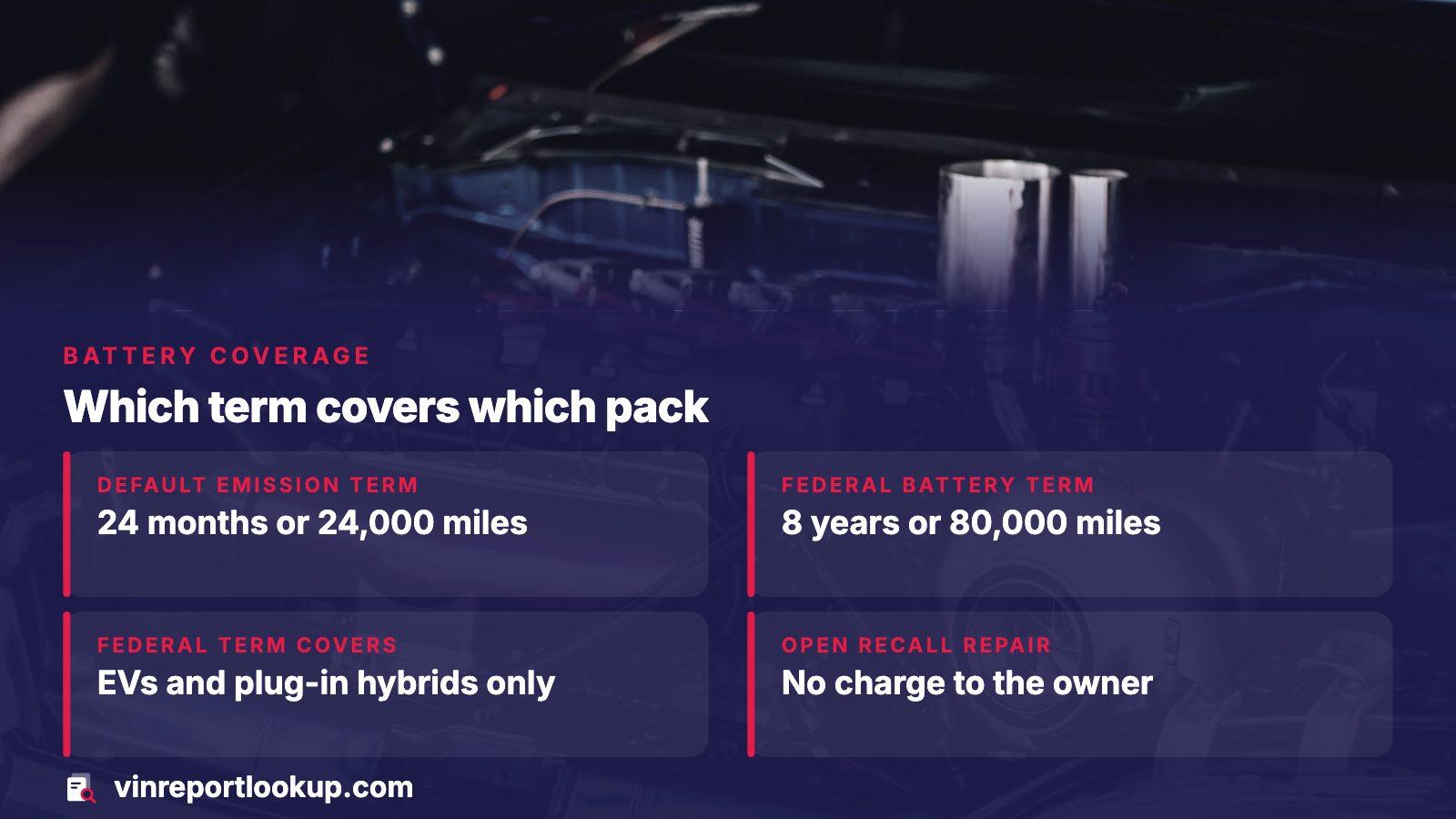
- Default emission term
- 24 months or 24,000 miles
- Federal battery term
- 8 years or 80,000 miles, named for EVs and plug-in hybrids only
- Open recall repair
- Performed at no charge to the owner
- VINReportLookup
- Free preview, then one payment, no subscription
What a VIN report can and cannot say about a hybrid pack
A history report records events; it is not a diagnostic scan, so it has no battery reading, estimate or warranty status. What it offers is a paper trail, and some entries bear on pack risk.
| Battery question | Does the report answer it? | Where the answer lives |
|---|---|---|
| What would a new pack cost? | No | A dealer parts department, quoted against the VIN |
| Is the pack still covered? | No | The warranty booklet and a franchised dealer's in-service date |
| Is a battery recall still open? | Yes, open recalls are listed | The report, and the NHTSA lookup |
| Was the car hit hard or written off? | Yes: accident, damage, title brand and salvage entries | The report |
| Are the miles real? | Yes, through odometer readings over time | The report |
| Did it work as a fleet car? | Yes, through ownership and use type | The report |
Why a repair price cannot come off a report
Cost hinges on the pack fitted to that generation, whether a single module can be swapped, whether a rebuilt unit is sold, any core deposit and the shop's hourly rate. Quoted averages tend to come from dealer quotes of unknown date and place.
From an NHTSA owner complaint
A 2008 Prius owner reported a failed hybrid battery at 149K miles, just past the end of coverage, and a replacement quote of $2,400. The owner adds that Toyota's term runs to 150K miles in states following California rules, and that neither dealer nor maker offered to share the bill.
That quote belongs to one car at one mileage, so this page offers no average. The cheaper work comes first: learn who might owe the repair, and read the car's past for reasons the pack could fail early.
Your checks before buying a used hybrid, side by side
Start with the options that cost nothing.
| Check | What it costs | What it settles on a hybrid |
|---|---|---|
| NHTSA recall lookup | No charge | Whether a safety campaign, battery ones included, is open on that VIN |
| Call to a franchised dealer | No charge | The in-service date and the maker's battery term for that model year |
| Title record from an NMVTIS provider | A small fee | Title brands and the title-side odometer record |
| VINReportLookup report | Free preview, then one payment; see the pricing page | Damage, odometer, salvage photos, liens, theft, recalls and use type together |
| Premium service-history report | Higher than the rest | Shop and dealer visits that someone reported, if any |
| Pre-purchase inspection | The shop's fee | Condition today, which no record can show |
Only the last row examines the car itself; the rest read its record and decide whether it earns an inspection.
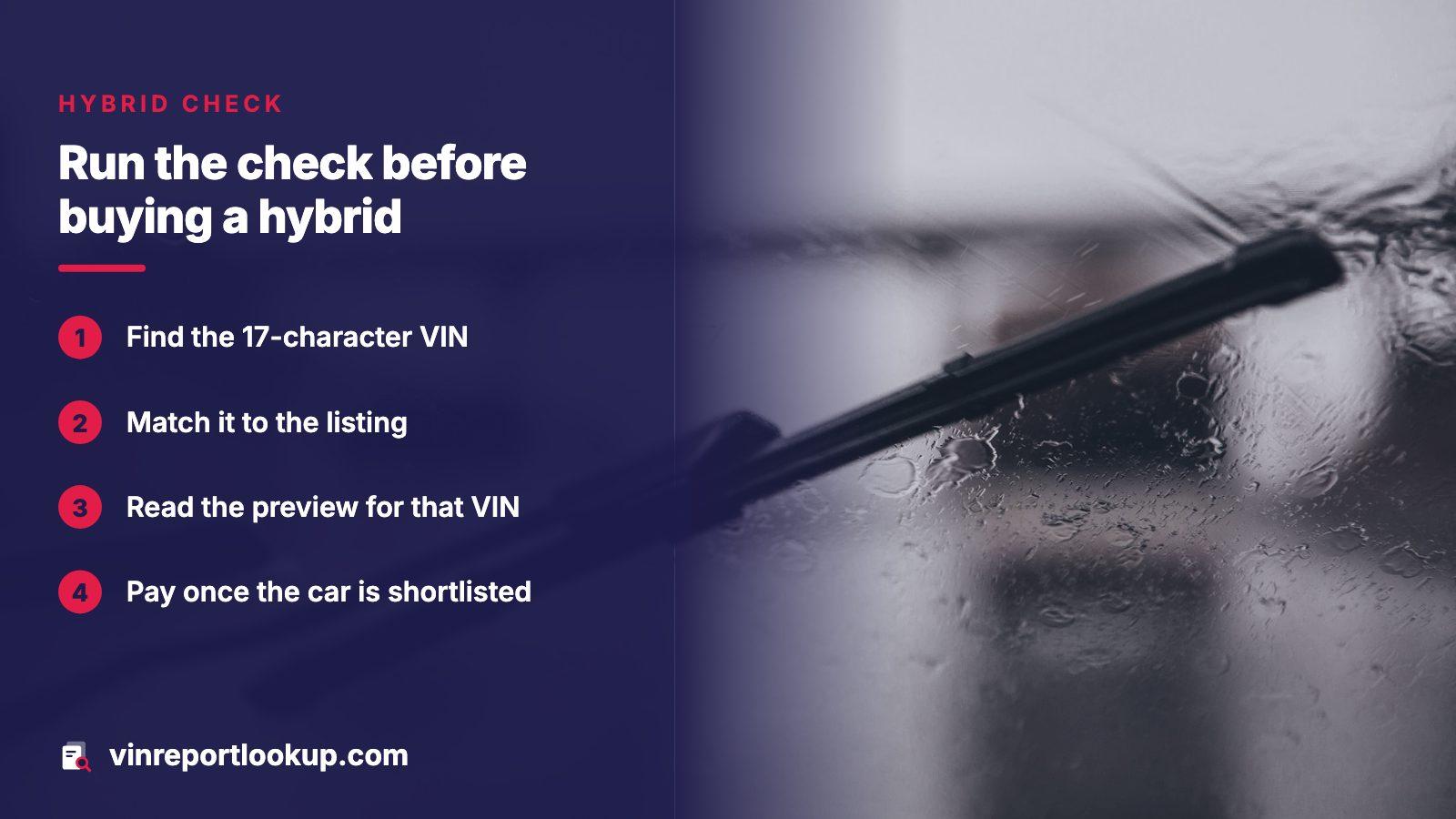
Run the check: find the VIN, read the preview, then decide
- Locate the VIN: 17 characters, visible from outside through the windshield, repeated on the driver's door jamb and on the title, registration and insurance card.
- Match it to the listing. A different VIN, or a model year that disagrees with position ten, needs an explanation first; NHTSA's decoder shows the factory build.
- Enter the VIN on this site. The preview is free: it confirms the vehicle, tallies open recalls and totals the title and auction records held for it.
- Pay for the full report once the car has made your shortlist.
Entries in the history that raise the battery stakes
- An accident or damage record, especially with salvage or auction photos: a high-voltage pack is a physical part, so have a hybrid-capable shop inspect it.
- A title brand: ask when it was issued and what was repaired.
- An odometer entry that drops below an earlier reading, which makes any mileage limit meaningless.
- A fleet or rental use type: heavy mileage may already have used up any coverage.
- An open recall on the high-voltage system, covered below.
- A lien or theft record, which needs settling before anyone talks about parts.
None of these predicts a failure. Each shows where to push for answers.
The coverage question: federal rule, maker's term and the clock
Under federal emission rules, light-duty vehicles are covered against emission defects for 24 months or 24,000 miles, but a short list of major components gets 8 years or 80,000 miles. The battery entry, in 40 CFR § 85.2103(d)(1)(v), names electric vehicles and plug-in hybrids. A conventional hybrid that never plugs in is not named, and carmakers need not apply it to light-duty vehicles up to 6,000 pounds before model year 2027.
So the eight-year line repeated online does not guarantee a used conventional hybrid; its cover comes from the maker's published battery term or a state rule, so read the term for that exact model year. The clock began at first retail delivery or first service as a demonstrator or company car, not on your bill of sale, and it ends on age or odometer, whichever arrives first.
From an NHTSA owner complaint
A 2010 Prius owner reported a hybrid system warning at 152,510 miles, with the car nine years old. The owner read the California emissions term as ending at 150,000 miles, says Toyota refused goodwill help, and puts the fix near $4K with a core exchange.
Check the age limit and the mileage limit separately.
The one battery repair that costs you nothing: an open recall
Recall remedies are performed at no charge to the owner. A few big campaigns have touched the high-voltage battery, and fixes ranged from a software charge cap to a whole new pack. A campaign still open on a hybrid you like is repair work waiting to be done, and by default not a reason to pass.
The report lists open recalls by VIN, as does the NHTSA lookup, at no charge. If one is open, ask why the work was never done and settle who books it before agreeing a price. A technical service bulletin is not a recall, so do not assume it brings a free repair.
Four questions that turn a guess into a quote
If coverage leaves the bill with you, one phone call can produce a figure for this car rather than an average.
- Ask a franchised dealer's parts desk for the pack price, giving the VIN, because packs can change within a model generation.
- Ask if one failed module can be swapped alone instead of the whole assembly; the answer frequently changes the final figure more than anything else.
- Ask whether a remanufactured pack exists and whether a core charge applies.
- Ask for the labor time on that model, then multiply by a local rate.
From an NHTSA owner complaint
A 2007 Camry Hybrid owner with 200,000 miles was told at the dealership that the pack had overheated and would cost $3,900 to replace, with no warranty left. The mechanic blamed dirt entering the battery compartment through a front filter.
When a shop prices a pack, also ask what caused the failure and whether the quote deals with that cause.
Paying for the report, then your next steps
The preview is free. Paying is a one-time step: one report, or a bundle for a shortlist of hybrids. There is no renewal, and today's prices are posted on the pricing page.
- Preview every hybrid you are serious about, so open recalls show early.
- Buy the report for the cars that remain, then read damage, odometer and use type.
- Call a dealer for the in-service date and battery term, and ask for the pack quote last.
Where this information comes from
- eCFR: 40 CFR 85.2103, Emission warranty — The warranty terms, the list of specified components, the battery paragraph and when the warranty period begins.
- NHTSA: Recalls — The regulator's lookup for open safety recalls by VIN, which carry a no-charge remedy.
- NHTSA: vPIC VIN decoder — Factory build details for a VIN, useful for matching a car to its listing.
- NHTSA owner complaint 11127919 — owner experience, paraphrased
- NHTSA owner complaint 11112520 — owner experience, paraphrased
- NHTSA owner complaint 10722823 — owner experience, paraphrased
Sources and photos: Facts checked against the sources above in November 2026. Photos by Towfiqu barbhuiya, Thibault Valjevac and Willian Cittadin on Unsplash; diagrams by VINReportLookup.
Keep reading
- Carfax alternatives: what each VIN report option covers and costsOther report options compared by records and cost.
- Vehicle history report cost: what each kind charges and coversWhy report prices spread so widely and what each band buys.
- TSB vs recall: who pays, and which one a VIN report showsHow a service bulletin differs from a recall, and who pays for each.
- Sample reportA worked example of what a full report contains.
Frequently asked questions
How much does hybrid battery replacement cost?
No figure is reliable without the car's VIN and a local labor rate. Ask a franchised dealer's parts desk, after checking whether a recall or warranty means you pay nothing.
Will a VIN report tell me the condition of the hybrid battery?
No. A history report lists accidents, title brands, odometer readings, auction photos and open recalls, but no battery health reading or repair estimate. Use it to spot concerns, then have a hybrid-capable shop examine the car before you pay.
Is there a federal eight-year warranty on every hybrid battery?
No. The federal paragraph names electric and plug-in hybrid vehicles, not conventional hybrids, and carmakers need not follow it for vehicles up to 6,000 pounds before model year 2027. A used hybrid is covered, if at all, by the maker's published term or a state rule.
Does the warranty restart when I buy a used hybrid?
No. The clock started at first retail delivery or first service as a demonstrator or company car, and it ends on age or odometer, whichever comes first. A franchised dealer can read the in-service date from the VIN.
Should I buy a pack of reports when shopping for hybrids?
A bundle suits a search across several cars: preview each, then buy the full report only for those that stay on your list. A single report fits one car you have nearly settled on. Amounts are on the pricing page.
Now check the car itself
The guide explains what to look for. The report shows what this VIN has on record.