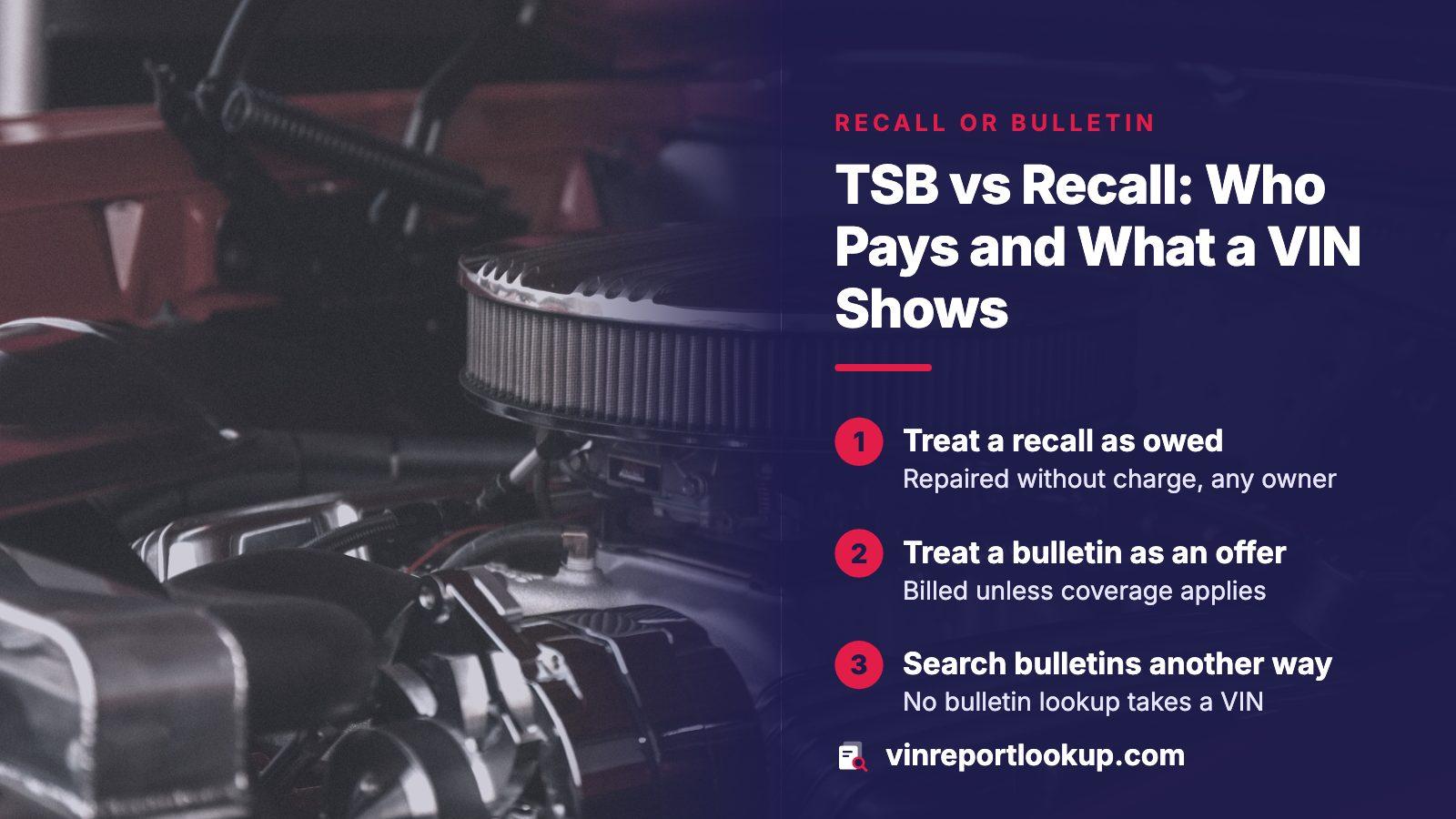
THE SHORT ANSWER
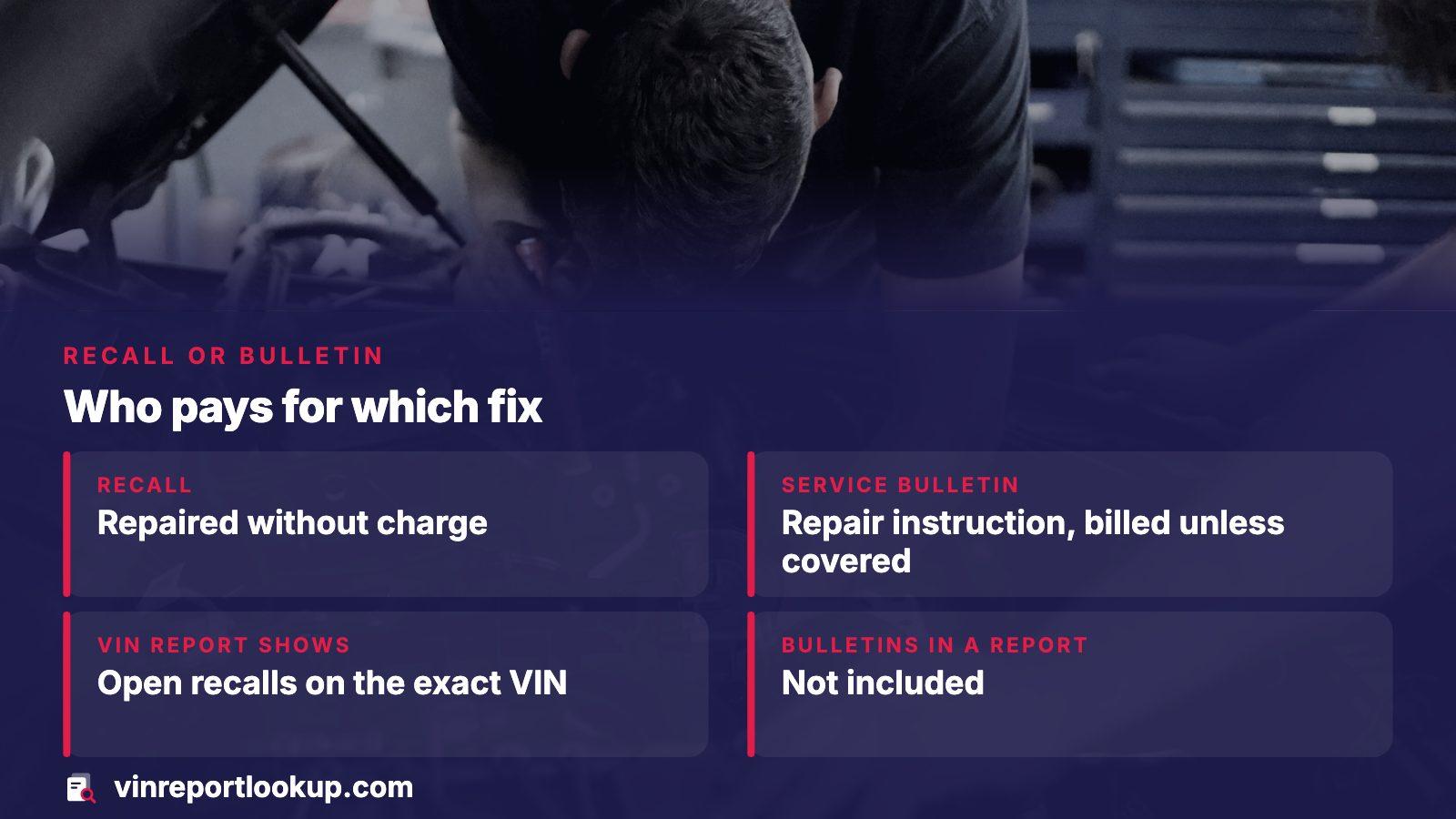
Recall repairs carry no cost to the owner by law, and that right travels with the car through every sale. A TSB is a dealer repair instruction for a known fault, billed unless warranty or a coverage extension applies. A VIN report shows open recalls for the exact car. Bulletins are filed per model, so search by year, make and model.
- Recall
- Repaired without charge, and the right stays with the car
- Service bulletin
- A repair instruction, billed unless something covers it
- VIN report
- Shows open recalls on the exact VIN, not bulletins
- Preview
- Free preview, then one payment per report, no subscription
A recall is owed to you, a bulletin is only offered
Follow the money first, because that is where these two documents part ways. Once a maker, or the government, decides a model has a safety defect or breaks a federal standard, the fix costs the owner nothing. The obligation attaches to the car and survives resale, so a used buyer inherits it.
A technical service bulletin promises nothing of the kind. It tells dealers how to diagnose and repair a fault the maker has seen often enough to write down. Unless warranty or a published extension applies, the person at the service desk pays for parts and labor.
| Question | Recall | Service bulletin |
|---|---|---|
| What is it? | A safety determination with a remedy attached | A repair instruction written for dealers |
| Who pays? | The manufacturer | You, unless warranty or an extension applies |
| Does it point at one car? | Yes, through the VIN | No, it describes a model and a build range |
What a VIN report settles and what it leaves to other searches
The recall half of the question is the part a report can answer for the car on the lot. VINReportLookup matches open campaigns to the exact VIN, so you see which are still unrepaired. The same report carries title brands, damage records and odometer readings, which often matter more than a bulletin when deciding whether to buy.
- In the report: open recalls on this VIN, plus the records above.
- Not in the report: dealer bulletins, which are written about models, or whether a bulletin repair was ever done on this car.
- Best left to a mechanic: testing for the fault a bulletin describes.
Why no bulletin search takes a VIN
No VIN-based bulletin search exists, and the cause is paperwork. For a recall, the maker hands NHTSA a defined group of vehicles under 49 CFR 573.6: make, line, model year, and the first and last build months. A VIN either falls in that group or does not, which is why a lookup can answer.
A bulletin reaches NHTSA under 49 CFR 579.5 as a copied document, whenever the maker sends it to several dealers or owners. A document is not a list of cars. It sets no cutoff, so a VIN has nothing to be tested against, and the affected build window, when there is one, sits in the bulletin text.
How to find bulletins when all you have is a VIN
Copy the VIN from the windshield-level plate on the driver's side, the door-frame sticker, or the title paperwork. Then work in this order.
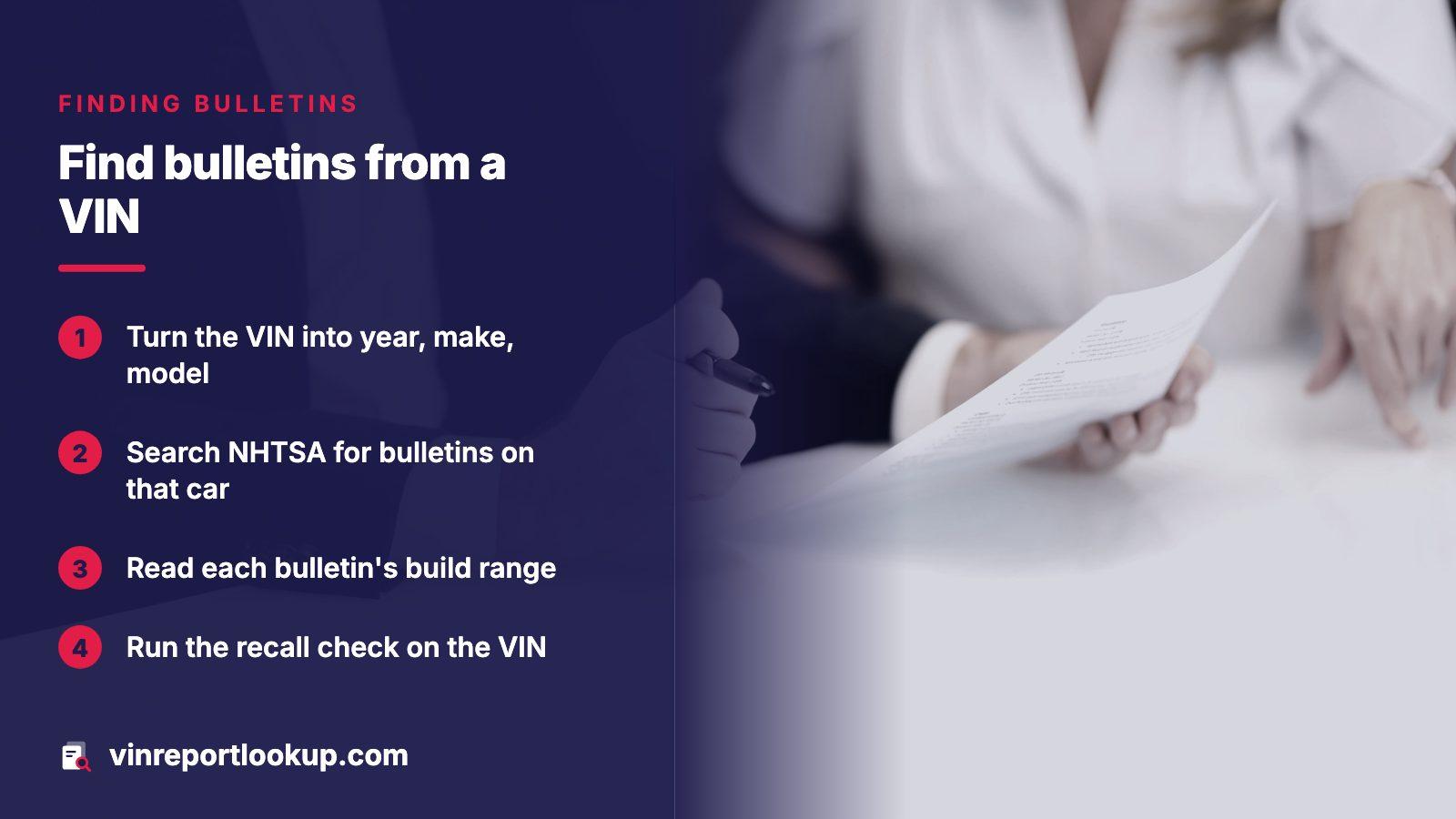
- Turn the VIN into a year, make and model, because bulletins are filed under those, not the full number.
- Search NHTSA for bulletins on that vehicle, starting with any component where the seller's car already shows symptoms.
- Open each bulletin and read the build range printed in it, which says which cars it covers.
- Run the recall check on the VIN as a separate step. It is the only part of this routine that resolves to one car.
From an NHTSA owner complaint
After buying a 2017 Ford Escape, an owner told NHTSA in June 2024, the check engine light came on with misfires in one cylinder. A local mechanic found the engine taking in coolant, and the owner then turned up a Ford bulletin on the problem. The dealer still declined to pay, citing about 94,000 miles and no official recall.
That is the case for reading a model's bulletins before the purchase, while the price can still move.
Choosing the source: what each option answers and costs
| Source | What it answers | What it costs |
|---|---|---|
| NHTSA recall lookup | Open recalls on one VIN | No charge |
| NHTSA bulletins by vehicle | Known problems on a model year | No charge |
| Independent inspection | Whether this car shows the fault | A mechanic's fee |
| VINReportLookup report | Open recalls plus title, damage and odometer history | Free preview, then one payment |
What the report costs and when buying it makes sense
The free preview shows what the check turns up for your VIN. Paying is a one-time step, for a single report or for one of the packs of 3, 5 and 10 that suit buyers comparing several cars. Nothing renews afterwards, and the pricing page carries the live amounts.
Buying earns its keep when open recalls are only one worry, which on a used car they usually are. A recall lookup cannot tell you the car was branded salvage or that the odometer readings disagree. If a safety campaign is your only question, the NHTSA lookup answers it at no charge, and the paid report can wait.
Who pays in each situation you may meet
| Situation | Who pays |
|---|---|
| Open recall, remedy available | The manufacturer, through a dealer for that brand |
| Open recall, remedy not ready | No one yet. Get the campaign number and ask for a status |
| Bulletin fix, car still under warranty | Normally the warranty covers it |
| Bulletin fix, warranty expired | Usually you, unless the maker offers goodwill |
| Published warranty or policy extension | The maker, within that program's stated terms |
The extension row is the one worth hunting for. The rule that sends bulletins to NHTSA names warranty and policy extension notices outright, so coverage can hide among routine repair instructions. Read the document itself, because model years and build dates in these programs run narrow.
From an NHTSA owner complaint
Another 2017 Escape owner told NHTSA in July 2024 that warning lights came on during an interstate drive and the car needed a tow. The owner matched it to a Ford bulletin on coolant reaching the engine, but says Ford called it a bulletin, not a recall, and priced a new engine at $10,000 at 73,000 miles.
Ask which document you are dealing with before assuming the maker pays. Only a recall carries the no-charge remedy.
Reading a recall result: the campaign number and its letter
A recall result carries a campaign number such as 24V-608. The leading two digits give the year the campaign was opened, not your car's model year. A 2019 car with a 24V number is normal: the fault was pinned down in 2024, five years after it left the factory.
The letter says what was recalled: V for a whole vehicle, E for equipment, T for a tire. An E or T means the campaign targets a part fitted to the car, which can change who does the repair. A bulletin has no such number, so a missing one tells you which document you hold.
Red flags, and what a bulletin cannot confirm
- An open recall the seller never mentioned: ask for the repair before you pay, or price in the delay.
- A bulletin on a costly component for this model year, backed by owner complaints on the same part.
- A coverage extension the seller cannot show was used: ask to see the repair invoice.
- The limits: a bulletin cannot say whether this car has the fault, was fixed, or has since been superseded.
Next step
Run the VIN preview to see open recalls and the other records for that car. Then hand your pre-purchase mechanic any bulletin number you found and ask for that symptom to be tested.
Where this information comes from
- eCFR: 49 CFR 579.5, notices, bulletins and other communications — The rule that sends manufacturer bulletins and extension notices to NHTSA, safety-related or not.
- eCFR: 49 CFR 573.6, defect and noncompliance report — The filing clock and the requirement to identify a recall population by make, line, model year and build dates.
- GovInfo: 49 U.S.C. 30120, remedies — The statute behind the no-charge remedy that a recall carries and a bulletin does not.
- NHTSA: Recalls — The agency's lookup for open recalls on a single VIN, at no charge.
- NHTSA owner complaint 11597818 — owner experience, paraphrased
- NHTSA owner complaint 11601615 — owner experience, paraphrased
Sources and photos: Facts checked against the sources above in November 2026. Photos by Victor Hughes, Carrie Allen www.carrieallen.com and Mustafa Sheikhmouss on Unsplash; diagrams by VINReportLookup.
Keep reading
- PricingWhat one report costs and how the larger packs work.
- Sample reportA worked report, so you can see where open recalls appear.
- Best VIN check: how to choose a report and what each one includesHow to choose a report and what each type includes.
- Vehicle history report cost: what each kind charges and coversWhy report prices differ and what the extra money buys.
Frequently asked questions
Are TSBs and recalls the same thing?
They are not. A recall follows a safety determination, and the maker must fix it without charge. A bulletin tells dealers how to repair a known fault, and the bill goes to you unless warranty or an extension covers it.
Does a VIN report show technical service bulletins?
No. A VINReportLookup report lists open recalls for the exact VIN beside title brands, damage and odometer entries. Bulletins describe models, so search them by year, make and model and read the build range inside the document.
Why can buyers read bulletins at all?
A federal rule requires makers to give NHTSA a copy of defect communications sent to several dealers or owners, safety-related or not. That is how you can read about problems the maker never had to recall.
Should a bulletin stop me from buying a car?
Rarely by itself. Well-built models collect bulletins too, since that is how a maker passes fixes to dealers. Act when one names a costly part on your model year and owner complaints on that part stand out, then have a mechanic test for the symptom.
Will a recall repair cost me anything on a second-hand car?
No, because the remedy stays with the vehicle, and later owners are treated like the first, within the statute's time limits. Book the work with a dealer for that brand. If the part is not ready, get the campaign number and a status date.
Now check the car itself
The guide explains what to look for. The report shows what this VIN has on record.