THE SHORT ANSWER
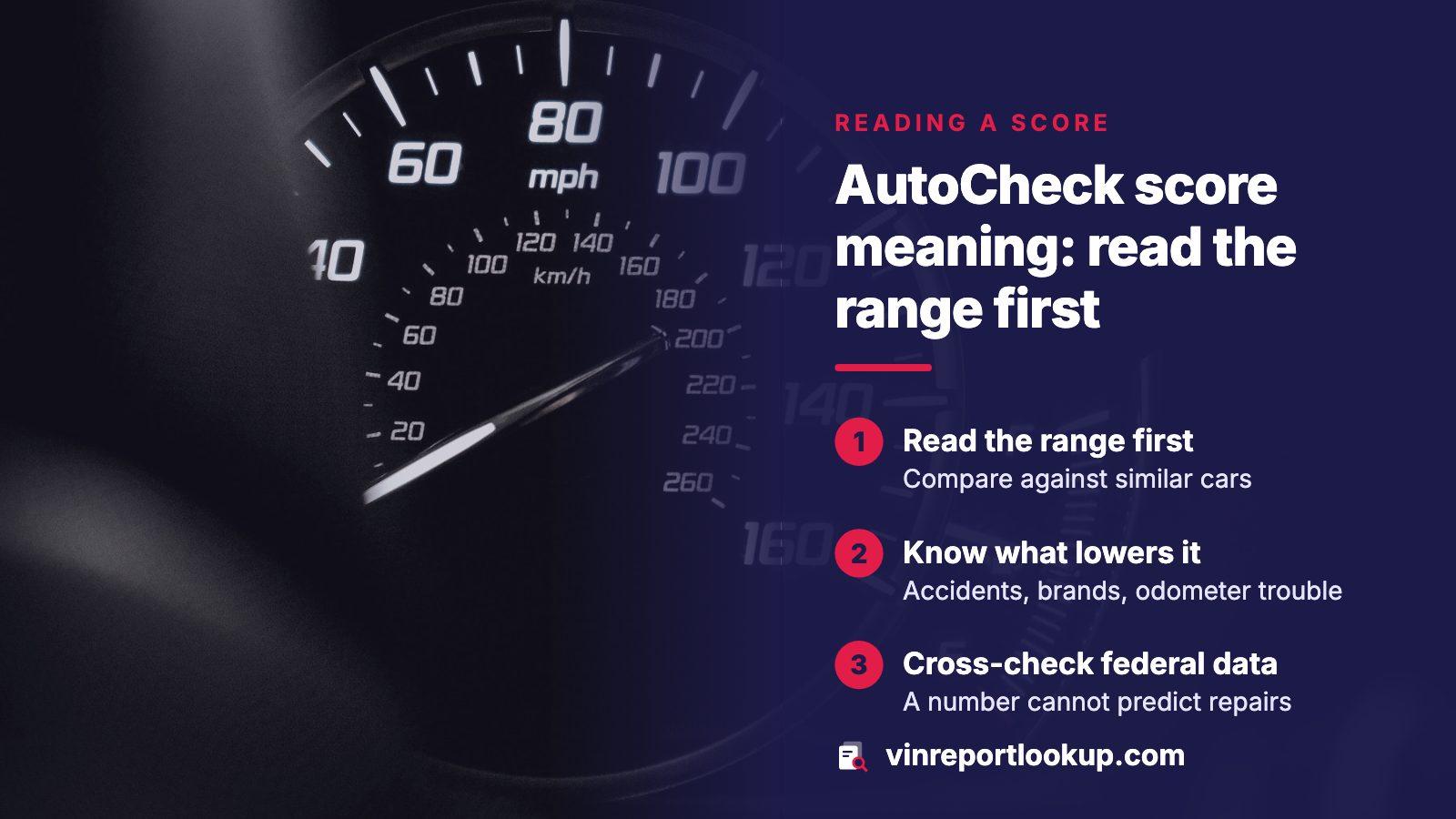
AutoCheck rates a vehicle from 1 to 100 using its history: accidents, title brands, odometer trouble, owners, mileage, age and use. Higher means a more favorable record, but only against peers. A car scoring inside or above its listed range is typical or better for its type; one below the range has more reported problems than similar cars. Read the underlying entries too.
- Scale
- 1 to 100
- Read it with
- The score range for similar cars
- Pulled down by
- Accidents, brands, odometer issues, theft, taxi or police use
- Not stated by the maker
- What the number predicts, or a pass mark
Why the range comes first
AutoCheck's own explanation of its score is blunt on one point: the number by itself shows half the story. Each report pairs the score with a range, and that range describes where comparable vehicles of the same age and class usually fall. Your car's score is judged against that band, not against 100.
A buyer who sees a modest score may panic, and a buyer who sees a high one may relax. Neither reaction is justified until the range is on the page. Older cars with many miles can sit in a lower band and still be perfectly ordinary for what they are, while a young car scoring below its band has something in its record that its peers lack.
The maker's own worked example
AutoCheck illustrates the point with two cars. The first is a 1999 Nissan Maxima that scores 84 when similar Maximas are expected to land between 76 and 81. It beats its peers. The second is a 2005 Chevy Malibu that scores 89 when similar Malibus are expected to land between 90 and 95. It trails them.
| Car | Score | Peer range | Reading |
|---|---|---|---|
| 1999 Nissan Maxima | 84 | 76 to 81 | Above its peers |
| 2005 Chevy Malibu | 89 | 90 to 95 | Below its peers |
The Malibu has the bigger number and the weaker history. That reversal is the whole lesson, and it is why a shortlist ranked by raw score can put the wrong car on top.
What pushes a score down
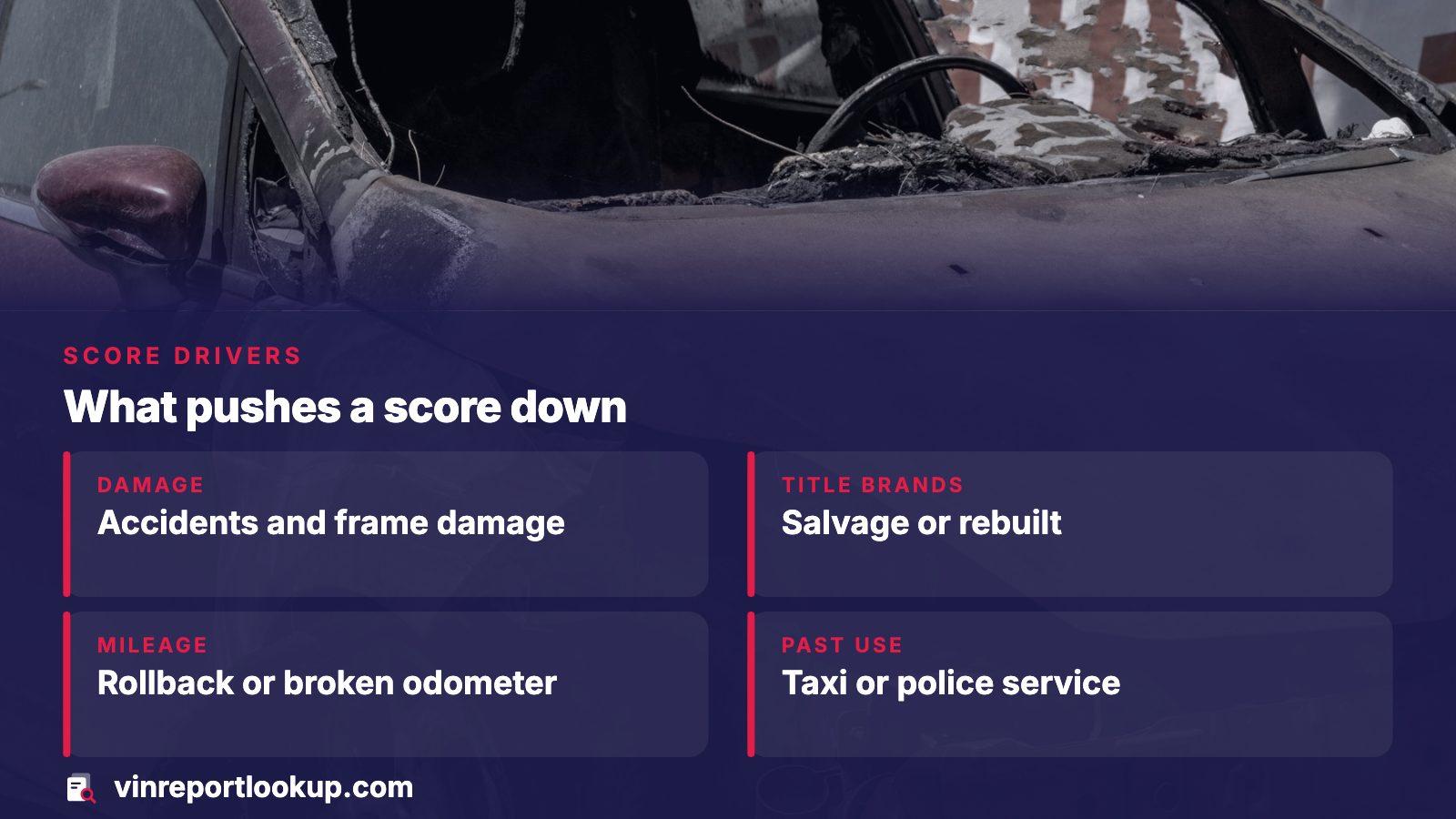
The maker lists the events that hurt a score. Some are record-level problems, and some are simply how a car has lived.
- Accidents and frame damage
- Salvage or rebuilt title brands
- Odometer rollback or a broken odometer
- Water damage and lemon-law branding
- Theft or repossession on record
- Past service as a taxi or police vehicle
Beyond events, the score leans on age, vehicle class, mileage and the number of owners. A car with more owners than is typical for its age loses points. A compact car and a pickup are not scored on the same yardstick, because their wear patterns differ.
What the score cannot tell you
On the page I read, the maker does not say what the number predicts, and it gives no pass mark. Some articles online attach a specific meaning to it, such as a survival forecast. If the maker does not publish that, treat the claim as unconfirmed.
A summary is not a record
A mid-range score can hide one ugly line, such as a total loss or a rolled-back odometer. Open the entries behind the number and judge each one on its own.
Any score rests on reported events alone. A cash repair, or a dent nobody filed a claim for, gives the formula nothing to count.
Where the data behind it comes from
AutoCheck was developed by Experian and names state licensing offices, auction houses, insurers and unnamed independent suppliers as its inputs. Crash data taken from police reports is offered for every state plus DC, it says, and the company marks storm-hit cars along with those registered in federal disaster zones when big storms strike. Its page speaks of all 50 states, nothing narrower.
Those are the maker's claims about its own product. Coverage still varies from car to car, so two reports on one vehicle can differ in detail.
Cross-check the score with federal title data
The Department of Justice runs the title system behind approved title-history reports. Those reports are deliberately brief and stick to five indicators. Where the title sits today and when it last changed hands is one. Brands, the odometer reading, total-loss events and salvage events make up the rest. In the department's words, a report with nothing on it is the outcome you want.
Those five sources, state title offices among them, are bound by federal law to send records in regularly. The same agency urges shoppers to pair any report with a mechanic's independent look. A strong score, a clean federal title record and a mechanic's look under the car make a firmer case than any one of them.
- Note the score and the range side by side.
- Read every accident, brand and owner entry behind it.
- Compare the odometer readings for jumps.
- Run a title check on the VIN.
- Have a mechanic inspect the car.

Using a preview before you pay for a report
Before buying any report for a car you like, type its VIN into the preview on this site. It costs nothing and hints at how much history sits behind that number. Should the hints justify it, the full report is a one-off purchase, and the pricing page has the present options.
Our report spells out brands, crashes, odometer readings and salvage entries one row at a time. That is the layer to read when the summary number of any provider looks reassuring but the seller is hurrying you.
Where this information comes from
- AutoCheck: The AutoCheck Score — the maker's account of the scale, the range, the factors and its data sources
- Department of Justice: Understanding an NMVTIS report — what federal title reports cover and who must report to them
- Department of Justice: VehicleHistory.gov — purpose of the federal title information system
Sources and photos: Facts checked against the sources above in November 2026. Photos by NATHAN MULLET, Alejandro Escamilla and engin akyurt on Unsplash; diagrams by VINReportLookup.
Keep reading
- AutoCheck review: when it earns its fee, what it misses, and what else to buyWhat the report is good and weak at, beyond the score.
- AutoCheck cost: what its two plans charge and what the fee coversHow AutoCheck charges, before you decide to buy.
- AutoCheck vs Carfax: which VIN report to buy, and when to buy bothHow two big reports differ on the same car.
- AutoCheck vs NMVTIS: pick the report that matches your riskWhere the federal title record fits next to a scored report.
Frequently asked questions
What is a good AutoCheck score?
There is no fixed passing number. A good score is one at or above the score range shown for similar vehicles, because the range reflects cars of the same age and class. A 1999 Maxima scoring 84 beats its peers, while an 89 can still fall short if its range sits higher.
Is a higher AutoCheck score always better?
Only when compared with the same range. The maker's own example shows a lower number beating a higher one because the lower car outperformed its peers and the higher car trailed its own. Use the number to compare similar cars, never across different types.
Does a low AutoCheck score mean the car is bad?
Not by itself. Age, mileage and owner count push scores down for perfectly sound older cars. Look at what sits below the number: accidents, title brands, odometer problems or theft entries are the items that should change your decision.
Can a car with a clean report still have problems?
Yes. A report shows what was reported. Unreported repairs, cash fixes and very recent events may be missing, which is why federal title data and a pre-purchase inspection belong alongside any score.
Do I need AutoCheck to get a score?
The maker says only its own reports carry the AutoCheck score. If you buy a different report, you will not see that number, so compare the underlying records instead of hunting for the score.
Now check the car itself
The guide explains what to look for. The report shows what this VIN has on record.