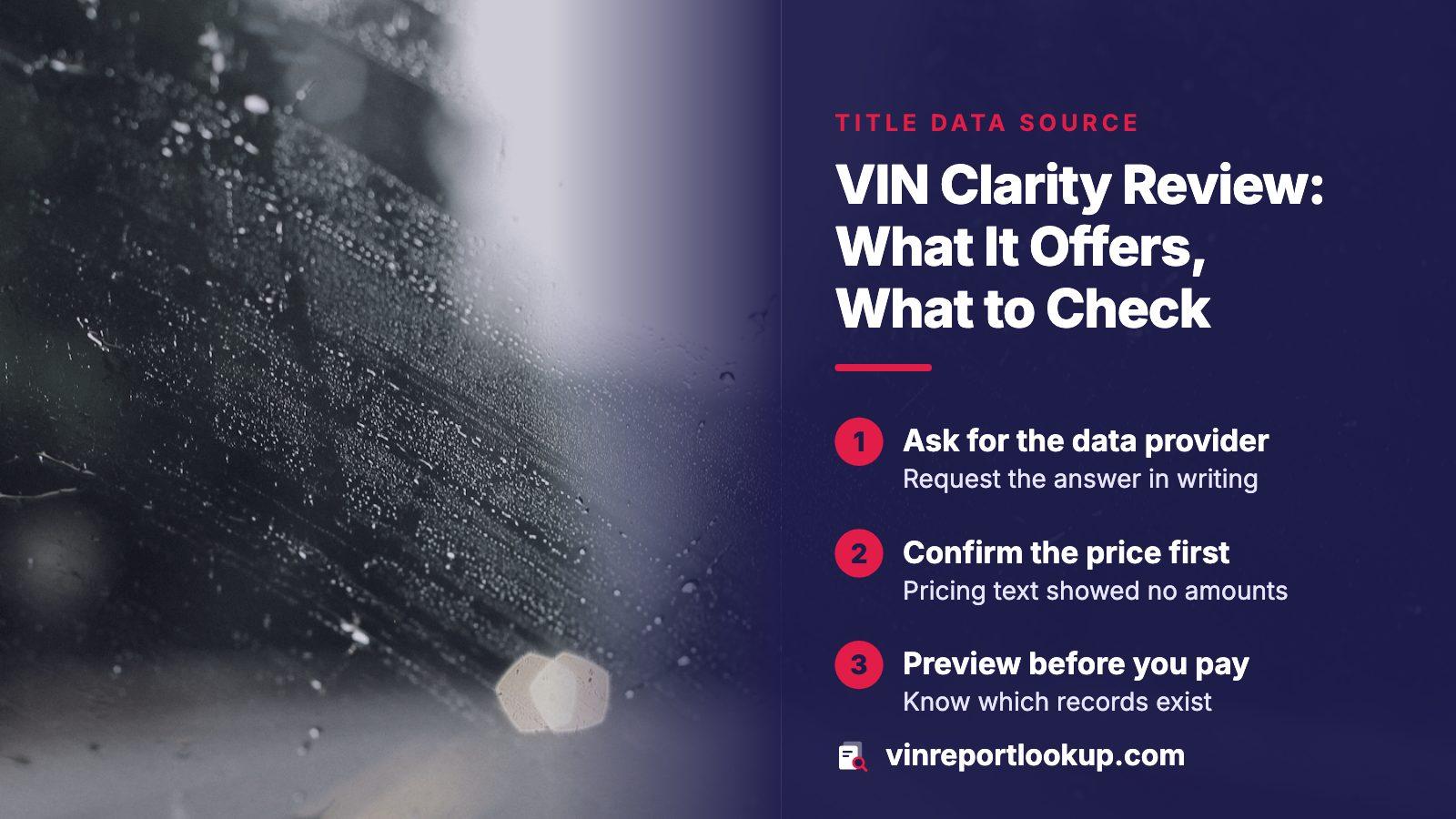
THE SHORT ANSWER
VIN Clarity is run by VinClarity LLC and offers a one-time report or a monthly membership that includes 20 reports. Its own pages cover refunds and cancelling. We did not find the name on the Justice Department's list of approved title-data providers, and its pricing page showed no dollar amounts in the text we read. Confirm the price and the title-data source before paying, and keep the card details for one report only.
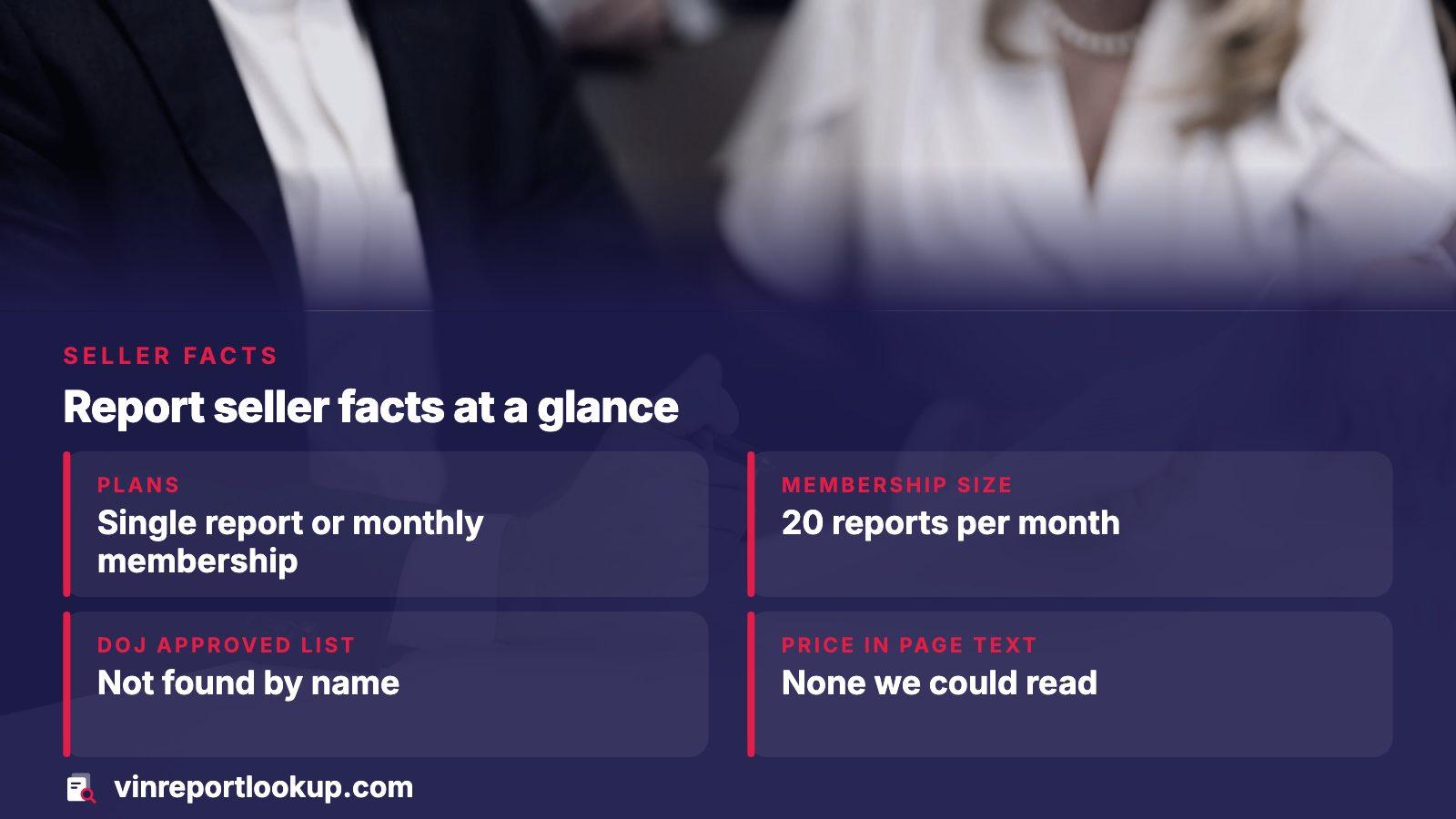
- Plans
- Single report or a monthly membership
- Membership size
- 20 reports per month
- On the DOJ approved list
- Not found by name when we read it
- Price shown in page text
- None that we could read
What we read, and where we stopped
This review rests on pages you can open yourself: the company's home, pricing, FAQ, refund and about pages, plus the Justice Department pages on the federal title system. We did not buy a report, so we cannot tell you how the finished document reads, how long it takes or how readable its layout is.
That limit matters. A review that grades a report it never saw is guessing. Where this page states something, it came from a page we opened. Where we could not find an answer, it says so, and the checklist further down shows how to get the answer yourself before any money moves.
What the company says the report covers
The home page starts a search from a 17-digit VIN, and it also shows a plate field with a state picker. It describes pulling records from government and private sources. The advertised topics are a market value estimate, an open-recall check, mileage verification aimed at odometer rollback, and accident history that draws on crash and insurer damage records.
The pricing page adds title and lien history, theft and salvage records and safety ratings. The company also says its reports can hold more than 100 data points. That is its own figure, not something we counted, and a long list of fields says little about whether the fields for your car are filled in.
How to use the feature list
Pick the one or two record types that decide your purchase, such as a title brand or an odometer reading, and look for them by name. Extra sections are a bonus, not a reason to pay.
Plans, and what the price pages showed
Two plans appear. A single purchase is described as a one-time payment for one report. The monthly membership is described as unlimited access with 20 reports a month, support given priority, plus vehicle monitoring, recall alerts, value tracking and maintenance reminders.
When we read the pricing and home pages as text, no dollar figure showed up. It may load some other way in a browser, so we are not printing a number. Look at the amount on the checkout screen, and check whether the charge is a single payment or the start of a recurring membership.
| Plan | What the company describes | What to confirm before paying |
|---|---|---|
| Single purchase | One-time payment, one report | The exact amount and that nothing renews |
| Monthly membership | 20 reports a month plus alerts | Renewal date, and how you cancel |
The question we could not close: where the title record comes from
NMVTIS is the federal title database. Motor vehicle agencies, scrap and salvage operators and insurance carriers all feed it. A buyer searching it can see what the current title says, any brand it carries, the newest odometer figure on file, and whether an insurer wrote the car off. A brand a state has applied does not drop out later.
The Justice Department also publishes the names of firms cleared to sell that record to the public, and VIN Clarity was not among them when we looked. A company can still buy data from someone who is listed, and the company's own FAQ says its sources include approved NMVTIS providers. But the FAQ is the seller describing itself, so treat it as a claim.
- Ask support, in writing, which approved provider supplies the title data.
- Check that the report names the state of each title and the date it was issued.
- If you want the record from a provider the government names directly, buy from one that is listed.
Refunds and cancelling, as written on its own pages
The refund policy says every product is digital. If you paid and never received the product, it promises a full refund. A single report that turns out not to help you may qualify for a refund, at the company's discretion. A membership refund covers only the latest payment, and a payment you dispute with your bank is excluded.
You ask by email or through the support form, since phone staff cannot grant one, and any money goes back to the card you used. The FAQ adds that heavy use can be a reason to say no. Ending a membership is easier: four routes exist, and billing simply stops when the current cycle ends.
Keep a record
Screenshot the plan you chose and the confirmation email. If a charge later surprises you, those two items settle what you agreed to far faster than a phone call.
Red flags to check before you enter a card
Nothing we read called the service a scam, and we have no evidence of one. Still, a few points are worth checking on any seller of these reports, and the gaps above make them worth checking here.
- A price you cannot see until checkout, or a membership offered where you expected one report.
- A report you cannot preview, so you pay before knowing what exists for your VIN.
- No answer when you ask where the title records come from.
- A footer disclaimer ruling out credit, rental, insurance or hiring uses. VIN Clarity carries one, so the report is for sizing up a car, nothing more.
Its site also lists a Delaware company address and support contacts, which helps if you need to dispute something. Contact details prove little by themselves, but their absence would be a worse sign.
Running the check here instead
If the open questions bother you, type the VIN into this site's search box. A free preview tells you whether any records turned up for that car before you decide. Going further is a one-off charge per report, and a bundle is offered if your shortlist has a few cars on it. Nothing here rolls into a subscription; check the pricing page for what each option costs.
Read the number from the vehicle and hold it against the paperwork the seller hands you. Any disagreement means you should step back before paying for anything, since no report repairs that.
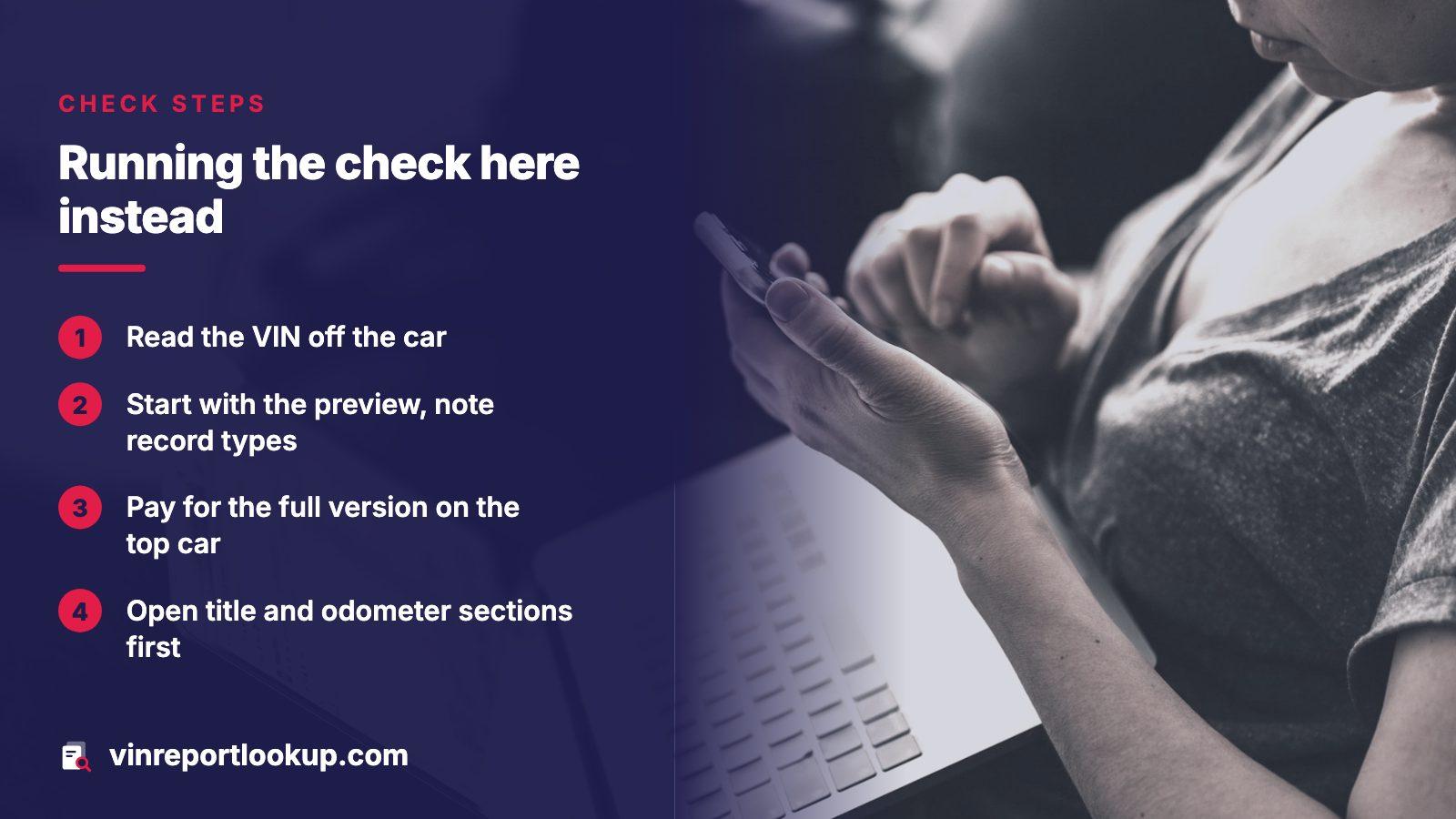
- Read the VIN off the car, not off the online ad.
- Start with the preview and jot down which record types show up.
- Pay for the full version on your shortlist's top car alone.
- Open the title and odometer sections first, then go look at the car.
What to do next
Decide the question first. If it is a title brand or total loss, make sure the provider you pay is open about its title source. If it is how the car looks and drives, only a mechanic of your own choosing, looking at it in person, can answer that.
A report also records only what someone reported. Damage repaired privately or never filed with an insurer may not appear anywhere, so a clean result narrows your worry without ending it. Back it up with a drive and the seller's documents.
Where this information comes from
- VIN Clarity: home page — Where the search starts, the advertised report topics and the company's own claims about its size.
- VIN Clarity: pricing page — The two plans and what each is said to include; no dollar amounts in the page text.
- VIN Clarity: refund policy — Rules for non-delivery, report and membership refunds, and how to ask.
- VIN Clarity: how do I cancel — The ways to end a membership and when billing stops.
- DOJ VehicleHistory.gov: approved NMVTIS data providers — The government list of providers selling the federal title record to the public.
- DOJ VehicleHistory.gov: NMVTIS for consumers — What the federal record shows and why brands stay on it.
Sources and photos: Facts checked against the sources above in November 2026. Photos by Cole Keister, Michal Biernat and Carrie Allen www.carrieallen.com on Unsplash; diagrams by VINReportLookup.
Keep reading
- Vehicle history report scams: how to spot a fake report seller before you paySigns of a bad report seller and how to protect your card.
- Best VIN check: how to choose a report and what each one includesChoose a check by the records your car actually needs.
- Vehicle history report cost: what each kind charges and coversWhat drives report pricing and how to avoid paying twice.
- Sample reportOpen a finished report first and see what it holds.
Frequently asked questions
Is VIN Clarity legit?
Its own FAQ says yes. We read nothing that called it a scam, and nothing independent that confirmed it either. The company shows a registered name and an address, and the pages we read cover refunds and cancelling. Verify the title-data source and the price yourself before paying.
Is VIN Clarity an approved NMVTIS provider?
The Justice Department's approved-provider page did not name it when we read that page. Its FAQ says its sources include approved providers, which could mean it resells their data. Ask support in writing which provider supplies the title records in your report.
How do I cancel a VIN Clarity membership?
Per the company's FAQ you can use your account settings, send an email, phone support, or fill in a contact form without logging in. Access ends when the paid cycle runs out and no further charge follows. Save the receipt it emails you.
Can I get a refund from VIN Clarity?
The refund policy promises a refund if the product never arrived. A report that did not help, or a mistaken membership, may be refunded at the company's discretion, and a payment you disputed with your bank is excluded. Ask by email or through its support form.
Can I use a VIN Clarity report to screen a tenant or employee?
No. The company's footer disclaims any status as a credit bureau-style reporting agency under the federal credit reporting law, and bars using a report for hiring, rental, lending or insurance choices. It is meant for judging a vehicle you may buy or sell.
Now check the car itself
The guide explains what to look for. The report shows what this VIN has on record.