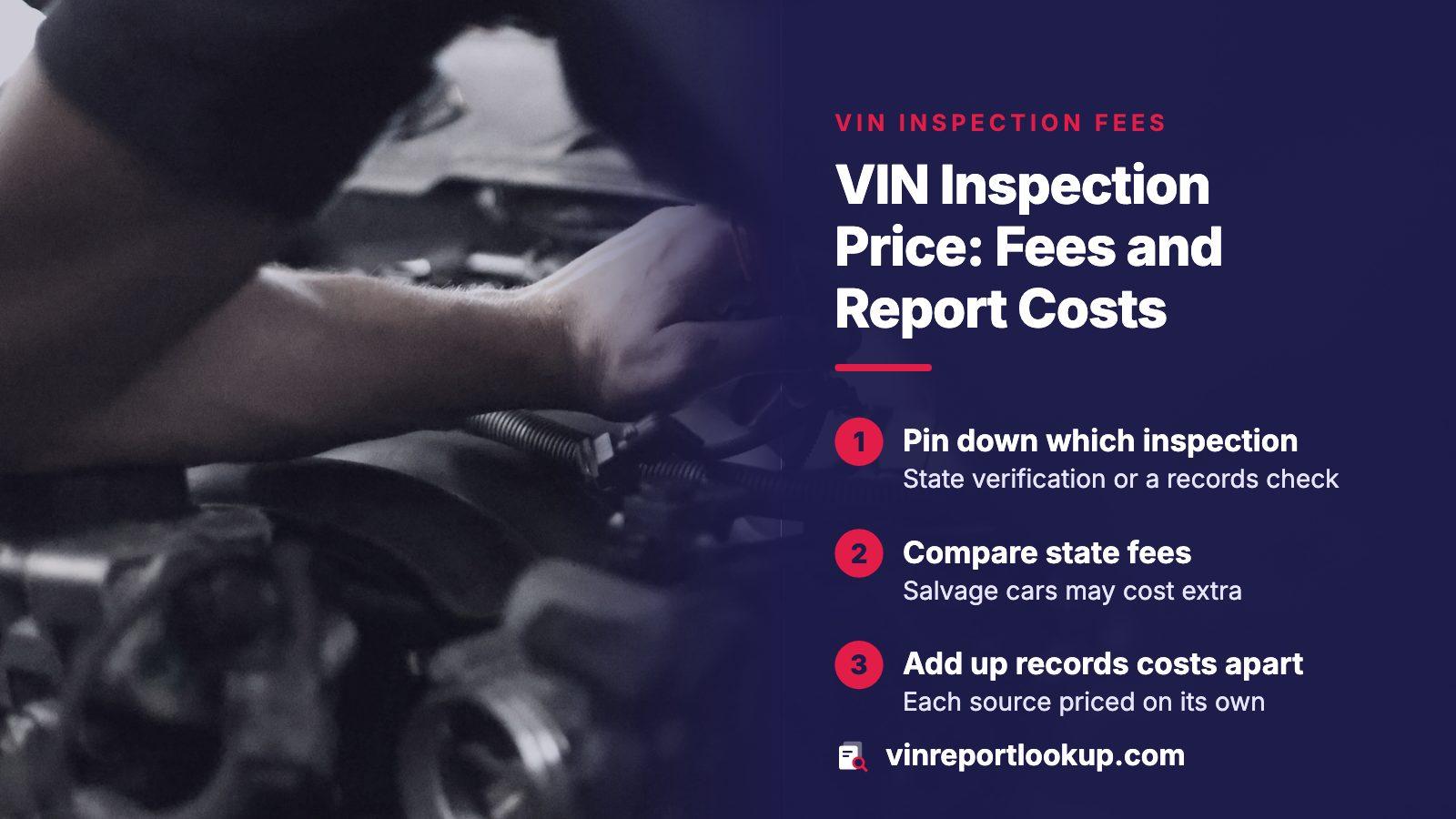
THE SHORT ANSWER
Expect $9 in Oregon, $10 at a Connecticut contractor station, and $20 in Kansas, rising to $25 for a salvage car, when a state wants the number on the car verified. Records checks are priced on their own: NHTSA recall lookups and NICB theft and salvage lookups cost nothing, and the Justice Department's buying tips say to expect up to $4 for a federal title report. The first look at VINReportLookup is a free preview, the full report is optional, and its amounts sit on the pricing page.
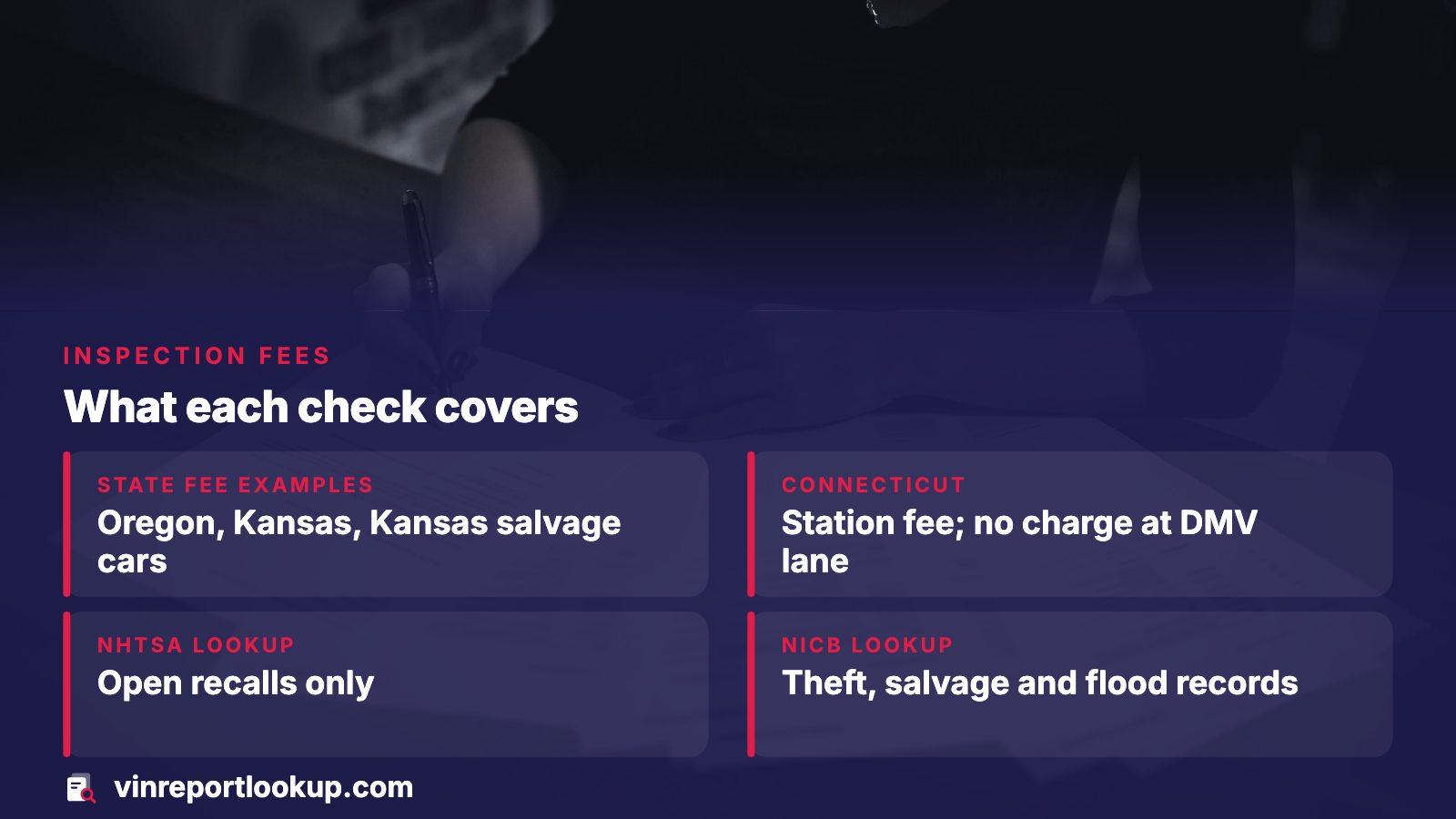
- State fee examples
- $9 in Oregon, $20 in Kansas, $25 for a Kansas salvage car
- Connecticut
- $10 at a contractor station, no charge at the DMV lane
- No-charge lookups
- NHTSA open recalls, NICB theft, salvage and flood records
- VINReportLookup
- Free preview, then a single payment, no subscription
Which VIN inspection are you pricing?
Search results for this phrase blend three jobs that have little in common. The price depends entirely on which one you need.
| The job | Who sets the price | What comes back |
|---|---|---|
| State VIN verification | The state, or a contractor it licenses | A signed form confirming the VIN on the car matches its title |
| Mechanic's pre-purchase inspection | The shop | An opinion on mechanical soundness and safety |
| Records check on the VIN | Each provider, except official lookups | What agencies, insurers and yards reported under that number |
Only the first is a government fee, and a buyer rarely owes it. The second and third are choices, so most of this page is about the third.
What states charge to verify the number on the car
Where a state prints its fee, the figure tends to be small. These are the amounts shown on agency pages when this guide was updated.
| State | Fee printed | Worth knowing |
|---|---|---|
| Oregon | $9 | DMV does it, a licensed dealer can on a car bought from that dealer, and the environmental agency can when an emissions test is due anyway |
| Kansas | $20 regular, $25 salvage | Patrol stations bill through the county treasurer at titling time; a sheriff's-office partner collects on the spot |
| Connecticut | $10 at a contractor station, nothing at the DMV lane | Salvage, homemade and imported vehicles must use the DMV lane |
Fees change and some states post none, so read the agency's own page for the state that will title the car. Kansas also suggests calling the location before you drive over.
When a state wants someone to look at the car
A physical verification is a paperwork step, aimed at cars whose paper trail is thin, foreign or interrupted.
- A title from outside the state, whether another state or abroad, which Oregon lists first.
- A car that was totaled and rebuilt, or assembled from other vehicles. Oregon also asks when a salvage-titled car applies for a regular title.
- A number that is in doubt, which Kansas names as its own reason.
- Exempt in Kansas: a brand-new car never titled before, sold with the maker's paperwork.
Plan around the paperwork too. A Kansas inspection form stops being valid 120 days after the visit, and the original signed title, purchase papers and a government ID go with the car.
What a records check costs, source by source
The VIN is identical for every service below. What changes is who supplied the records and whether you pay.
| Source | Cost | What comes back |
|---|---|---|
| NHTSA recall search | No charge | Open safety recalls attached to the VIN |
| NICB VINCheck | No charge, five searches per 24 hours from one IP address | Stolen-and-missing, salvage and flood flags from member insurance companies |
| Federal title record from an approved provider | Up to $4, per the Justice Department's buying tips | Current title state, brand history, last odometer reading, total-loss and salvage entries |
| Full history from a private company | Usually a charge, set by each company | Title records from DMVs, auction results and service visits |
| VINReportLookup | Free preview, then a paid report | Amounts are on the pricing page |
Treat the $4 as guidance rather than a quote. Each provider decides its own price and what to bundle, so read what is included before paying.
What the no-charge lookups leave out
- NICB looks only at insurance data from member insurers that participate. Law enforcement records are not queried, and an empty result is no guarantee.
- NHTSA's VIN search is about open recalls. Repaired ones, fresh announcements still waiting for VINs, recalls older than 15 years, small makers and non-safety campaigns may not appear.
- The federal title report limits itself to five indicators and is built to stay brief. Not every reporting body has reported, so an empty result can be a false all-clear.
Going by what those agencies publish, none of the three covers liens, auction photos or a market value. That gap is where a paid report comes in.
What the VINReportLookup payment buys
The preview carries no fee. If you continue, a single payment buys the report and no subscription begins; people comparing several candidates can instead choose a larger purchase covering 3, 5 or 10 reports. Amounts live on the pricing page.
- Title brands and salvage records, so a rebuilt or salvage past shows before money changes hands.
- Odometer readings from different dates, which lets you spot a reading that drops.
- Salvage and auction history with photos, plus accident and damage records.
- Liens, impounds, theft and insurance records, then open recalls and an estimate of market value.
It is a records report and does not replace a mechanic. The Justice Department's tips treat an independent inspection and a title report as a pair.
Reading the result: what should change your offer
- A rebuilt, salvage or flood brand on the title.
- A total-loss entry in the insurance or salvage records. It can also come from a theft that went unrecovered, so read the detail before walking away.
- An earlier odometer reading above what the dash shows now.
- Auction pictures of damage that the listing skips.
From an NHTSA owner complaint
A 2013 Ford Focus owner wrote to NHTSA about a car that hesitated when accelerating and at times would not start. At the dealer, the owner was also told the car had a crash history and a rebuilt title, which the dealer said cancelled warranty coverage for the repair. The owner says they did not know about the brand when they bought the car, and the repair left them facing $2,200.
Take this from it: in that owner's account the brand decided who paid, so find it before the sale, not at the service desk.
A low-cost order for the checks
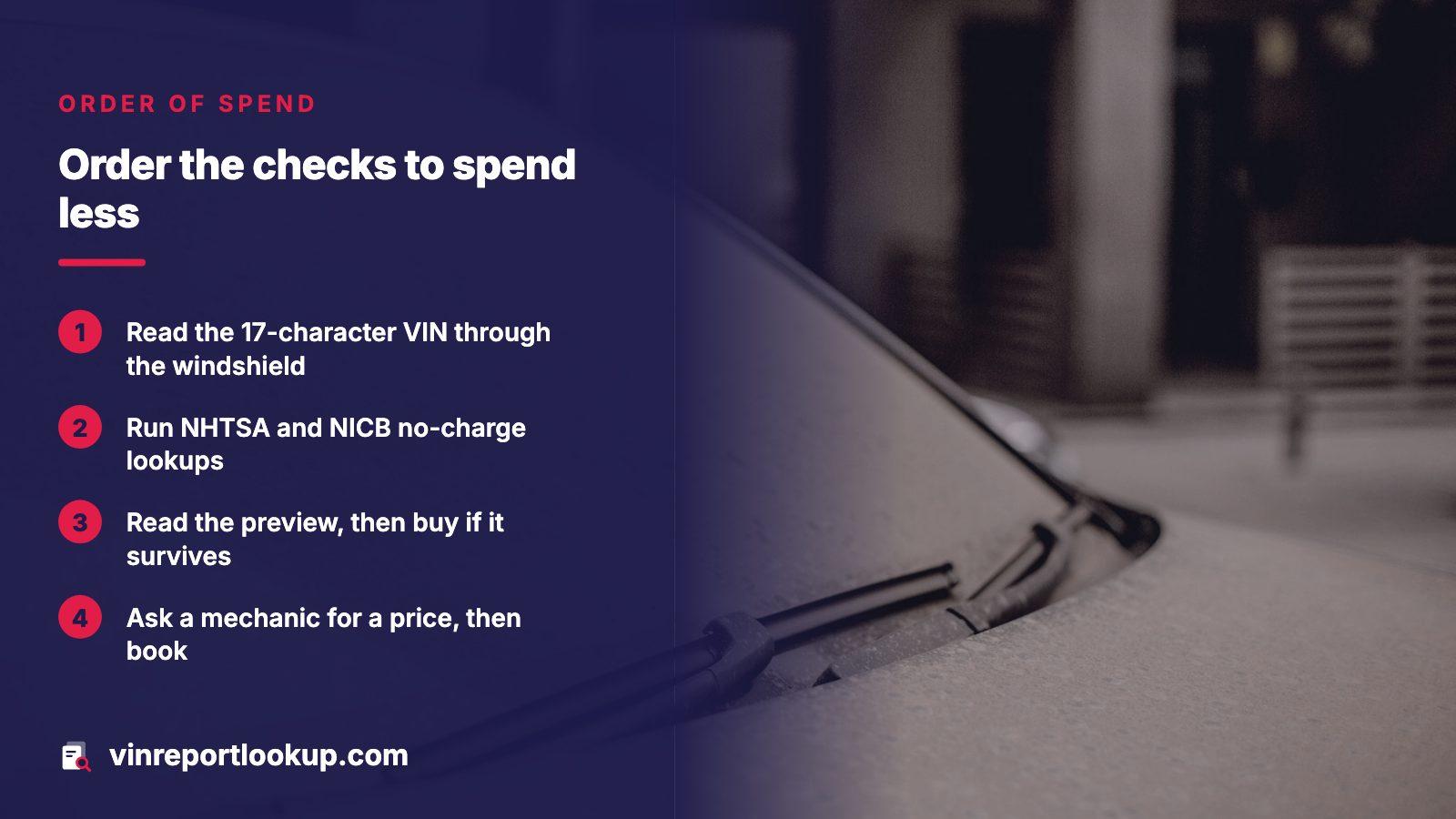
- Before paying for an inspection, go to the driver's door from outside and note the 17-character VIN, then match it to the registration card and the listing.
- Run the no-charge lookups: NHTSA for open recalls, NICB for theft, salvage and flood.
- Look at the VINReportLookup preview. If the car survives that, buy the report; a bundle makes sense when several cars are in play.
- Ask a mechanic for a price, then book the inspection.
- Pay a state VIN fee only when the state asks, for example on a title from another state.
The inexpensive steps run first, and a single bad finding can retire a car before you spend more.
Where this information comes from
- Oregon DMV: Vehicle Identification Number inspections — the state's fee, who may inspect, and the out-of-state option
- Kansas Highway Patrol: VIN frequently asked questions — regular and salvage fees, form validity, and the new-car exemption
- Connecticut DMV: Verify a VIN — station fee versus the DMV lane
- NMVTIS: Used car buying tips — the federal price guidance and the advice to pair a report with an inspection
- NICB: VINCheck — what the no-charge insurance lookup covers and its limits
- NHTSA: Check for Recalls — what the VIN recall search shows and omits
- NHTSA owner complaint 11340837 — owner experience, paraphrased
Sources and photos: Facts checked against the sources above in November 2026. Photos by Mustafa Sheikhmouss, JavyGo and Dimitri Karastelev on Unsplash; diagrams by VINReportLookup.
Keep reading
- Vehicle history report cost: what each kind charges and coversPrice bands for every kind of history report, side by side.
- Carfax vs inspection: what each shows and which to buy firstWhat a report can and cannot tell you next to a mechanic's inspection.
- Rebuilt title inspection cost: state fees and what a buyer paysWhat an inspection costs when the car carries a rebuilt or salvage brand.
- PricingToday's amounts for one report and for each bundle size.
Frequently asked questions
How much is a VIN inspection?
It depends on the state. Oregon lists $9. Kansas asks $20, or $25 when the car carries a salvage title. Connecticut charges $10 at contractor stations but nothing at its DMV lane, and it wants $10 again if a lost form is replaced 30 days or more later. Some agencies post no fee, so check the page for your state.
Is a VIN inspection the same as a VIN check?
No. An inspection is a person comparing the number on the vehicle with the title, usually because a state requires it. A VIN check is a lookup of records filed under that number. The first proves the car carries the number its paperwork claims. The second shows what agencies and insurers reported, which nobody can see from the driveway.
Does opening the preview cost me anything?
Yes. Looking at the preview costs nothing, and money changes hands only when you choose the full report. You pay one time and no renewal follows. Shoppers weighing several candidates can choose a set of 3, 5 or 10 reports. For the amounts, open the pricing page.
Do I need a state VIN inspection when I buy a used car privately?
Only if your state asks for one. If the car sits in another state, Oregon accepts an inspection by that state's own DMV employee or a police officer and adds no fee of its own, though the other state may charge. A records check is optional and can be run before you travel.
Can a mechanic's inspection replace a VIN report?
No, they answer different questions. The Justice Department's buying tips ask buyers to get an independent inspection, a title record and other sources, treating them as a set. A mechanic judges soundness and safety on the day. A report shows what was recorded before you arrived.
Now check the car itself
The guide explains what to look for. The report shows what this VIN has on record.