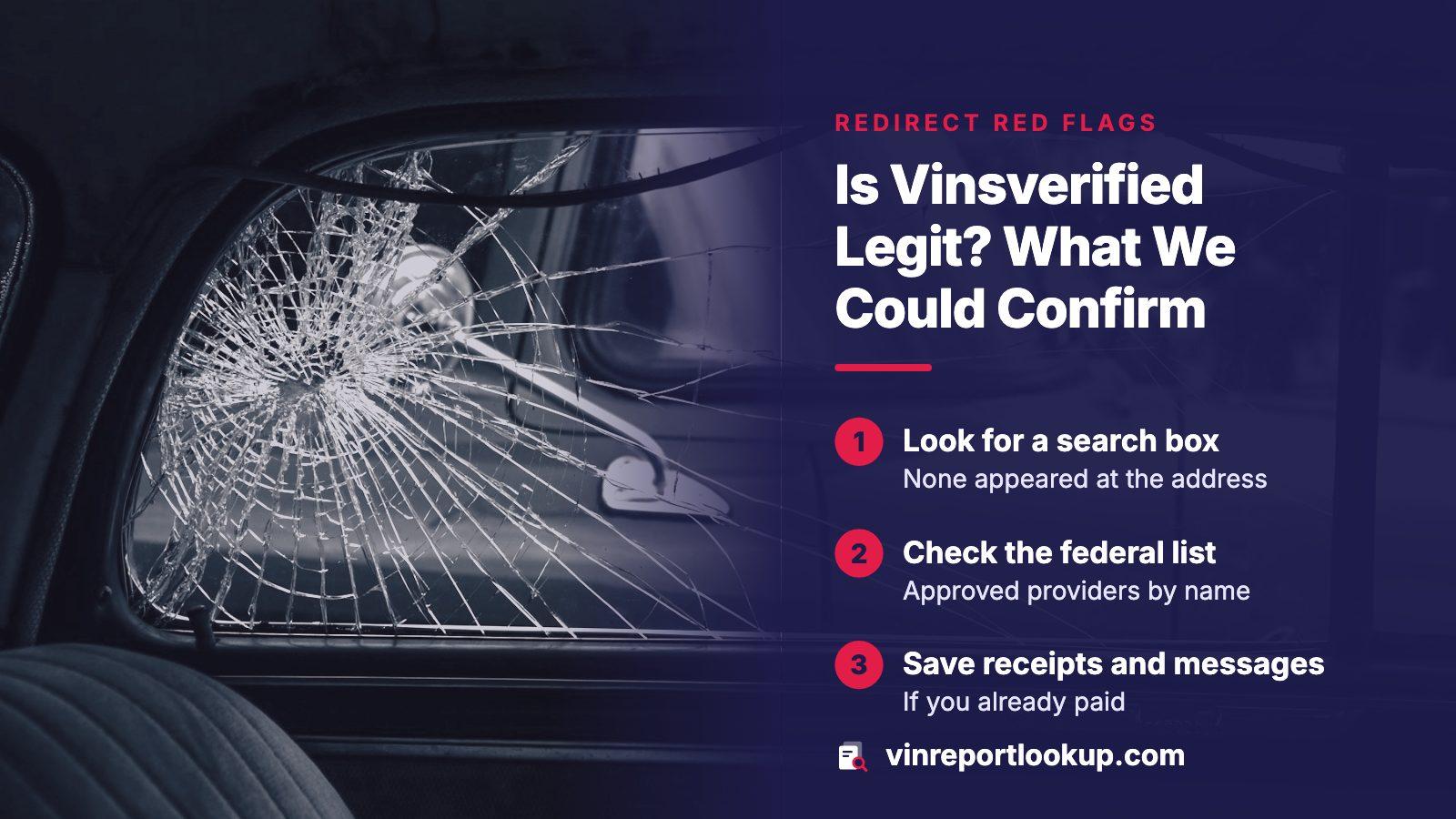
THE SHORT ANSWER
We found nothing we could vouch for. The address vinsverified.com redirected us to an electronics shop, not a report page, and the Justice Department's list of approved title-data providers does not include the name. That is not proof of fraud, since redirects can vary by visitor. It does mean there was no price, refund policy or company to check, so do not pay it until you can see all three.
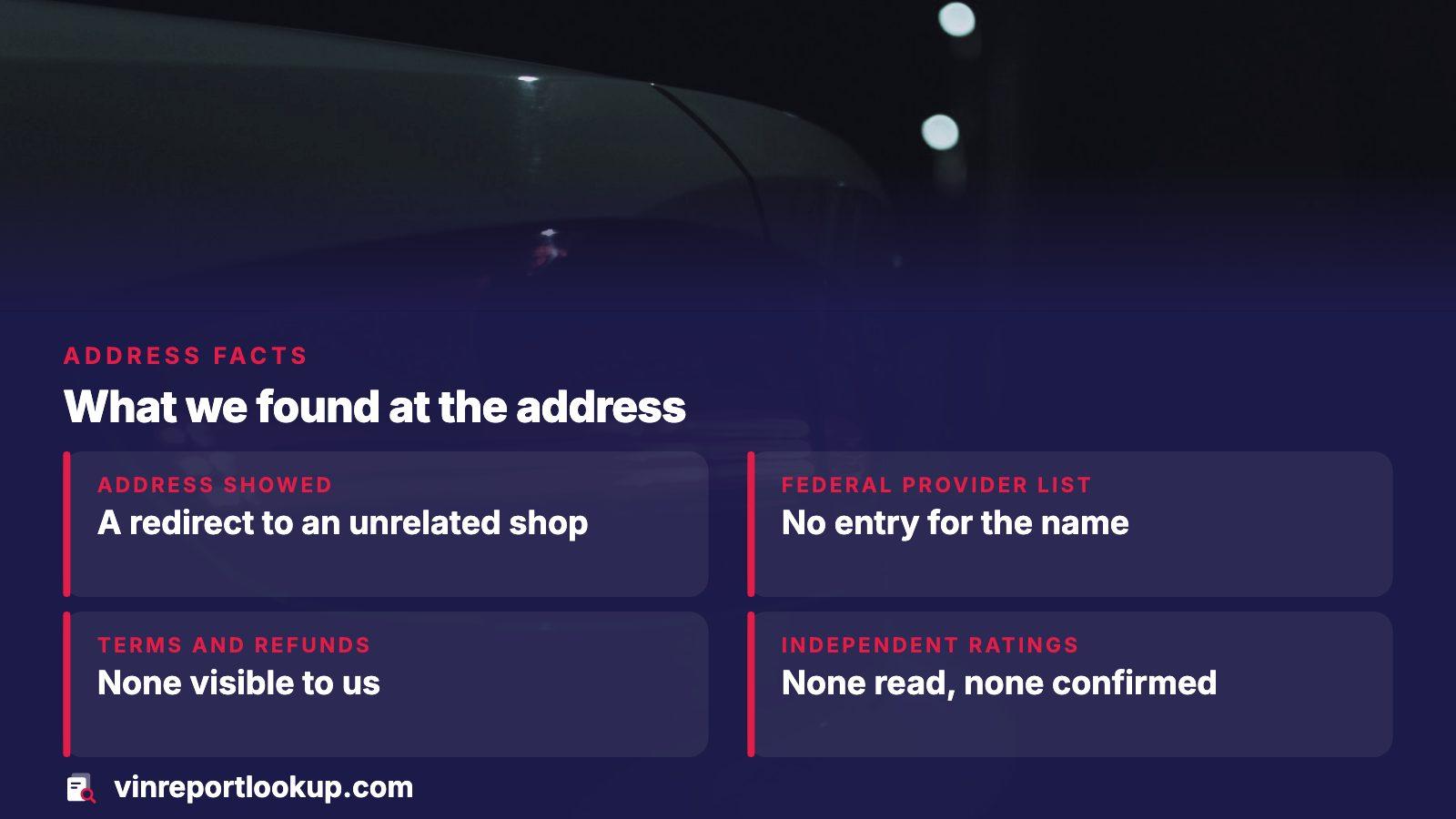
- What the address showed
- A redirect to an unrelated online shop
- Federal provider list
- No entry for the name
- Terms and refund rules
- None visible to us
- Independent ratings
- None read, none confirmed
How we looked, and what we skipped
A search for a site name plus the word legit usually comes from someone about to type in a card number. So we kept to evidence we could open ourselves: the address itself, the federal list of approved title-data sellers, and the Federal Trade Commission's published advice. We did not read review sites, forum threads or star ratings. None of those can be traced to a source we can check, and a pile of anonymous praise or abuse proves little either way.
We also did not buy anything. Whatever we say about Vinsverified is limited to what was visible without paying, and we flag every gap.
What the web address did when we opened it
Plain page requests from our machine got no answer at all. In a browser, the address briefly showed a redirect screen and ended up on a Vietnamese-language page for a shop that sells gadgets, tools and toys, nothing to do with cars. The destination link carried a tracking-style identifier. We never saw a place to enter a VIN, and we never saw a company name, a price list, privacy terms or a way to contact anyone.
- No VIN search box appeared at any point.
- No sample report or list of report sections was shown.
- No terms, privacy policy or refund rules were reachable.
- No business name or support contact appeared.
We opened it a second time and the browser again began with a redirect, though we did not follow it. Redirects can depend on the visitor's country, device or the moment, so your result may differ from ours.
What a redirect like that can and cannot mean
It does not prove a scam. A domain can be parked, left over from a closed business, or pointed at an affiliate offer by whoever now holds it. It also does not prove the service is fine. If you reached this address from a search result, a text or an email, the fair reading is that nothing you can inspect stands behind it.
The practical takeaway
A report site you can pay should let you see, before checkout, who runs it, what a report covers and how refunds work. An address that shows none of that has not earned a card number.
Checking the Justice Department's approved list
The federal title database behind these reports publishes a page naming each business cleared to sell its records to the public. Some businesses appear nested under a larger provider that owns them. We searched the page for the name and found no match. The one near-lookalike, BeenVerified, is a separate company listed in another provider's group.
Be fair about what that means. A seller can buy title data from an approved provider and never be listed itself. The list tells you who is certain to carry federal title records. It cannot tell you who is lying. That page adds that ordinary shoppers cannot buy the federal version from three well-known names that deal only with dealerships.
The FTC's warning about report sites you do not know
In an October 2018 alert, the FTC described sellers pressed by a would-be buyer to purchase a history report from one specific website, about $20 on a credit card, after which the buyer vanished. The agency's advice still reads well. If someone insists on a particular site, ask why. You may have no idea who operates it, and the page may only exist to harvest your payment details, or to gather contact data that marketers resell.
That article is about a different scheme and never mentions Vinsverified. We cite it for the habit it teaches: do not pay an unfamiliar report site on someone else's say-so. It also says to look up the company online beside terms like complaint, rating or scam before you hand over money.
What a fair report price looks like
The Justice Department notes that NMVTIS runs on user fees, so providers charge for reports, and that as recently as May 2020 the fees ran from $8 to $12.99 per report. Reports that add accident and damage detail can cost more, and some sellers use prepaid credits or subscriptions. The point is not a number to match. It is that a genuine seller shows the price, and whether it is per report or per pack, before you pay.
| Before you pay | What you should be able to see |
|---|---|
| Who runs it | A named company and a way to reach it |
| What you get | A sample report or a list of sections |
| What it costs | One price, stated as per report or per pack |
| If it goes wrong | A written refund rule and a support address |
If you already paid an address like this
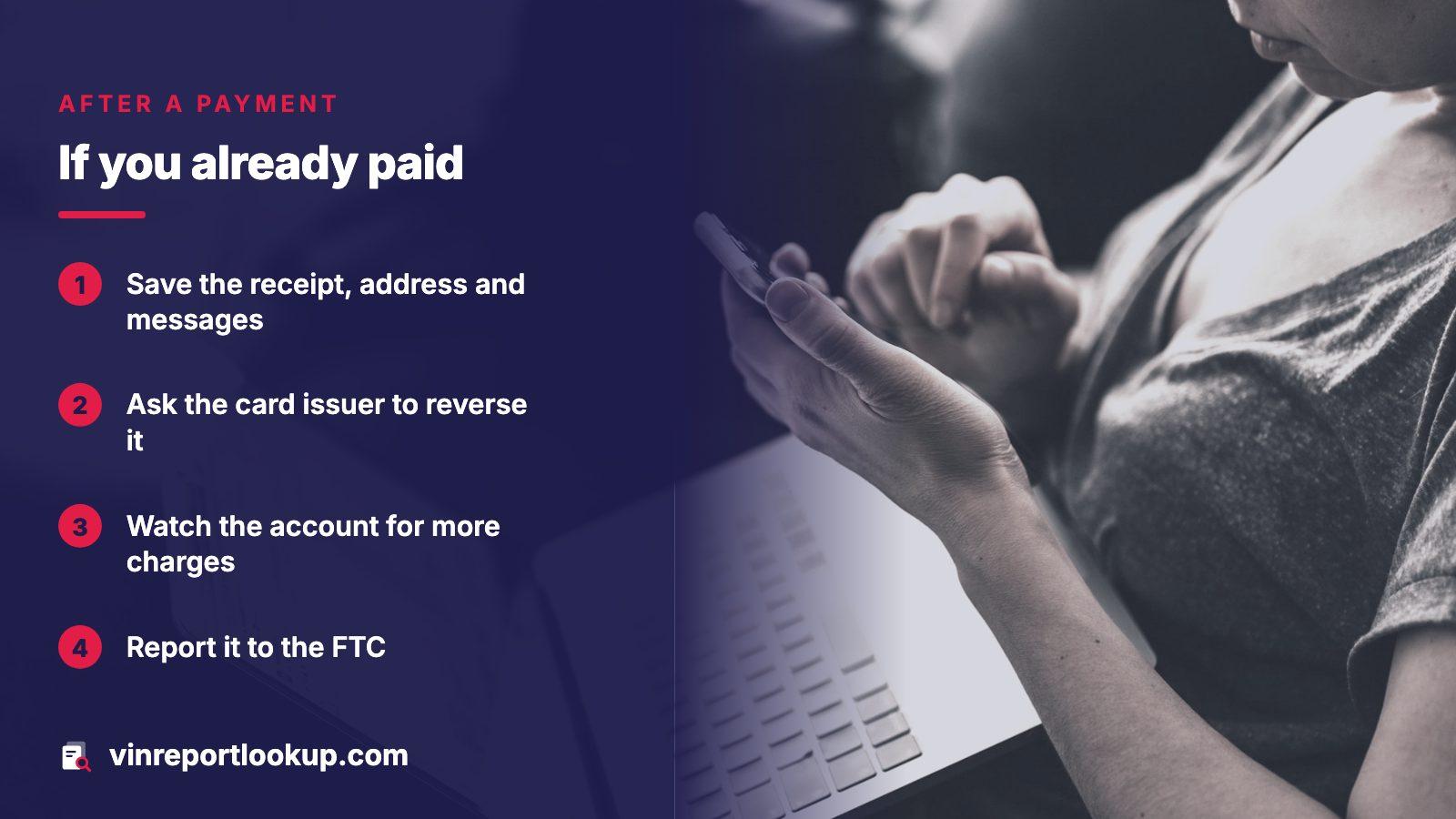
Move quickly, because speed is what gives you a chance. The FTC says that if you paid by credit card you should tell the card issuer right away and ask for a refund, and that federal law protects against unauthorized use. With a debit card, call your bank or credit union. If you used a payment app such as PayPal, report the charge to the app and ask it to reverse the payment.
- Save the receipt, the web address and any messages.
- Contact the card issuer, bank or app and ask for the charge to be reversed.
- Watch the account for further charges and consider replacing the card.
- Report it to the FTC at ReportFraud.ftc.gov.
The FTC is plain that your money might already be gone. It is still always worth asking.
Buying a report from a place you can inspect
VINReportLookup is set up to meet the table above. You type in a VIN and get a preview at no cost, so you see what the car has on file before deciding. If you go on to the full report, you make one purchase. Larger packs of 3, 5 or 10 exist for people weighing a few cars, and nothing renews afterward. Current prices sit on the pricing page.
Once you have it, go straight to the title brand lines, then accident damage, mileage readings and auction or salvage photos. No report replaces a mechanic's inspection, so book one for any car you plan to keep.
Where this information comes from
- Justice Department NMVTIS: approved data providers — The list we searched for the name, and the dealer-only note.
- Justice Department NMVTIS: frequently asked questions — How the system is funded and the fee range it cites.
- FTC: steering clear of vehicle history report scams — The 2018 warning about pressure to use one named report site.
- FTC: what to do if you were scammed — How to ask a card issuer, bank or payment app to reverse a charge.
Sources and photos: Facts checked against the sources above in November 2026. Photos by sippakorn yamkasikorn, Michal Biernat and Johnathan Kaufman on Unsplash; diagrams by VINReportLookup.
Keep reading
- Vehicle history report scams: how to spot a fake report seller before you payHow report-site scams work and the signs that give them away.
- Is Vinfixer legit? A look at its credits, refund rules and gapsAnother report site read the same way, with its credit and refund terms.
- Vehicle history report providers: who sells VIN reports and how they differWhich providers sit behind the reports you can actually buy.
- Best VIN check: how to choose a report and what each one includesHow to pick a report once you know what to compare.
Frequently asked questions
Is Vinsverified a scam?
We cannot say that, and we will not guess. What we can say is that its web address showed no report service when we opened it, only a redirect to an unrelated shop. With no company, price or terms to inspect, treat it as unverified and keep your card out of it.
Are there Vinsverified reviews I can trust?
We did not rely on any. Anonymous ratings on review sites and forums are hard to trace and easy to fake in either direction. A better test is whether the site itself shows who runs it, what a report contains and how refunds work. Without those, a score tells you little.
Is Vinsverified an approved NMVTIS provider?
The Justice Department's approved list did not contain the name when we searched it. A seller could still buy title data from a listed provider, so absence is not proof. If federal title records matter to you, pick a seller the list names, or ask the one you are considering which provider supplies its data.
What if a car buyer told me to use this site?
Be careful. The FTC has warned about buyers who push sellers to pay for a report on one named website and then disappear. Say you will gladly show a report from a source you choose, or invite them to run their own. If they insist on one site, walk away.
How can I check a car without trusting an unknown site?
Start with the free recall lookup from the federal safety agency and the theft and salvage check some insurers support, then add a report from a seller whose price, terms and company you can read. Finish with an independent inspection before paying for the car.
Now check the car itself
The guide explains what to look for. The report shows what this VIN has on record.