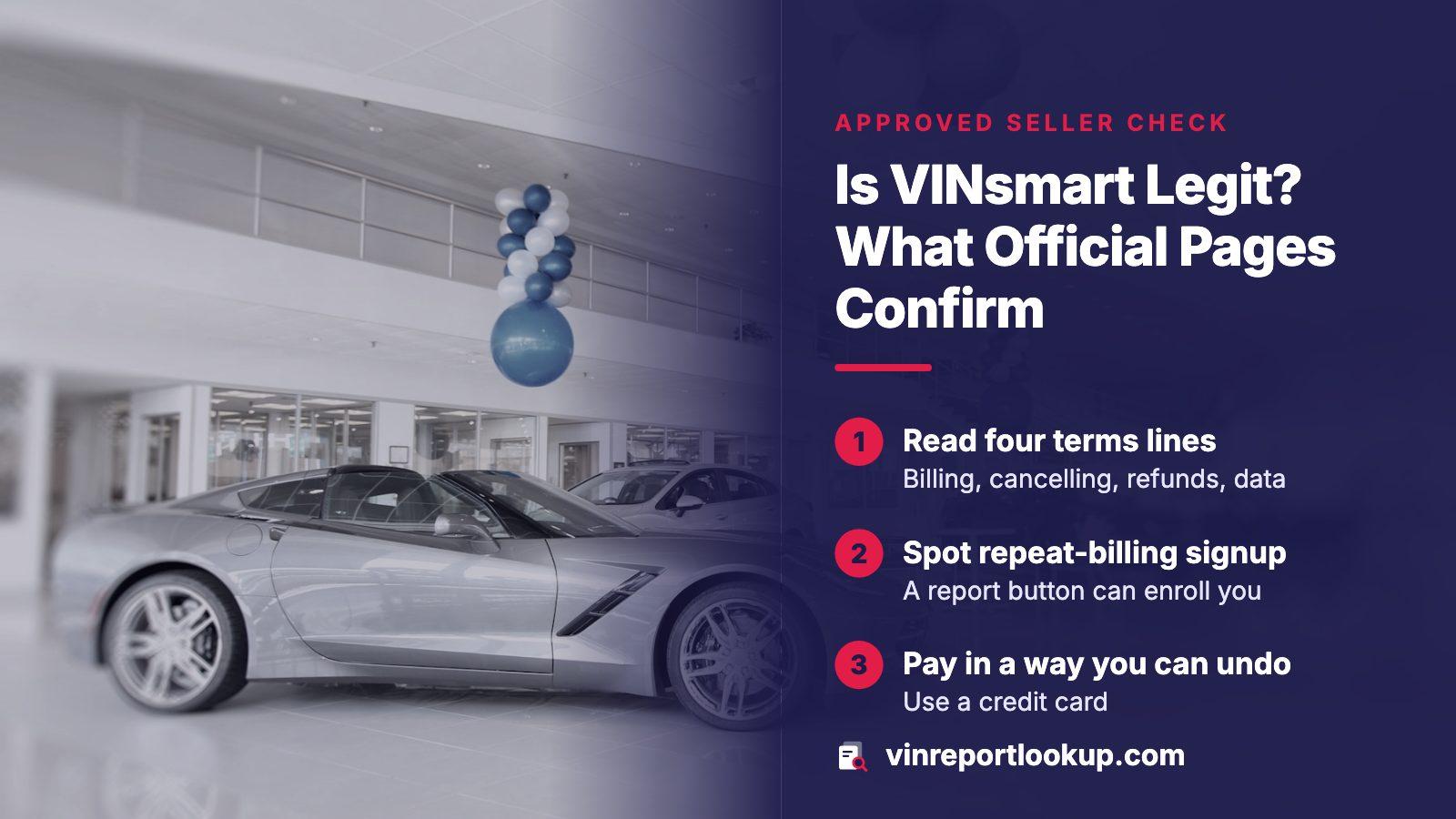
THE SHORT ANSWER
One government fact is confirmed. VINsmart has its own slot on the Justice Department's roster of cleared NMVTIS sellers. We could not open VINsmart's own pages, so its pricing, extras, renewal terms and refund rules are unverified here. Approval covers the title data only. Before paying any report site, read its terms, check how it handles recurring charges, and use a credit card.
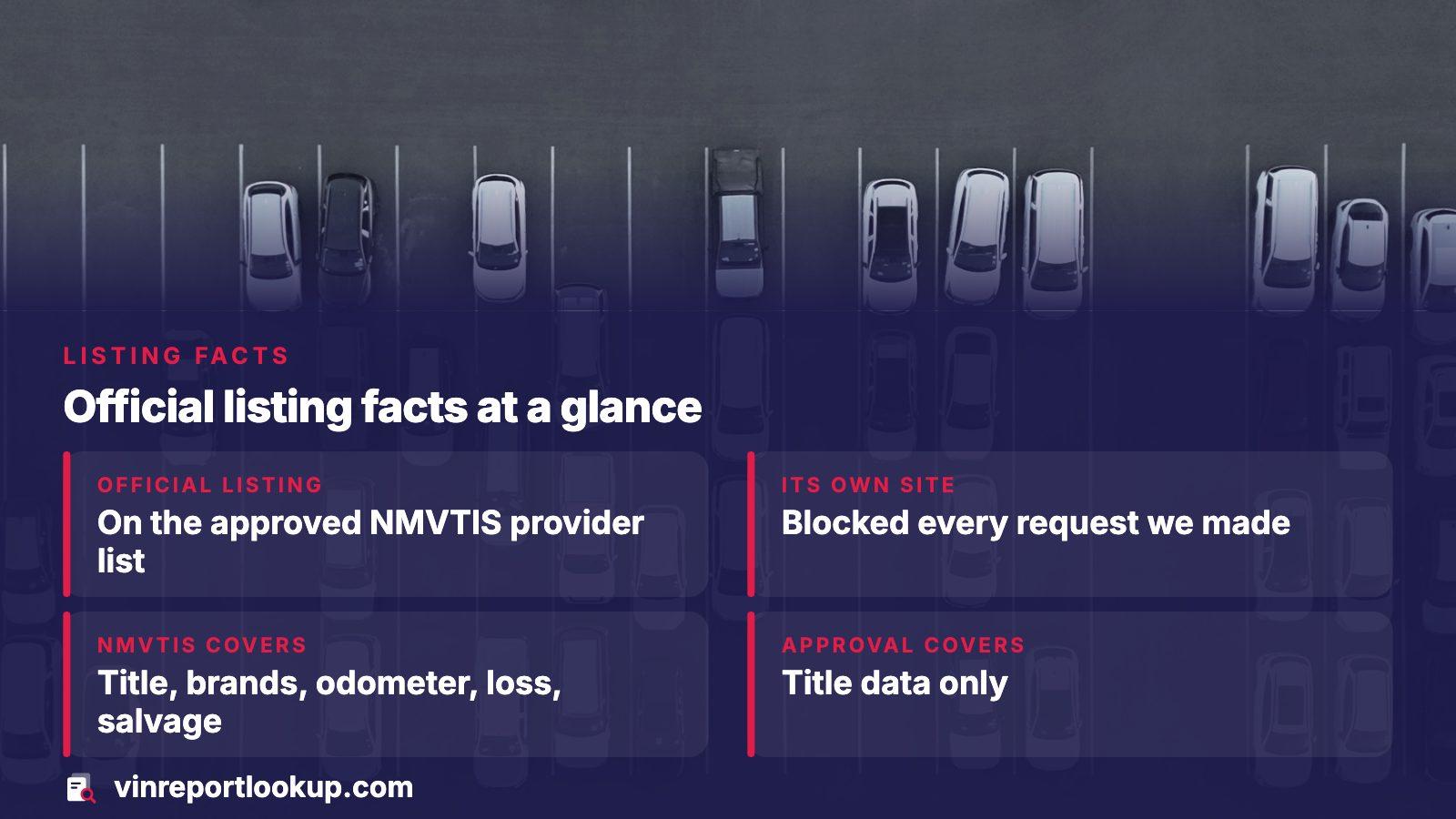
- Official listing
- VINsmart is on the Justice Department's approved NMVTIS provider list
- Its own site
- Blocked every request we made, so nothing from it is quoted
- NMVTIS covers
- Title, brands, odometer, total loss and salvage history
- VINReportLookup
- Free preview, then one payment, no subscription
The one thing a government page confirms
The Justice Department publishes a page naming the companies cleared to deliver NMVTIS reports. VINsmart appears there as a separate entry, in the group that serves businesses and the public alike, with a link to its website. Entries run in alphabetical order, and the department states that position implies no endorsement.
That listing answers one narrow version of the question. A name on that roster has been cleared to resell federal title data to consumers, so VINsmart is not a look-alike that borrowed a name. It does not tell you how pleasant the checkout is, whether the report is worth its price, or what happens to your card after the first charge.
What we could not check, and why
We tried VINsmart's home page with a plain request and again in a browser window. Both times a security screen from the site's host returned an error and no page. We did not try to work around it, so we have nothing from VINsmart itself.
- Price per report, and whether packs exist.
- What the report adds beyond the federal title records.
- Whether a purchase starts a recurring charge, and how to stop one.
- Refund terms and who answers support questions.
- Who owns and runs the business.
We also read no customer reviews. Star ratings on review pages are easy to game in both directions, and no official page rates VINsmart either way. If you see a confident verdict online, ask what page it came from.
What approval covers and what it leaves out
An NMVTIS report is deliberately short. The Justice Department keeps it to five items. Think of them as a title snapshot, a brand log, one odometer line, and two severe-damage flags for total loss and salvage. Titling offices, scrapyards, recyclers and insurers supply the data because federal rules make them.
| Question you have | Federal title records answer it? |
|---|---|
| Was the car ever branded salvage, junk or flood? | Yes, with the brand history |
| Did an insurer declare it a total loss? | Yes, within the reporting rules |
| Has the odometer reading gone backward? | Partly, from the readings states report |
| What repairs has it had? | No, repair history is not held |
| Is there an open recall? | No, that comes from the maker or NHTSA |
The department also says a clean NMVTIS report is a good result, not an empty one. Private providers may add accident, repair or recall data on top, which is where reports differ most from one seller to the next.
Red flags worth checking on any report seller
Legitimacy is mostly about behavior at the moment of payment. These are the signs that deserve a pause before you enter a card.
- No operator name, address or contact method anywhere on the site.
- A price shown only after you enter your VIN and email.
- A "report" button that quietly signs you up for repeat billing.
- Terms that let the seller pass your details to marketing partners.
- A seller or buyer who insists you use one specific site.
The last one matters most in private sales. In 2018 the FTC described a ruse in which a would-be buyer demanded the seller purchase a report, for about $20 by card, from a named site that bounced visitors to a .vin address, then vanished. The agency's advice was to ask why anyone insists on a particular site.
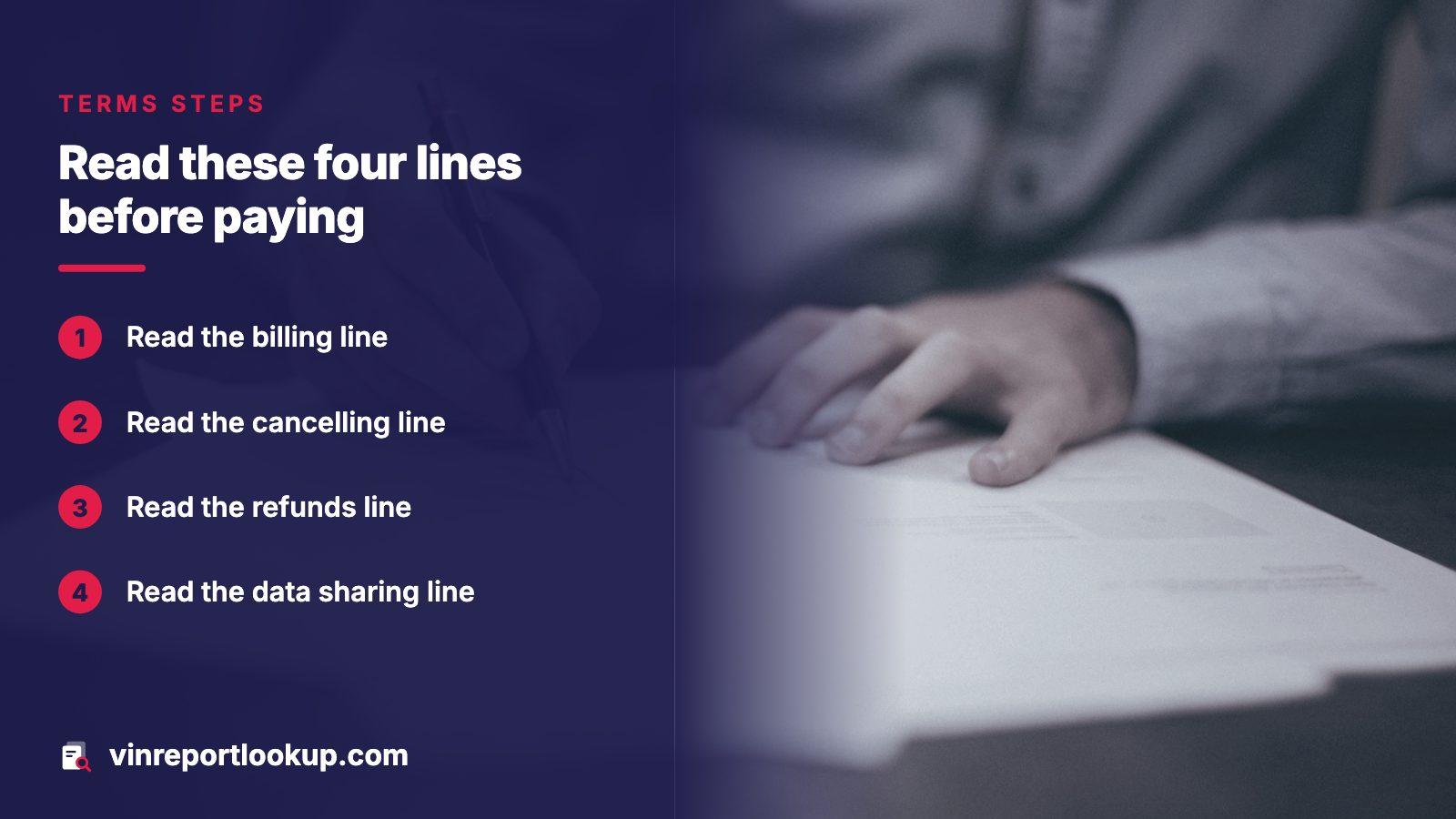
Read these four lines of the terms before paying
Because we could not read VINsmart's terms, we will not say what they contain. You can read them yourself in about five minutes, and the same test works on every competitor.
- Billing: does one purchase mean one charge, or a membership that renews?
- Cancelling: can you stop online, or only by phone or email?
- Refunds: who decides, and is there a time limit?
- Data: does submitting your contact details mean marketing messages from third parties?
If the terms are vague
Treat a missing answer as a no. A seller confident in its billing explains it plainly, and you can always buy a one-off report elsewhere instead.
Pay in a way you can undo
The FTC's guidance on getting money back after a scam turns on how you paid. With a credit card, call the issuer immediately on the phone number printed on the card, or log in to the account, and request a refund. Federal law protects you against unauthorized use. Debit cards work through your bank in much the same way.
Payment apps and bank transfers can sometimes be reversed if you tell the app or bank immediately. Gift cards and wire transfers are the hardest to recover, which is exactly why scammers ask for them. No honest report seller needs either. Keep the order email and a screenshot of the checkout page showing what you agreed to.
A different route: preview first, pay once
If your real goal is to learn whether a particular car has a bad past, you do not have to settle the VINsmart question first. Here, you type the VIN and get a preview at no charge, and nothing is billed until you decide to go on. The report itself is bought once, never as a membership that renews, and the pricing page lists the amount.
Use the same discipline here that we ask of any seller. Look at the preview, confirm the make and model match the car in front of you, and read what the report will include before you pay. A history report supports an inspection by a mechanic you trust, and it does not replace one.
What to do next
If you already bought from any report site and the charge looks wrong, contact the seller first, then your card issuer or bank the same day. The FTC takes scam reports at ReportFraud.ftc.gov. For questions about the contents of an NMVTIS report, the Justice Department says to ask the provider that issued it.
If you have not bought yet, decide what you need the report to answer. Title brands and salvage history are the core of the federal data. Accident detail and market value depend on the seller. Match the report to the question, then compare sellers on the four lines of terms above.
Where this information comes from
- Justice Department: Approved NMVTIS data providers — Where VINsmart is listed and what the listing does and does not say.
- Justice Department: Understanding an NMVTIS vehicle history report — The five indicators in a federal title report and where the data comes from.
- Justice Department: NMVTIS frequently asked questions — Fee ranges, data timing, missing repair history and who handles disputes.
- FTC: Steering clear of vehicle history report scams — The pay-for-a-named-site ruse and the advice to ask why.
- FTC: What to do if you were scammed — How to ask for money back depending on how you paid.
Sources and photos: Facts checked against the sources above in November 2026. Photos by Richard R, Scott Graham and Iain on Unsplash; diagrams by VINReportLookup.
Keep reading
- Vehicle history report scams: how to spot a fake report seller before you payMore on the tricks aimed at buyers and sellers of used cars.
- Carfax vs NMVTIS: what each report shows and which to buyHow federal title records differ from a full commercial report.
- Best VIN check: how to choose a report and what each one includesA way to pick a report by the question you need answered.
- PricingWhat one report or a pack costs today.
Frequently asked questions
Is VINsmart legit?
The Justice Department lists VINsmart among businesses approved to sell NMVTIS reports to the public, which is the one official confirmation we found. Its own site blocked us, so we cannot vouch for its billing, price or support. Read its terms and pay by credit card.
Are VINsmart reviews reliable?
We read none, and no government page rates VINsmart. Reviews on commercial sites can be written by the seller or its affiliates, or skew toward angry customers. A more useful check is whether the terms explain billing and cancelling in plain words.
Does an NMVTIS listing mean the report is accurate?
It means the business is approved to resell the federal title data. The Justice Department says states report on different schedules, some instantly and others daily or within days, so a very recent title change can lag. Questions about a report go to the provider that issued it.
What if I was charged more than I expected?
Contact the seller with your order details, and call your card issuer or bank the same day if the answer is poor. The FTC advises asking the payer for a refund right away, and reporting scams at ReportFraud.ftc.gov. Credit cards generally give you the strongest footing.
Does a federal title report show repairs or recalls?
No. The Justice Department says repair history is not in NMVTIS, and that private providers add things like recall and maintenance data. For recalls, ask the maker or check NHTSA by VIN. For repairs, ask the owner for records and have a mechanic inspect the car.
Now check the car itself
The guide explains what to look for. The report shows what this VIN has on record.