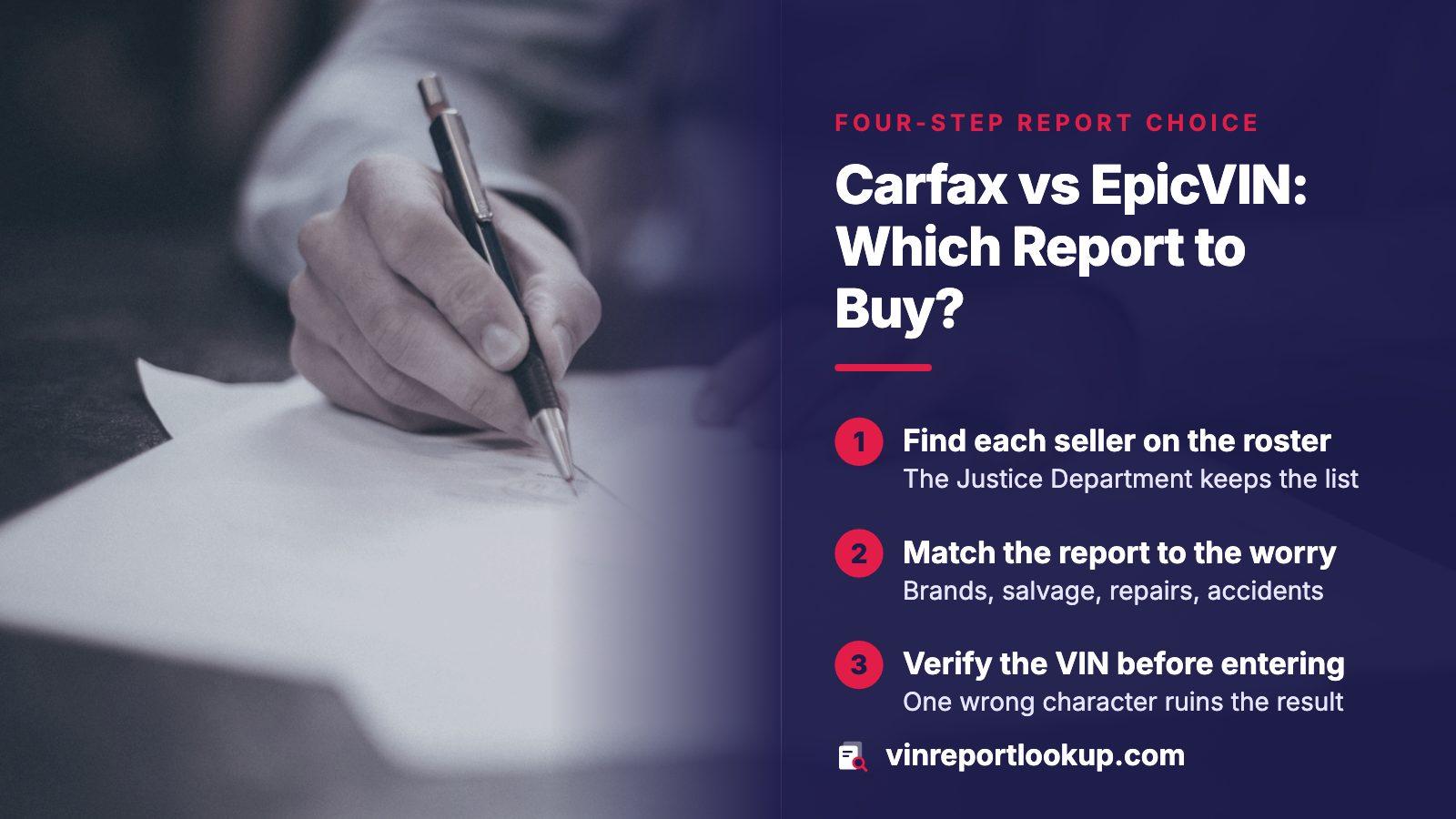
THE SHORT ANSWER
Choose EpicVIN when a federal title screen is the goal: the Justice Department lists EpicVin.com among sellers that serve the public, so brands, salvage and total-loss entries are in scope. Choose Carfax when you want to learn whether accident and repair entries exist, which the FTC says its reports sometimes hold. Neither company's website would open during research, so read each price and sample report there, and look at a preview of your VIN first.
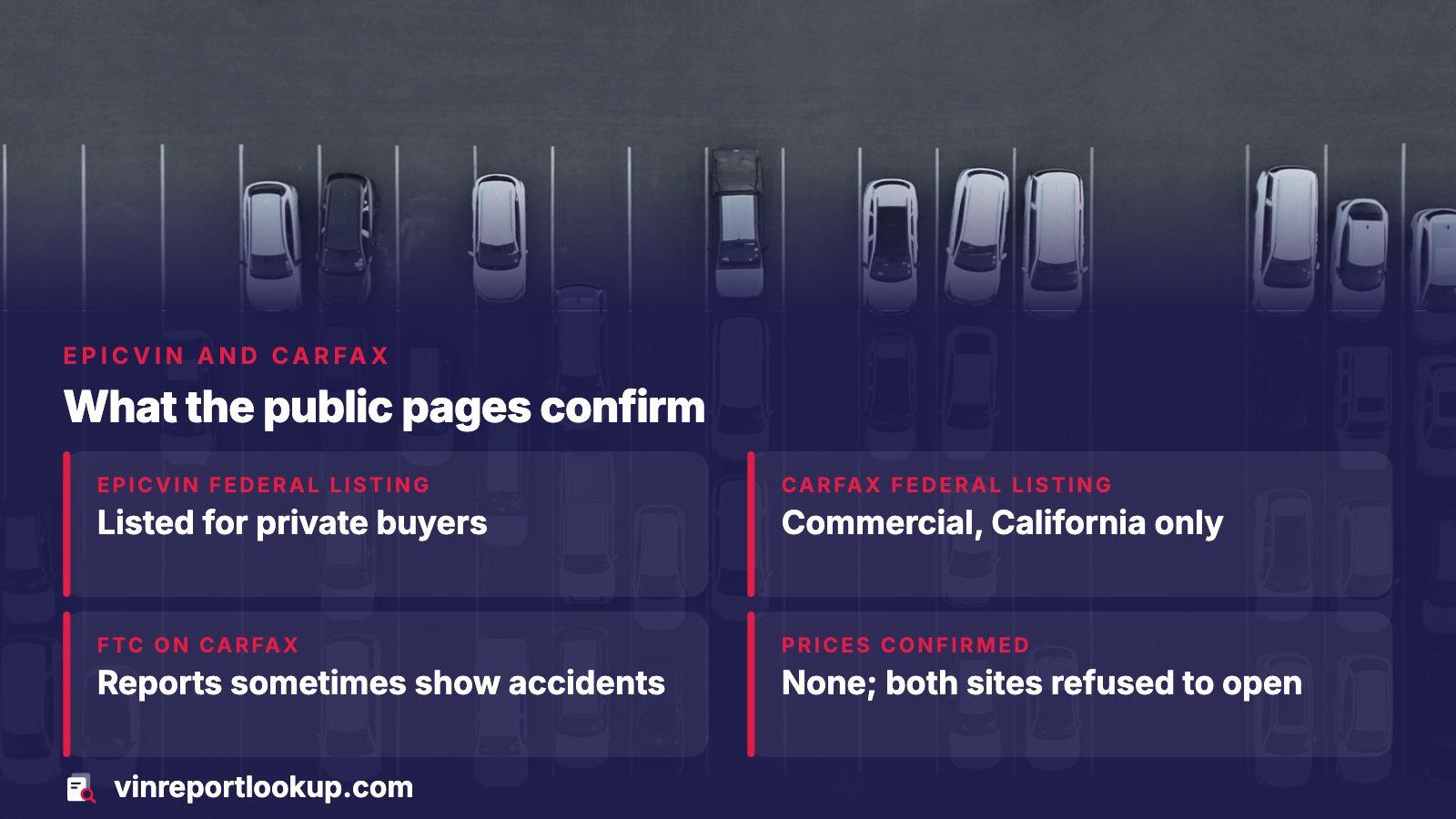
- Federal title record for private buyers
- EpicVin.com is listed; Carfax is commercial only, California only
- Where the FTC names Carfax
- As a seller whose reports sometimes show accident and repair entries
- Prices confirmed for this page
- None, because both company sites refused to open
- Buying route that never renews
- Preview first, then one payment
Carfax and EpicVIN side by side, as far as public pages go
Government pages describe both sellers. Neither seller's own website would open during research, so the table keeps to what could be read.
| Question | Carfax | EpicVIN |
|---|---|---|
| May a private buyer get the federal title record from it? | No. Its listing is for commercial customers in California only | Yes. It is filed with sellers that serve all interested parties |
| Does the FTC name it as a source of accident and repair entries? | Yes, alongside two other sellers | Not on the FTC page that was read |
| Price of one report or a pack | Read it on Carfax's order page | Read it on EpicVIN's order page |
| Sample report | Ask the site for one before paying | Ask the site for one before paying |
Check 1: find each seller on the Justice Department's roster
Begin with the roster, not an ad. The Justice Department publishes a list of firms approved to resell the national title system's records, divided into sellers that serve everyone and sellers that serve commercial customers only. EpicVin.com is in the first group, and its entry names two more sites run by the same operator. CARFAX.com is in the second, limited to commercial customers in California.
The page states that consumers cannot receive these federal reports from Carfax, which supplies dealerships. It also says the alphabetical order signals no preference, so the roster shows who may sell the federal feed, not whose report reads better.
What the roster cannot tell you
An entry covers one government feed. It says nothing about how deep a seller's own accident data runs, how its pricing is built or how it treats a refund. Those answers sit in the seller's terms.
Check 2: match the report to the worry about this car
The federal record is short by design. It carries the title state and date, any brand with the date it was applied, the latest odometer figure, total-loss and salvage entries, and sometimes theft. Repair history is absent, and the Justice Department says so outright.
- Afraid the car was branded salvage or flood in another state: the federal record exists for that, and EpicVIN sells it to the public.
- Wondering if an accident or repair was ever logged: the FTC names Carfax as a seller whose reports sometimes hold such entries, so look for that section in its sample.
- Doubting the mileage: the federal record shows the latest reported figure, so set it against the number on the dash.
- Comparing many cars on a budget: start with the cheapest source that covers title and brands, then pay for a deeper report on the one car you like.
Check 3: get the VIN right before either site sees it
- Read all 17 characters off the vehicle, then compare them with the title or registration, then with the ad. Stop if any copy differs.
- Type the seller's address yourself or use the roster's link, so a lookalike ad cannot catch you.
- Enter the VIN and study what appears before payment is requested. A preview that names sections tells you more than a bare yes.
- Ask for a sample report if one exists, and find where it covers accidents, repairs and mileage.
- Pay only when the VIN on screen matches the car in front of you.
A mistyped VIN buys a report on some other vehicle, and you may not get the money back. Read the refund wording first.

Check 4: weigh both prices against the billing terms
Neither company's price could be read for this page, and the Justice Department prints no seller's current fee. Its FAQ calls federal reports fee-for-service and gives a range of $8 to $12.99 per report, a figure it dates to May 2020. Treat that as history and read today's figure on each order page.
Then read the terms. The FTC's advice on trials and renewals fits a history report as well as any other online purchase.
- Learn whether you are buying one report, a pack or a plan that renews.
- Uncheck any pre-ticked box you did not choose, and walk away if cancelling looks unclear.
- Note the date a trial or plan ends, and watch your card statement afterward.
- If a charge continues after you cancel, dispute it with your card company and keep every email.
Check 5: read the result for what it can and cannot say
| Result on screen | Reading | Action |
|---|---|---|
| Brand: salvage, junk or flood | A state titling agency applied a damage label, and the report shows when it did | Walk away, or price the damage with a mechanic's written estimate |
| Total-loss entry | An insurer recorded the car as a total loss, which raises the question of what damage caused it | Ask the seller for claim details and repair receipts |
| Recorded odometer figure above the dash | Mileage may have been wound back, or a record is wrong | Ask the seller to explain and request service paperwork |
| Nothing at all | Good news, yet a reporting gap can hide a brand | Run a second source and have the car inspected |
Coverage explains that last row. Roughly 87 percent of the vehicles on US roads sit in the federal system, but only more than half of the states send data to it, and the Justice Department warns that an empty search can still miss a brand. Timing differs too: a few states post records as titles are issued, while the rest lag by a day or several.
Check 6: add the steps no report replaces
The FTC is blunt that a report cannot stand in for an independent inspection, and adds that reports rarely list mechanical faults. Pay a mechanic who answers to you, not to the seller, even on a dealer-certified car. A dealer who will not allow an outside inspection is, in the FTC's view, a reason to shop elsewhere. Request an estimate in writing with the VIN printed on it, then use that number when you bargain.
The Justice Department's buying tips add habits worth keeping: a VIN search in the National Insurance Crime Bureau's database, which includes flood damage, a recall lookup on NHTSA's website, a test drive over hills, highways and stop-and-go traffic, and a request for maintenance records.
Where a VINReportLookup preview fits the choice
VINReportLookup puts a free preview on screen from the VIN, so you learn whether title, damage or mileage entries exist before any money moves. After that comes one payment: either a lone report or a bundle sized three, five or ten. No plan sits behind it. The pricing page lists the amounts.
- One car and a title worry: run the preview, then buy one report only if records appear.
- A shortlist of cars: a bundle covers several VINs on one payment.
- A wish to see Carfax's accident and service detail: read its sample first and compare it with what the preview lists.
- A wish for the federal feed from a named seller: reach EpicVIN through the roster.
Where this information comes from
- Bureau of Justice Assistance: approved NMVTIS data providers — The two roster groups, where EpicVin.com and CARFAX.com are filed, and the note on consumers and Carfax.
- Bureau of Justice Assistance: NMVTIS for consumers — What a consumer report holds, the coverage figures and the warning about false negatives.
- Bureau of Justice Assistance: NMVTIS questions and answers — The fee-for-service model, the May 2020 fee range, update timing and the missing repair history.
- Bureau of Justice Assistance: buying tips — The pre-purchase habits listed there, including the NICB VIN database and the recall lookup.
- FTC: Used cars — Where the FTC names Carfax, what such reports may add and why an inspection still matters.
- FTC: Buying a used car from a dealer — Mechanical problems missing from reports, independent inspections and the written estimate.
- FTC: Free trials, auto-renewals and negative option subscriptions — Reading cancellation terms, pre-checked boxes, card statements and chargeback disputes.
Sources and photos: Facts checked against the sources above in November 2026. Photos by Scott Graham, Jakub Żerdzicki and Iain on Unsplash; diagrams by VINReportLookup.
Keep reading
- Carfax vs NMVTIS: what each report shows and which to buyWhat the federal title record holds that a Carfax report may not, and the reverse.
- Car history report subscription: when a plan pays and when to skip itHow renewing plans differ from one-time reports, and how to stop a charge.
- Carfax vs inspection: what each shows and which to buy firstWhich problems a report can show and which only a mechanic can find.
- PricingWhat one report and each larger pack cost today, once the preview has run.
Frequently asked questions
Is EpicVIN legitimate?
The Justice Department's roster lists EpicVin.com among approved sellers that serve all interested parties, with two affiliated sites under the same entry. That confirms approval for the federal title feed. It does not grade the rest of its report, so read the preview or sample and the terms before you pay.
Is EpicVIN cheaper than Carfax?
This page cannot say: neither company's website would open during research, and the government pages print no seller's current price. Compare both order pages on the same day, counting the cost per car in a pack and any renewal. A lower price helps only if the report covers what your car needs.
Can a private buyer get the federal title report from Carfax?
Not according to the Justice Department. Its roster limits Carfax's federal offer to commercial customers in California, and a note says consumers cannot receive these reports from Carfax, which supplies dealerships. That covers one government feed, not the other records the FTC says Carfax reports may include, such as accident and repair entries.
Do I need to buy both reports for one car?
Rarely. Look at a preview and the roster, decide which gap worries you most, and buy one report for that. A second report earns its cost on a car you are ready to buy, when the first came back empty yet the price or mileage still looks odd. An inspection belongs in every plan.
Will either report show mechanical problems?
Do not count on it. The FTC says reports rarely list mechanical faults, and the Justice Department says the federal record leaves out repair history. A mechanic who works for you can check brakes, rust and leaks. Ask for an estimate in writing with the VIN on it.
Now check the car itself
The guide explains what to look for. The report shows what this VIN has on record.