THE SHORT ANSWER
We could not verify anything about Bidfax from its own pages, because the site refused our requests, and the Justice Department's list of approved title-data providers does not include the name. That proves nothing about its accuracy, but it means you have no confirmed source for what it shows. Before paying for a car, pull a report whose data sources are stated and that lets you preview the match first.
- Bidfax site
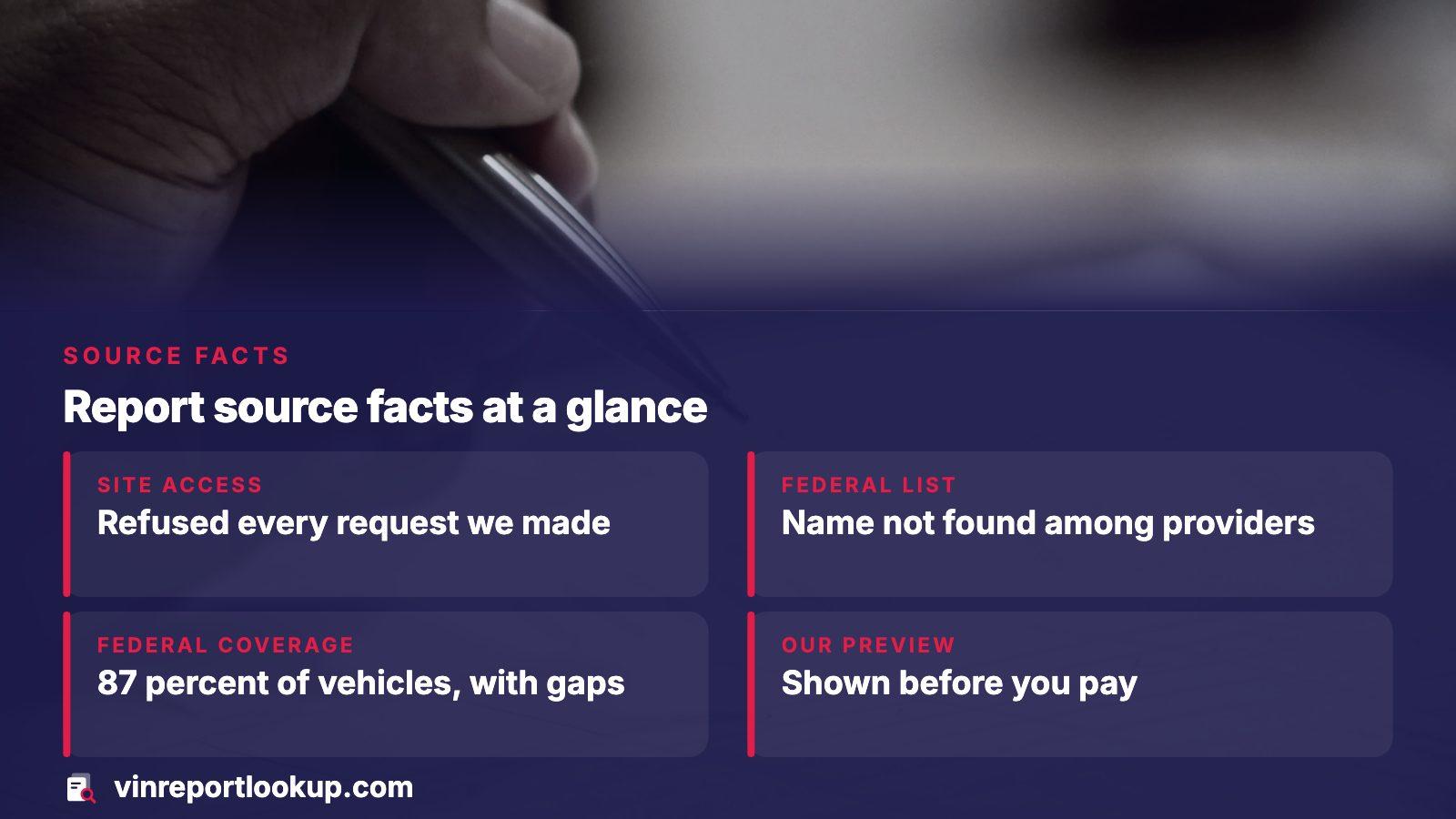
- Returned a 403 refusal to every request we made
- Federal list
- Name not found among approved NMVTIS providers
- Federal coverage
- 87 percent of vehicles in NMVTIS, but gaps remain
- Our preview
- Shown before you pay
What we could and could not read
A review is only worth reading if it separates things the writer saw from things the writer guessed. So here is the record. We requested the Bidfax home page and a few of its other pages with a plain request and again in a normal browser window. Each time the server answered with a refusal, not a page.
That leaves us with no price, no statement of what a lookup returns, no terms, and no description of where its records originate. We will not fill those gaps from forum chatter or from reviews on third-party sites, because none of that is a record we can check. Anything you read elsewhere about Bidfax, including this page, should be held to the same standard.
Why this matters
A source that cannot be read cannot be graded. Silence about a service is a reason for caution, not a verdict in either direction.
What the federal list does and does not tell you
The Justice Department publishes the businesses it has approved to sell title-based vehicle history reports to the public, and it also shows websites owned by those providers. We searched the text of that page for the name Bidfax and found nothing, either as a provider or as an affiliated site.
Read that narrowly. Not being listed does not show that a site is inaccurate, and many useful tools sit outside the list. What it does mean is that the federal title database is not something you can assume stands behind the results. If a seller of lookups claims title data, ask which company supplies it.
What title data can and cannot do for you
Since a lot of Bidfax searches come from people checking an auction car, it helps to know what a national title record is built to answer. The Justice Department says it holds title details, the latest odometer reading, brand history and sometimes theft data. Its feeds come from motor vehicle agencies, insurers and the businesses that dismantle or resell wrecks.
- States stamp a brand on a title for conditions like junk, salvage or flood, and the national record keeps it permanently.
- It can show an insurer's salvage or total loss determination and a transfer to a recycler or salvage yard.
- The report is kept short on purpose, built on five fraud and theft indicators, and the department treats a clean one as good news.
It does not carry photos of a damaged car or the details of a repair. Those come from other record holders, which is why a buyer often wants more than one view of the same VIN.
Why a clean result can still mislead
The department is frank that about 87 percent of the national vehicle population is in the system, yet only a little over half of states report into it. Salvage and total loss entries in the system number around 20 million. A lookup can still report a clean past for a car that has a bad one, and privately run databases have the same blind spots.
States also disagree. One may brand a car salvage after damage crosses its own value threshold while its neighbor does not. A flood car can carry a flood brand in one state and nothing in another. A car that sat in a salvage yard need not carry a brand at all.
Total loss does not mean wrecked beyond use
Take a stolen car nobody finds for 30 days: the insurer may class it as a loss. If it reappears undamaged, that classification is not reversed, and the car may go to sale in good running order.
A five-question test for any report source
Whether the source is Bidfax, a site you found yesterday or a name you have heard for years, put the same questions to it before you spend money on a car because of what it shows.
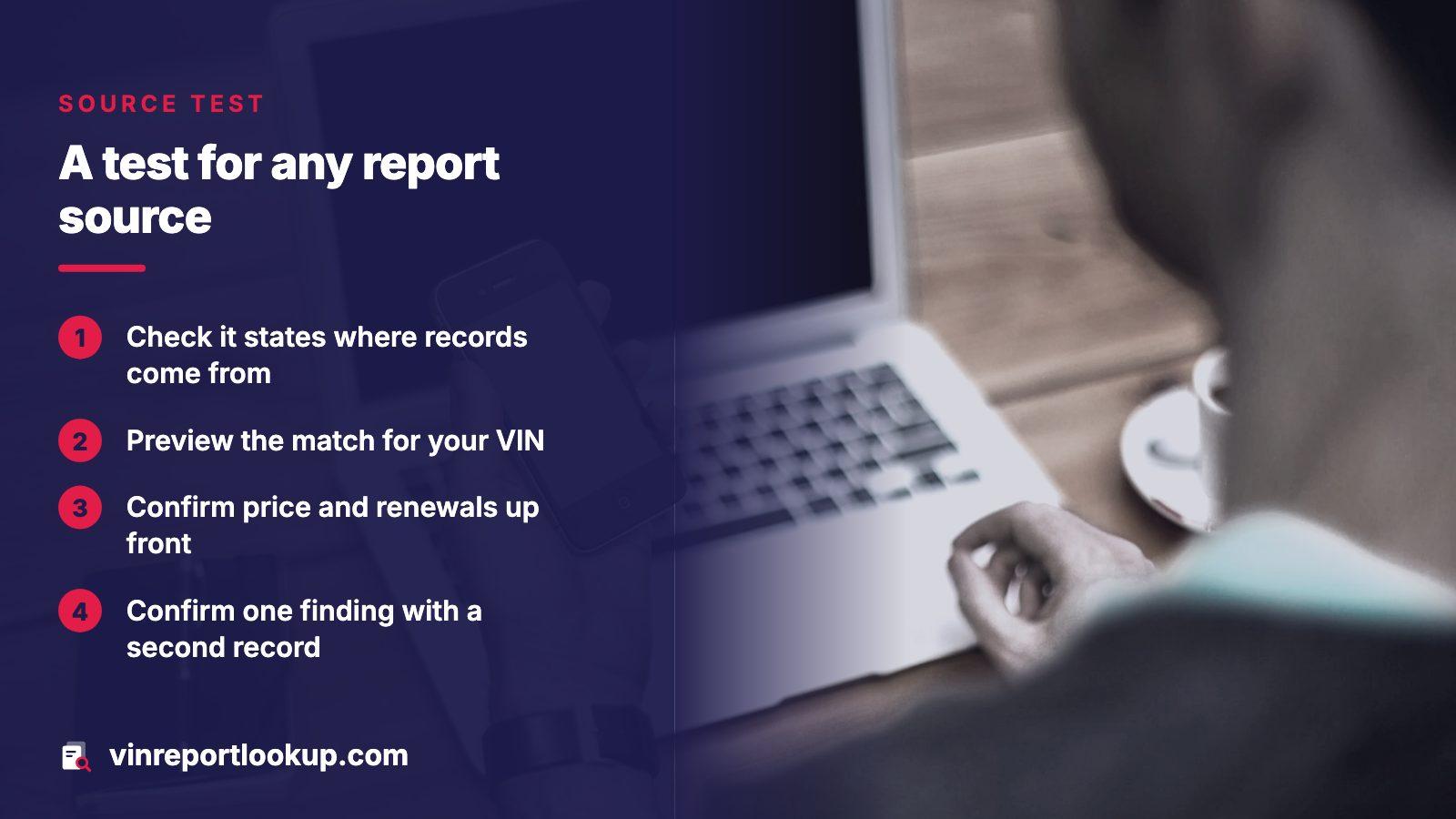
- Does it say where its records come from, in words you can check?
- Does it let you see a preview of the match for your VIN before you pay?
- Are the price, the number of reports and any renewal stated before checkout?
- Does it say what it cannot see, such as repairs paid for privately?
- Can you confirm the key finding, a brand or an odometer reading, against a second record?
A source that answers three or fewer of these plainly is one to treat as a hint, not as proof.
Running a check here instead
VINReportLookup is built around choosing a report with its contents in view. Enter the 17-character VIN and you get a free preview first. Only then do you decide whether to buy, and the purchase is a single payment for one report or a pack. There is no renewal to cancel later, and the pricing page has today's amounts.
For an auction or salvage question, read the brand section first, then the auction photos and damage entries, then mileage readings, and finally any theft or lien flags. Ask the seller for the VIN in writing and compare it with the number on the car before you search, so you are checking the right vehicle.
Back it with the state's own title record
Any history report, from us or anyone else, holds only part of what a state keeps on file. The Justice Department urges buyers to request the actual title record from the state, and says each consumer report from an approved provider points to how to do that.
For a car with a branded past, that record can settle the argument a report starts. Pair it with a mechanic's inspection, because paperwork describes history and an inspection describes the car on the lot today.
Verdict
We cannot give Bidfax a rating, and we will not pretend otherwise. The site refused our requests, it is not on the federal approved list, and no page we could open describes what it returns. That is a gap in what we know, not a finding that it is wrong.
If a purchase hangs on the answer, run a report with stated sources, confirm any brand or mileage problem against the state record, and inspect the car before you pay.
Where this information comes from
- Justice Department: approved NMVTIS data providers — The federal roster we searched for the name Bidfax, and how affiliated sites are shown.
- Justice Department: NMVTIS for consumers — What the national title system covers, where it falls short and why states differ.
- NHTSA: recalls by vehicle API — The public recall data that sits alongside any history report; opened directly.
Sources and photos: Facts checked against the sources above in November 2026. Photos by Patrick von der Wehd, Alejandro Escamilla and Masjid MABA on Unsplash; diagrams by VINReportLookup.
Keep reading
- Best VIN check for auction cars: what to run before you bidHow to pick a check when the car came through an auction.
- Best VIN check for salvage cars: what a report must show before you buyWhat to look for when a salvage or rebuilt brand is possible.
- Vehicle history report providers: who sells VIN reports and how they differHow the wider field of report sellers differs.
- Sample reportSee the layout of a report before you decide to pay.
Frequently asked questions
Is Bidfax legit?
We cannot say. Its site refused our requests, so we read nothing it publishes about itself, and the federal approved-provider page does not list the name. That is an absence of confirmation, not evidence of wrongdoing. Judge any source by whether it states where its records come from.
Does Bidfax show auction photos?
We could not open the site to check, so we will not say. If you want salvage and auction history with photos for a VIN, our report has a section for that, and you see a preview of the match before any payment is requested.
Why would a clean report still hide a salvage past?
Reporting is uneven. The Justice Department says only a little over half of states report into the national system, states apply brands by their own rules, and a car in a salvage yard need not be branded. A clean line means no matching record was filed.
Is the federal list the only trustworthy source?
No. It identifies businesses approved to sell title-based reports, which is useful when title data is the point. Other tools cover recalls, theft or auction records. Use the list to ask better questions, then confirm important findings with the state title record.
What should I do before buying a car I found through an auction lookup?
Confirm the VIN on the car matches the listing, run a report with stated sources, request the state title record and have a mechanic inspect it. A total loss label can be old or misleading, so verify any brand or damage claim with a second record.
Now check the car itself
The guide explains what to look for. The report shows what this VIN has on record.