THE SHORT ANSWER
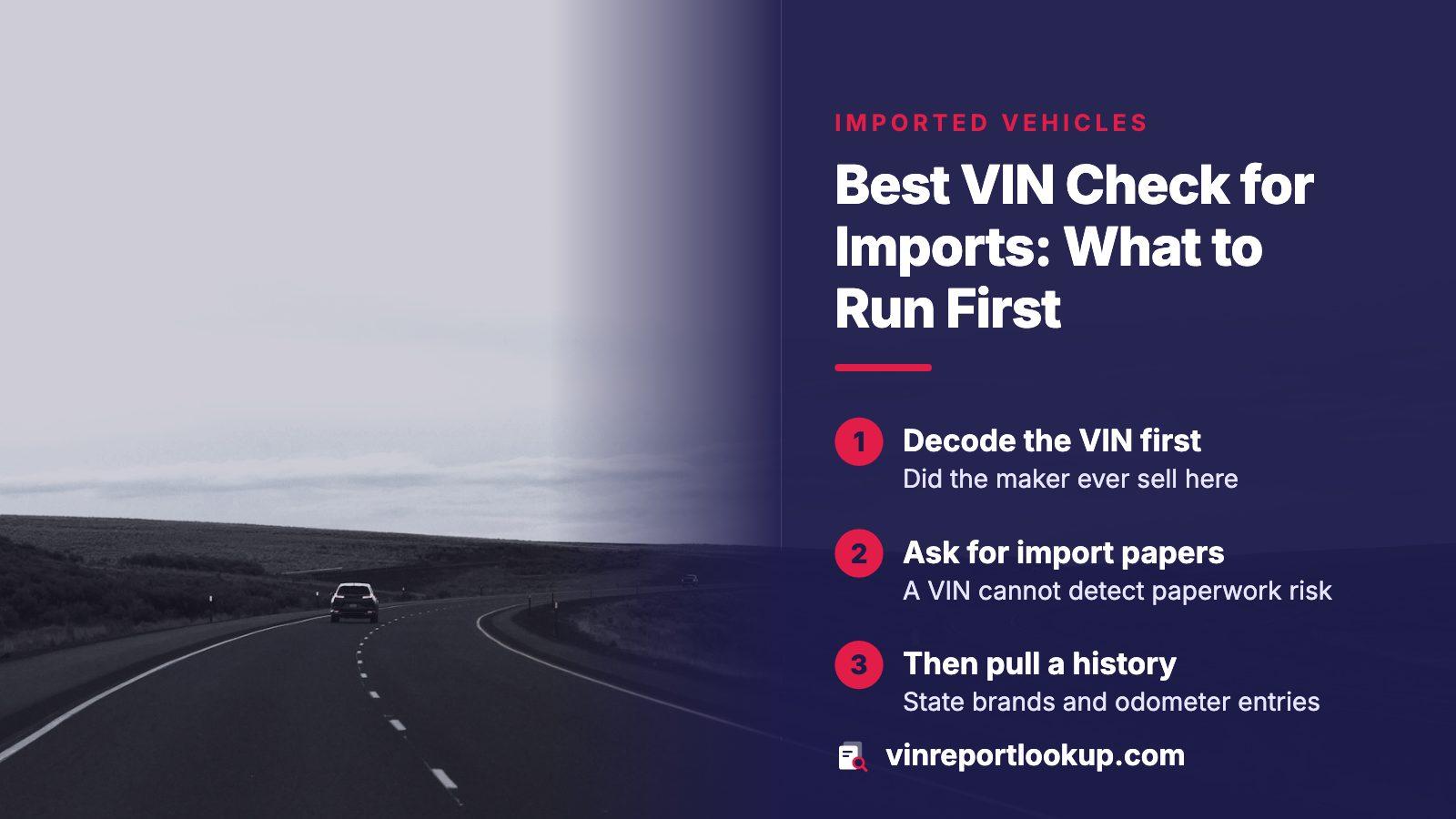
For a car brought in from overseas, run three things in order. Decode the VIN with NHTSA to see whether the maker ever sold in the US. Ask the seller for the import paperwork. Then pay for a full history report on the finalist, which shows US title brands, odometer entries, salvage records and theft flags from the moment the car landed. It will not prove the import was cleared.
- 25-year route
- One of several ways a car can legally enter
- NHTSA decoder
- Reports only what the maker registered
- Title database
- State brands, odometer, total loss, salvage
- VINReportLookup
- Free preview, one payment, no subscription
Why an imported car needs a different kind of check
A car built for the American market has a paper trail that starts at the factory gate: a US-registered maker, a standard label and a first title issued by a state. An import often skips the first half of that story. It may have been titled in another country for years, then crossed the ocean under a special declaration, then been titled in a US state for the first time.
That shapes what a VIN check can do. Anything recorded after the car reached a US state, such as a brand, a mileage entry, a total-loss decision or a theft flag, can show up in a report. What happened in the previous owner's country mostly cannot. Treat the report as proof of the car's American life and nothing more, and judge the earlier years from paperwork and a physical inspection.
Start with the NHTSA decoder, and read what it refuses to say
NHTSA publishes a VIN decoder at no cost. Its page says the answers rest on manufacturer reports, and the results include the plant and country of build. Use it to confirm the listing describes the car in front of you.
I put two numbers through the API on 2026-11-11. The first was a Skyline-style chassis number I invented. It returned four error codes (6, 7, 11 and 400), left make and model blank, and populated just 6 of its 154 fields. Code 7 translates to a maker that never registered the model for sale on US roads. The second was a made-up VIN in BMW's pattern, 17 characters long. The decoder named it a 2011 BMW 550i from Germany and filled 40 fields, then flagged the check digit, which is fair: I invented the number.
| What the decoder returns | What it usually means |
|---|---|
| Full make, model and plant | The maker registered this model for US sale |
| Error 7, almost no fields | The maker never registered it here; a grey-market import is likely |
| Check-digit warning | A typo, a mismatched plate or a doctored VIN; ask the seller to photograph the number |
The ways a car can legally arrive, and which ones to ask about
Federal rule 49 CFR 591.5 lists the declarations an importer can file. A few matter to a buyer. A car carrying its maker's label that it meets US safety standards needs no special treatment. A car 25 or more years old can enter on age alone. Another group enters with a surety bond worth 150% of the car's dutiable value, through an NHTSA-registered importer, and only for a model and year the agency has already cleared. Others arrive as Canadian-market cars that the maker told NHTSA also meet US standards.
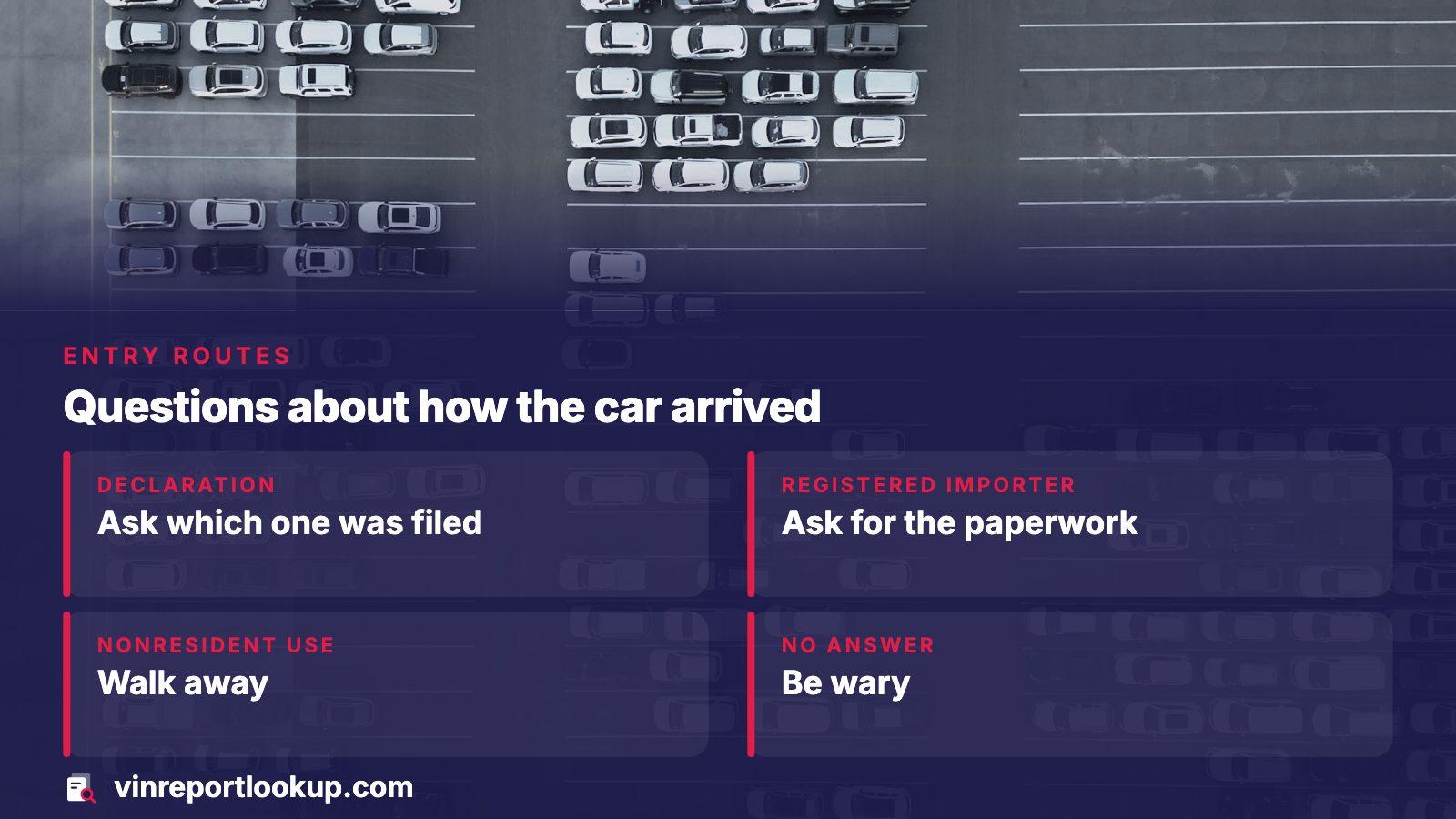
- Ask which declaration was filed and request a copy of the entry paperwork.
- If the car came through a registered importer, ask for the conformity documents.
- Walk away from any car sold as nonresident personal use or as a show vehicle; those routes carry limits on sale and use.
- Be wary when the seller cannot say how the car entered at all.
What a US history report can show on an import
The federal title database, NMVTIS, is deliberately narrow. Its consumer pages name five things it reports on. One is the state holding the current title, with the date of the latest title action. The rest cover brands, mileage, write-offs and salvage sales. The Justice Department treats a short report as good news and describes brands as labels that state agencies attach, for example junk, salvage or flood. None of the pages I read says anything about imported or foreign vehicles.
A full commercial report goes further, with auction and damage records, theft entries, liens and open recalls, depending on the provider. For an import, the entries that earn their price are the ones that follow the car's first American title. A salvage brand applied by a state after arrival is a serious flag, and so is a mileage entry that goes backward.
The gap no report closes
I could not confirm that any report includes records from the car's country of origin. Assume it does not, and ask the seller for the foreign registration, service book or auction sheet instead.
The paperwork risk a VIN cannot detect
Customs rule 19 CFR 12.80 covers a car that is modified to meet standards after it lands. Customs lets it in against a bond, and the charge is lifted once NHTSA approves the importer's conformity statement and sends a letter. If 180 days pass after entry without that letter, the port issues Form 4647, a Notice of Redelivery, ordering the vehicle back to Customs. Miss the deadline to hand it back or ship it out, and the penalty is the entire bond amount for a single-entry bond.
No history report reads that file. A car can have a clean US title and still have an unresolved entry behind it. That is why the paperwork request sits first in the plan above, and why a report supplements it rather than replacing it.
Emissions are a separate test. EPA's outright exclusions are tied to calendar dates that never roll forward: 1968 for gasoline cars and light trucks, 1975 for diesel cars, 1976 for diesel light trucks and 1978 for motorcycles. EPA's rule also says an admitted vehicle still has to satisfy any other federal or state requirement. Clearing NHTSA on age does not clear EPA.
How to choose the report for an import
Judge a report seller on four points. It should let you preview the VIN before paying, so you see whether it recognizes the car. It should state which records come from the federal title system. It should sell one report for one payment rather than a subscription you might forget. And its sample should show title and odometer sections clearly.
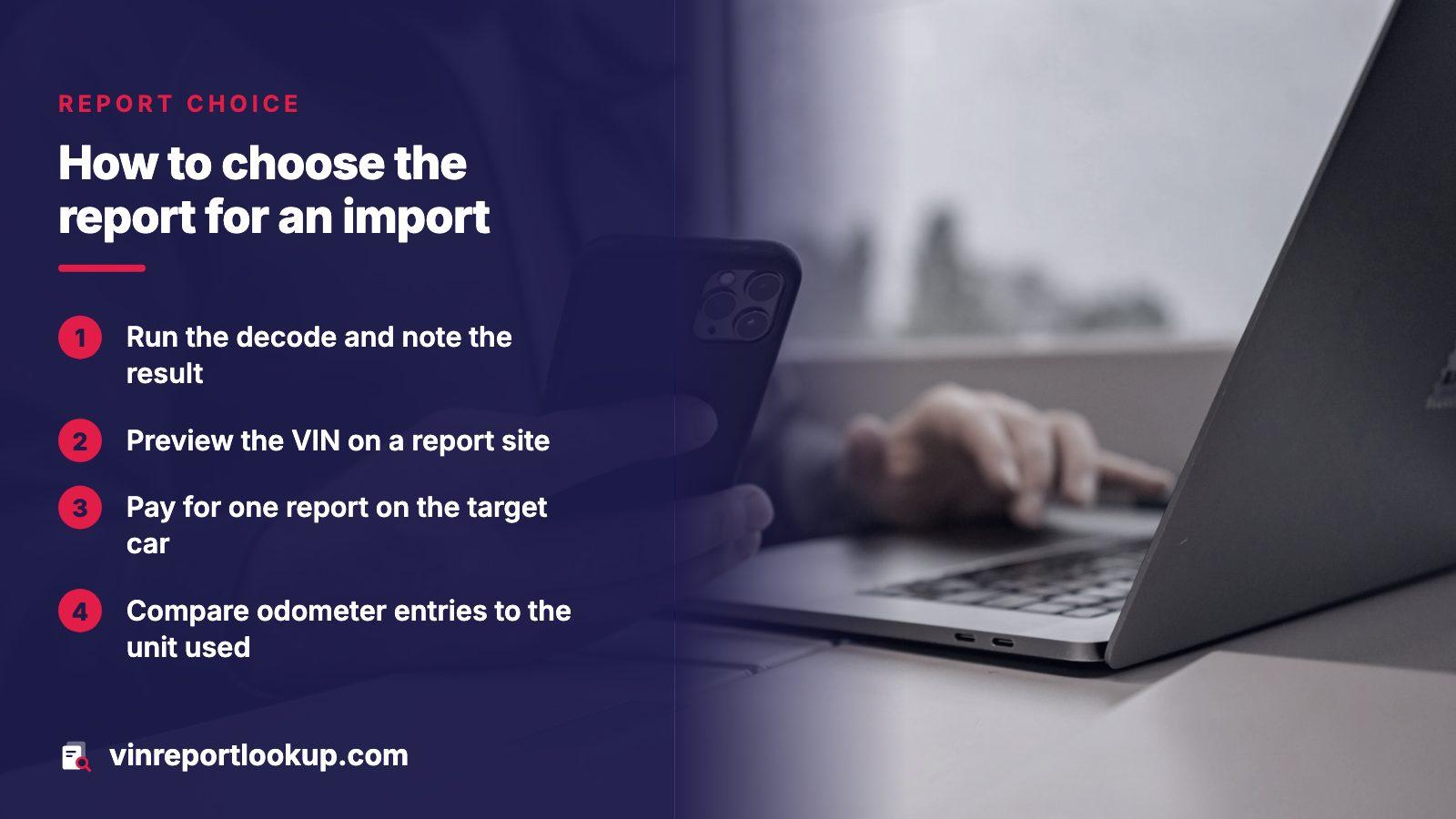
- Run the NHTSA decode and note the result.
- Preview the VIN on a report site and see which sections respond.
- Pay for one report on the car you actually plan to buy.
- Compare the odometer entries against the unit of measure on the dash.
Paying for the check, then the inspection
Enter the VIN in our preview and you see what responds before spending anything. If the car looks worth pursuing, the paid report is a one-off charge listed on the pricing page, and bundles of 3, 5 or 10 suit anyone lining up several imports. No plan renews afterward.
Keep the order simple: decode, ask for paperwork, preview, then buy one report for the finalist. After that, book an independent inspection by someone who knows the make, since a specialist can spot rust, swapped parts and a missing label that a database never records.
Where this information comes from
- eCFR: 49 CFR 591.5 declarations for importation — the list of routes an importer can use, including the 25-year and bond routes
- eCFR: 19 CFR 12.80 safety standards at entry — bond, approval letter and the Notice of Redelivery timeline
- eCFR: 40 CFR 85.1511 exemptions and exclusions — EPA's fixed-date exclusions for older vehicles
- NHTSA: vPIC VIN decoder — what the decoder reports and where its data comes from; my own two test decodes
- Justice Department: understanding an NMVTIS report — the five indicators a federal title report covers
Sources and photos: Facts checked against the sources above in November 2026. Photos by John Kakuk, Anastasiia Nelen and Iain on Unsplash; diagrams by VINReportLookup.
Keep reading
- Best VIN check: how to choose a report and what each one includesThe general comparison for any vehicle.
- Vehicle history report providers: who sells VIN reports and how they differWho sells reports and how they differ.
- Sample reportSee which sections a report returns before you buy.
- Best VIN check for auction cars: what to run before you bidMany imports pass through auctions before sale.
Frequently asked questions
Does a VIN check show a car's history before it was imported?
Usually not. A US report is built from American title, salvage and insurer records, so it picks up the story from the car's first US title. For earlier years, ask the seller for the foreign registration and service papers, and have a specialist inspect the car.
Why does NHTSA's decoder return errors for my imported car?
Error 7 means the maker is not registered with NHTSA for US sale. That is common for cars built only for another market. A chassis number in a foreign format may also fail the 17-character check. The error is a clue about origin, not proof of a problem.
Is a car over 25 years old automatically fine to buy?
Age settles one federal declaration route and nothing more. EPA applies its own dates, and other federal or state rules can still apply. Ask how the car entered, what paperwork exists and whether the state issued a clean title.
Can I check an import before paying for a report?
Yes. Decode the VIN with NHTSA, then use the preview on this site to see whether the number is recognized. Pay for the full report only when the car is a real candidate, because it is a one-time purchase per VIN.
What red flags matter most on an imported car?
A salvage or flood brand applied after arrival, an odometer entry that drops, a VIN with a failed check digit, and a seller who cannot explain the entry paperwork. Any one of these is reason to pause and ask for proof.
Now check the car itself
The guide explains what to look for. The report shows what this VIN has on record.