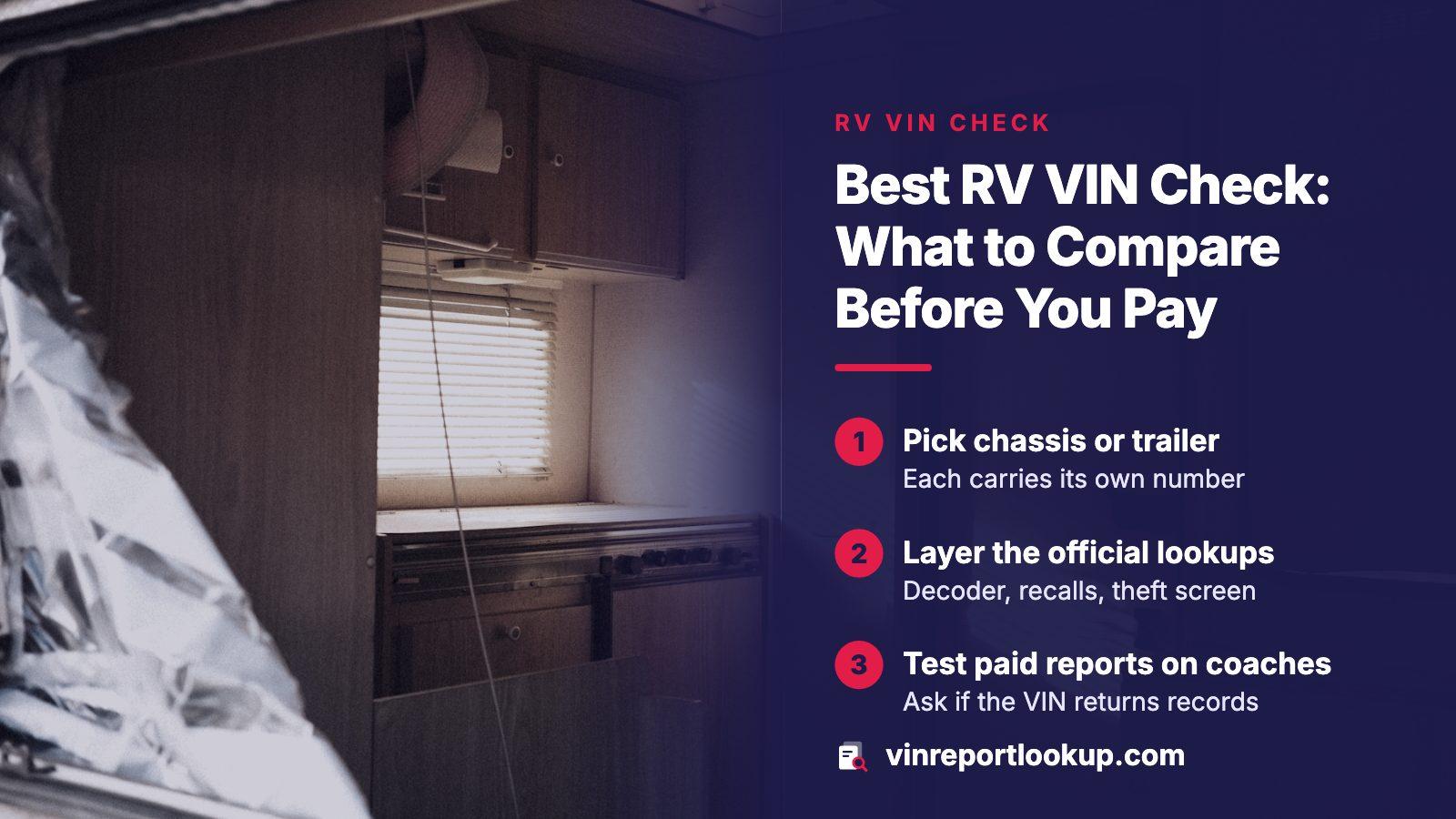
THE SHORT ANSWER
Decode the VIN with NHTSA, search it for recalls, and screen it with NICB's VINCheck; all three cost nothing. Then compare paid reports on three points: whether the VIN returns records for a motorhome chassis or a trailer, which sections the report fills, and how the charge works. Preview the VIN first, buy a report only for a rig still on your shortlist, and book an independent inspection either way.
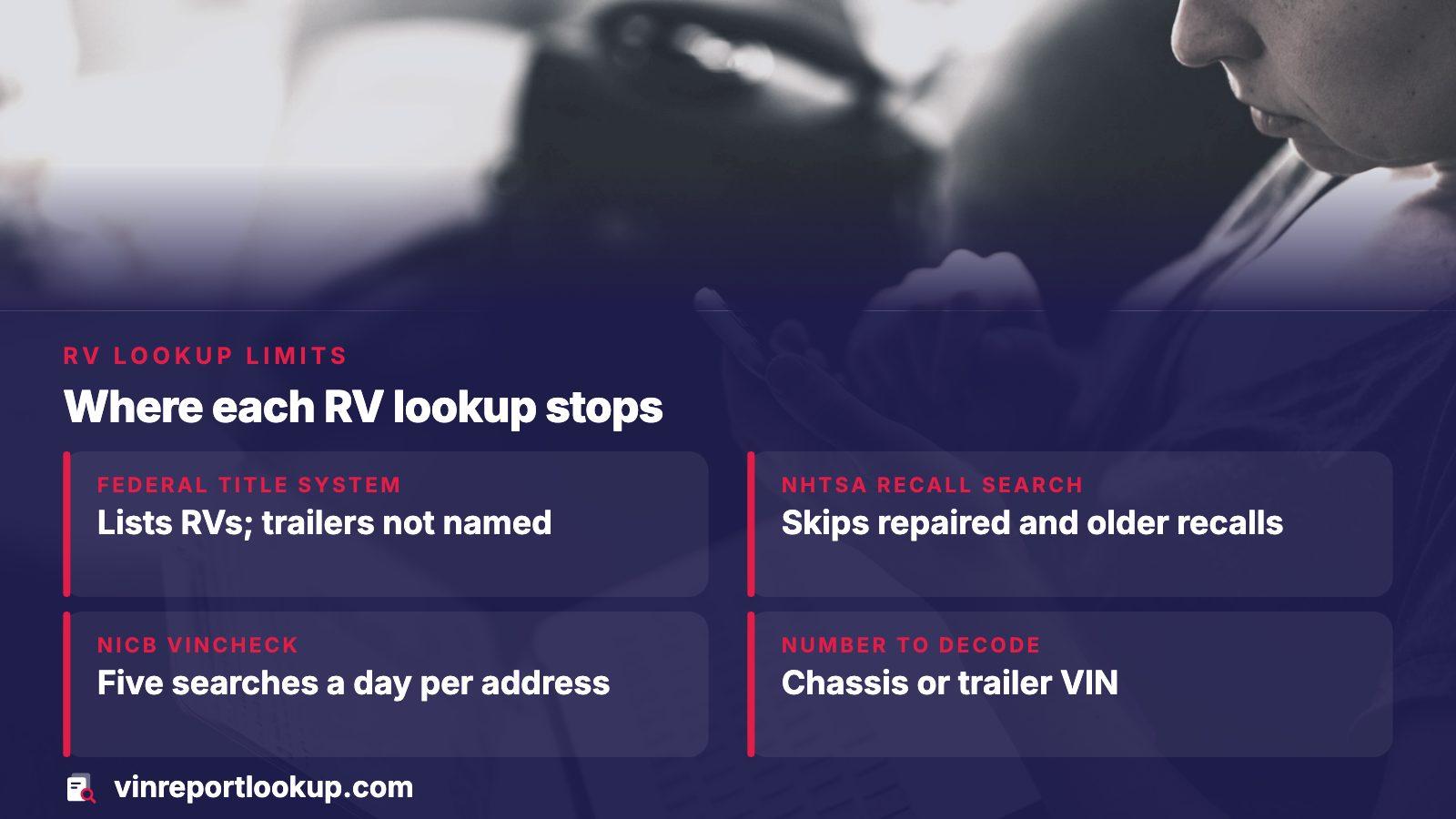
- Federal title system
- Lists RVs and motor homes; trailers not named
- NHTSA VIN recall search
- Skips repaired and 15-year-old recalls
- NICB VINCheck
- Five searches a day per IP address
- VINReportLookup
- Free preview, one payment, no subscription
Which number you are decoding: the chassis or the trailer
A motorhome is finished in stages, and its VIN can belong to the first one. NHTSA's decoder showed this in a test on a partial VIN taken from a Winnebago Vista complaint: the answer named a Ford motorhome chassis, classed it as an incomplete vehicle and warned that the vehicle may have been altered since. A travel trailer behaved differently, as the table shows.
| Rig tested | What the NHTSA decode returned | What it means for your check |
|---|---|---|
| Winnebago Vista motorhome | Ford as make, motorhome chassis, incomplete vehicle, with an alteration warning | The VIN speaks for the chassis. Ask the coach builder about everything built on top. |
| Forest River Cherokee travel trailer | Forest River as maker, ball-pull trailer, camping or travel trailer body | The builder's own VIN, so the decode describes the unit you would tow. |
Give the decoder the model year when you know it; NHTSA recommends always sending one.
Five layers of RV check, and where each one stops
Sort the options by what they hold, not by brand.
| Layer | What it tells you about an RV | Where it stops |
|---|---|---|
| NHTSA decoder | Maker, vehicle type and chassis details as filed | Says nothing about history; an incomplete-vehicle result may not match the rig today |
| NHTSA recall search | Unrepaired recalls tied to the VIN | Leaves out repaired recalls, campaigns older than 15 years, and small makers or specialty builds |
| NICB VINCheck | Theft, salvage and flood flags from participating insurers | Five searches a day per IP address; no police records; not a full history |
| Federal title record | Title brands, latest odometer reading, theft and total-loss history | Names RVs and motor homes but not trailers; holds no repair history |
| Full paid report | Wider sources such as auction photos, liens and insurance entries | Coverage differs by VIN, so preview before paying |
Nothing paid improves on the first three layers, because they come straight from the organizations that hold the records. Money buys the last two.
What a paid report has to add for a coach or trailer
Pay only for rows the no-charge layers cannot fill. On an RV, these are the entries that move an offer or end a deal:
- Title brands and total-loss entries, including labels another state applied.
- Salvage and auction records with photos, which show how the damage looked when the unit sold.
- Dated odometer readings on a motorhome, to test the mileage in the listing.
- Theft and lien entries, either of which can stall a transfer.
- A count of open recalls to take to a dealer.
Ask any report seller for a sample and compare it row by row. VINReportLookup has a sample report page, and its free preview of your own VIN shows what exists for that number before checkout.
Comparing prices and terms without a price list
Prices move, so this page prints none, and a number lifted from an old roundup can mislead. The Justice Department notes that federal title reports are sold fee-for-service, with the cost depending on the provider, and the fee range on its FAQ page carries a 2020 date. Put three questions to any seller:
- Whether the charge repeats: a subscription renews, a single report does not.
- How many reports the price buys: weighing three coaches is a different job from vetting one.
- What happens if the VIN returns nothing: find the refund terms before paying anyone.
VINReportLookup sells one report at a time, or packs of 3, 5 and 10 for comparing several rigs. Amounts are listed on the pricing page, and nothing renews.
What the federal provider list means for a private buyer
The Justice Department keeps a list of approved sellers of federal title data. It names 18 primary providers: 12 sell to the public and to businesses, and 6 sell to businesses only. The page also states that consumers cannot get federal title reports from three companies it names, because they serve car dealerships alone.
Read that list as a map of who may sell the title layer to you, nothing more. An approved company can still hold little for a particular RV, and its other sources are its own, so compare contents instead of logos.
When a recall search comes back clean for the wrong reason
NHTSA's VIN search lists unrepaired recalls and says so plainly when there are none. It leaves out repaired campaigns, those past the 15-year mark except where the maker covers more, and recalls from small manufacturers, including some specialty builds. On a motorhome the chassis and the coach come from different makers, so ask both about recalls.
From an NHTSA owner complaint
A recent buyer, whose complaint is filed under the 2021 Thor Motor Coach Chateau and who describes the vehicle as a Ford E-450, told NHTSA that a recall notice covering the engine had arrived. The dealer contacted to book the repair said "the VIN was not under recall." The complaint does not say why the answers differed, and no failure had happened.
Take from it that a notice, a VIN search and a dealer lookup can each see a different slice. Ask the coach builder and the chassis maker separately, and get each answer in writing.
What no report sees inside a coach
A federal title record holds no repair history, so a clean answer says nothing about how a rig was built or sealed. Title and insurer records share that blind spot: they log events somebody reported, not the condition of the roof, floor or frame.
From an NHTSA owner complaint
After a two-week trip, the owner of a 2018 Thor Freedom Elite found heavy water damage beneath the rear bed and a gap in the back wall open to the ground. A dealer's service shop traced it to a coach body never secured properly to the frame: it had shifted back over an inch, letting in water and leaving mold under the cushions. Thor approved six hours of labor, and the extended warranty did not cover water damage.
A defect like that rarely appears in title or loss records. Let the report decide which rig deserves an inspection, then have an independent inspector check roof seams, floor and frame fastening before any deposit.
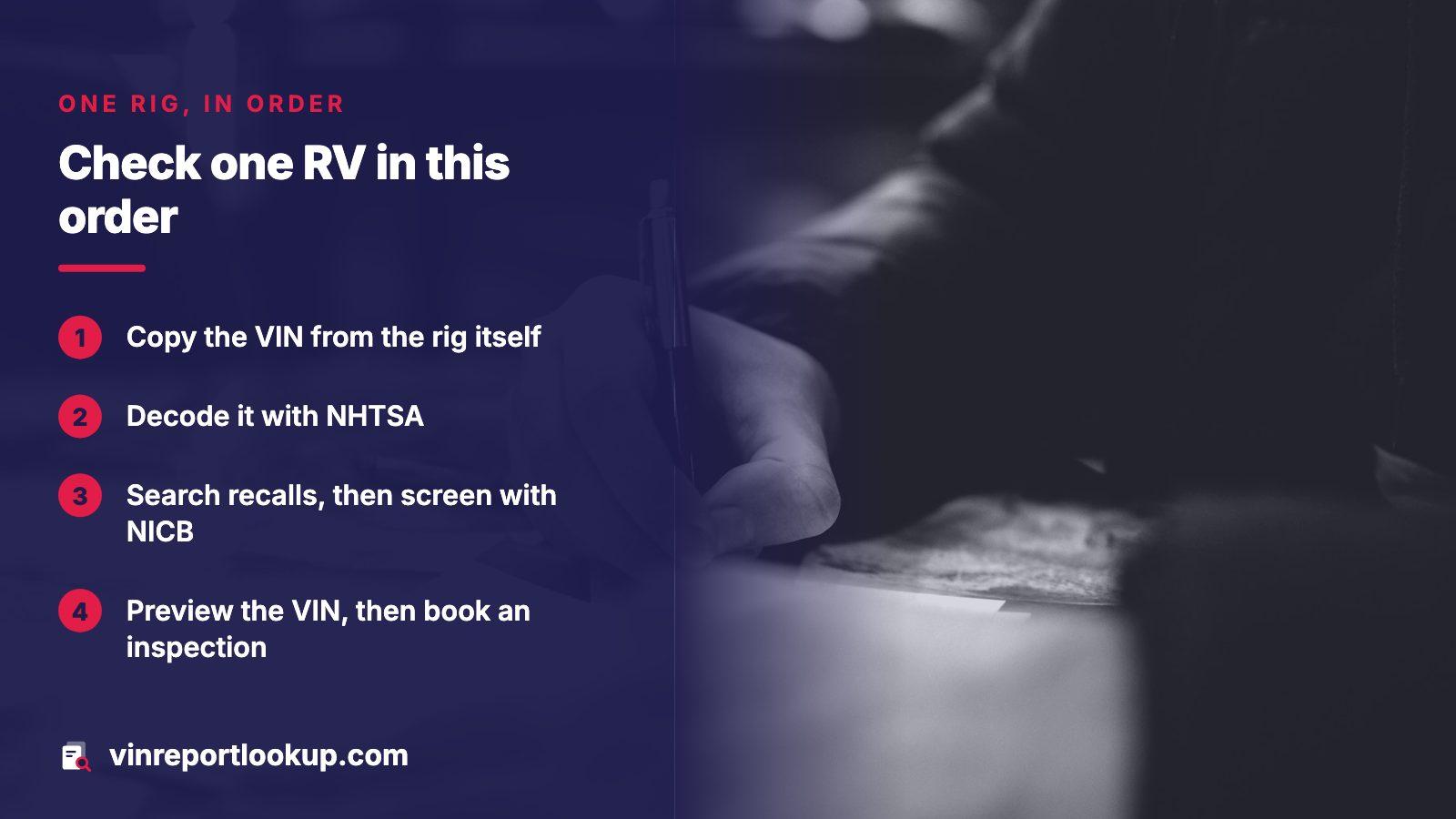
Your next step: one rig, in this order
- Copy the VIN from the rig itself, never the listing, and compare it with the title or bill of sale.
- Decode it with NHTSA, remembering that a motorhome decode describes the chassis.
- Search recalls by VIN, then ask the coach builder as well.
- Screen it with NICB's VINCheck, within its five-a-day limit.
- Enter the VIN in the VINReportLookup preview. If it points to records worth reading, buy one report for that rig.
- Book the independent inspection before any deposit becomes hard to recover.
If the preview shows little on a trailer, read that as thin coverage, not a clean record. The refund policy explains what happens when a VIN returns nothing, and the pricing page lists current amounts.
Where this information comes from
- NHTSA: check for recalls — what a VIN recall search shows and leaves out, and the 100-VIN batch search
- NHTSA: vPIC decoder API — the decoder behind the motorhome and trailer test decodes, and its partial-VIN and model-year rules
- NICB: VINCheck — insurer theft, salvage and flood records, the daily search limit and what a clean result means
- NMVTIS: frequently asked questions — which vehicle types are listed, what a federal title report lacks, and the fee-for-service model
- NMVTIS: approved data providers — the count of approved providers and who sells to consumers
- NHTSA owner complaint 11697635 — owner experience, paraphrased
- NHTSA owner complaint 11416443 — owner experience, paraphrased
Sources and photos: Facts checked against the sources above in November 2026. Photos by Alexander Lunyov, Owen Michael Grech and Michal Biernat on Unsplash; diagrams by VINReportLookup.
Keep reading
- Best VIN check: how to choose a report and what each one includesHow the free and paid checks stack up on an ordinary car or truck.
- Vehicle history report providers: who sells VIN reports and how they differWho sells history reports and how the options differ.
- Sample reportSee a completed report section by section before paying for one.
- Vehicle history report cost: what each kind charges and coversWhat drives report prices and what to look for on the payment page.
Frequently asked questions
Is there a free RV VIN check?
In part. NHTSA's decoder and VIN recall search cost nothing, and so does NICB's VINCheck, which screens insurer theft, salvage and flood records. None of them is a title history. VINReportLookup adds a free preview of your VIN; the full report is bought separately, once.
Does a VIN check cover travel trailers as well as motorhomes?
The Justice Department's FAQ lists recreational vehicles and motor homes among the vehicles in the federal title system but does not name trailers. NHTSA's decoder does recognize a travel trailer's VIN. Because coverage is what differs between providers and rigs, preview the VIN before paying.
Why does my motorhome VIN decode to a chassis maker?
Because a motorhome is built in stages and the decoder reports the stage the VIN belongs to. NHTSA also warns that an incomplete-vehicle result may not describe the vehicle as it stands now, so confirm the coach side with the builder and the seller's paperwork.
Can I trust one clean result when buying an RV?
No single clean result settles it. NICB says a clean VINCheck is no guarantee, and neither it nor a federal title record shows repair history or leaks. Combine the report with a recall search, a title in the seller's name and an independent inspection.
How many rigs can I run through the free lookups in a day?
NHTSA's recall page accepts a batch of up to 100 VINs, while NICB caps searches at five a day per IP address, so a long shortlist fits the first and strains the second. On the paid side, VINReportLookup sells single reports and bundles of 3, 5 and 10.
Now check the car itself
The guide explains what to look for. The report shows what this VIN has on record.