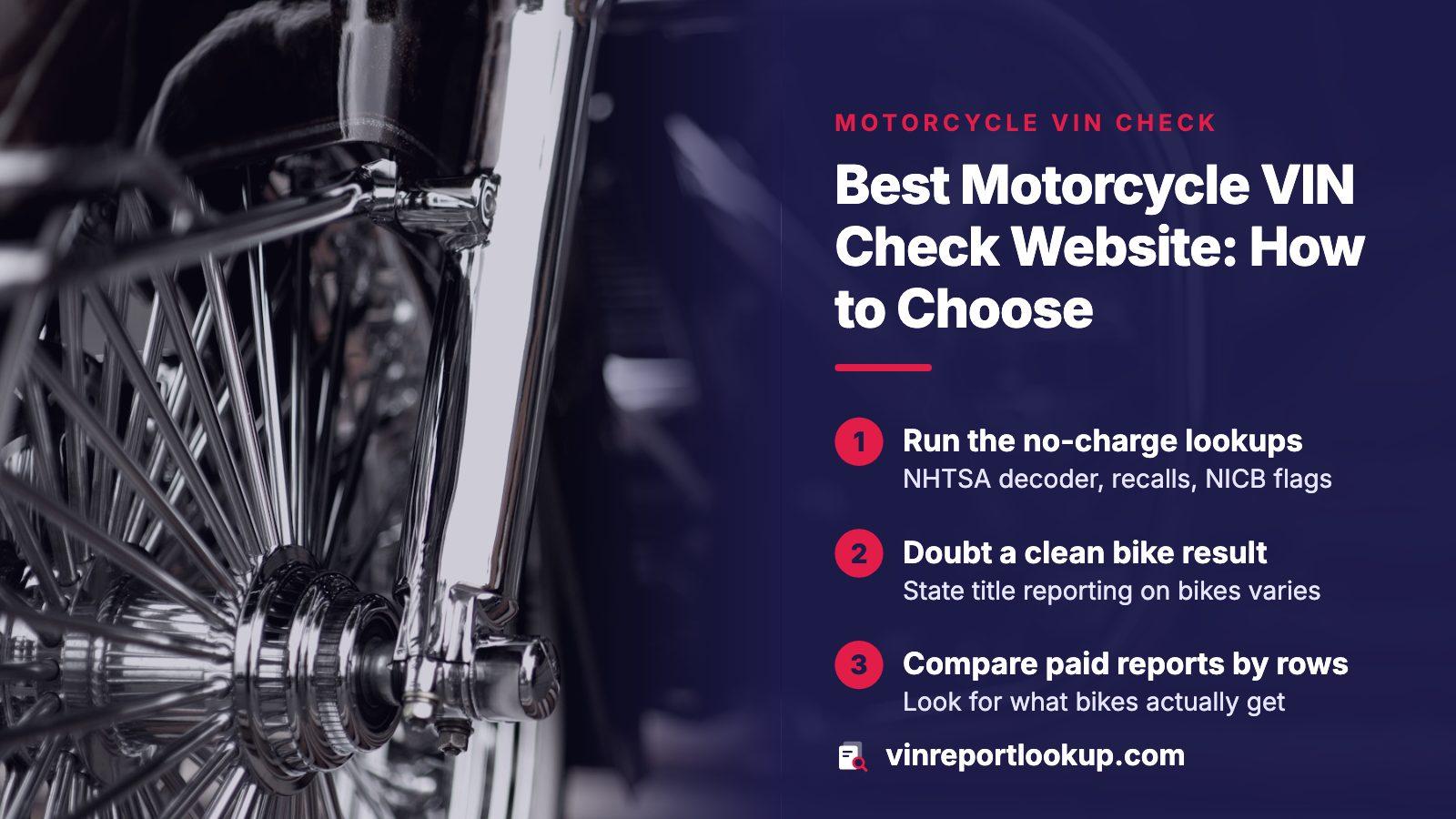
THE SHORT ANSWER
Start with what costs nothing: NHTSA's decoder and recall data, plus the NICB lookup for theft, salvage and flood flags. Then compare paid options by what they hold on motorcycles, since state title reporting on bikes is patchier than on cars. Look for title brands, write-offs, odometer readings, theft and lien entries and open recalls. Preview your VIN first and still book an inspection.
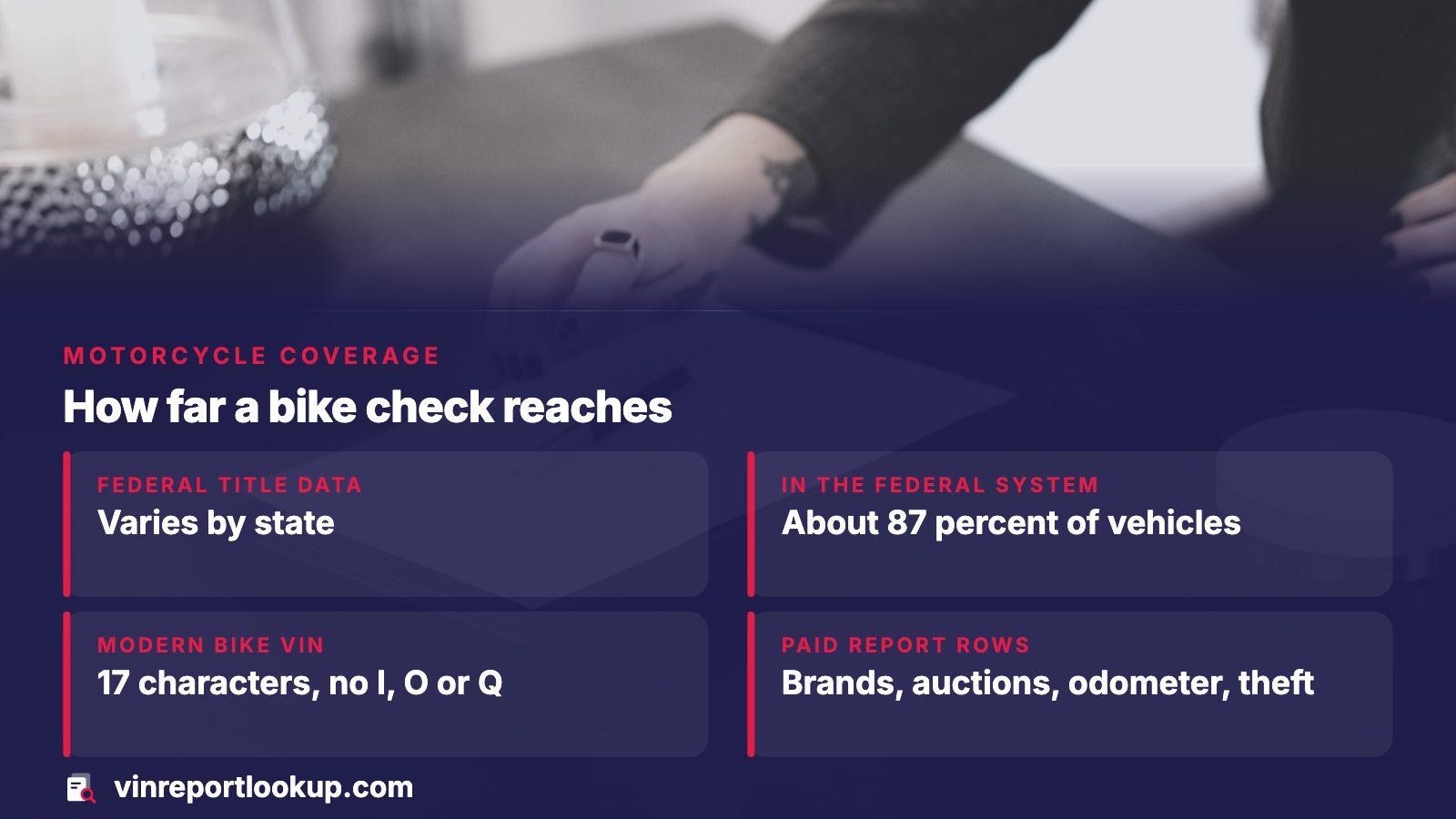
- Federal title data on bikes
- Varies by state
- Vehicles in the federal system
- About 87 percent
- Modern motorcycle VIN
- 17 characters, no I, O or Q
- VINReportLookup
- Free preview, one payment, no subscription
Three layers of motorcycle check, and what each one settles
Sites that claim the top spot blur several products into one. Sort them into layers, and each answers a different question about the bike in front of you.
| Layer | What it can tell you about a bike | Where it stops |
|---|---|---|
| NHTSA decode and recall data | Make, model year and engine as the maker filed them, plus recall campaigns | Silent on the bike's history |
| NICB VINCheck | Flags for flood damage, theft without recovery, or salvage | Not a title record: no brands, no mileage trail |
| Federal title record from an approved provider | Title brands, the most recent mileage entry, insurer write-offs and salvage-yard transfers | Thin where a state skips bikes; no repair history |
| Full history report | Title data plus accident, damage, auction, lien and insurance entries the company collects | Contents and bike coverage vary by company |
The top two layers cost nothing, and no paid report holds a better copy of them. Money buys the bottom two.
Why a clean result on a bike deserves less trust than on a car
The Justice Department words motorcycle coverage two ways. Its FAQ names motorcycles among the vehicles in the federal title system. Its consumer page is more guarded: the reporting mandate covers ordinary automobiles, and bikes show up only where a state adds them, so coverage differs.
That is why a spotless result weighs less on a bike. By the page's own estimate the database holds 87 percent of the country's vehicles, over half the states contribute data, and a clean answer may only mean nothing was reported. Because each state writes its own brand rules, the same wreck can be labeled in one state and unlabeled in the next.
The rows in a paid report that change what you offer
Judge a site by the rows it fills, not by its homepage. On a motorcycle, these entries move the price or end the deal:
- Title brands and total-loss records: a salvage, rebuilt or flood label, or an insurer write-off the seller never mentioned.
- Salvage and auction entries with photos, showing the damage behind a brand.
- Odometer readings with dates, to test the seller's mileage claim.
- Theft and lien entries, either of which can stop a sale from clearing.
- Open recalls, meaning repairs still owed on that bike.
Ask any site for a sample first. VINReportLookup has a sample report page and a free preview of your own VIN, which identifies the bike, shows photos when on file, and tells you how many recalls are open and whether title and auction records exist.
How report prices work, and what to compare at checkout
At checkout compare three things: whether the charge repeats, how many reports the price buys, and what happens if the VIN returns nothing. VINReportLookup charges once per report, plus packs of 3, 5 and 10 for comparing bikes. There is no subscription, and amounts live on the pricing page instead.
Prices drift, so this page prints none. The Justice Department's own pages quote two different fee figures for the federal title record, one dated May 2020. Trust the total at checkout over any old comparison.
If the VIN returns nothing
Thin records are common on motorcycles, so read the refund terms before paying anyone. The VINReportLookup refund policy covers a report that does not match your VIN and a VIN the site holds no data on.
Where Carfax and AutoCheck sit on the federal list
On its consumer site the Justice Department lists the companies it has approved to supply title data. Twelve sell to the public as well as to businesses. Six sell to businesses alone, among them Carfax, whose entry limits the data to business customers in California, and Experian, which the page ties to AutoCheck.
The page adds a warning that private buyers cannot get NMVTIS reports through Carfax or Experian, since dealers are their customers. That says nothing about their own reports: the FTC says AutoCheck and Carfax can include accident and repair entries, and it endorses no service.
Neither page says whether either company covers a particular motorcycle, so ask before paying. The approved list is alphabetical and signals no favorite; clicking a name leaves the government site.
Running the check on one bike, cheapest step first
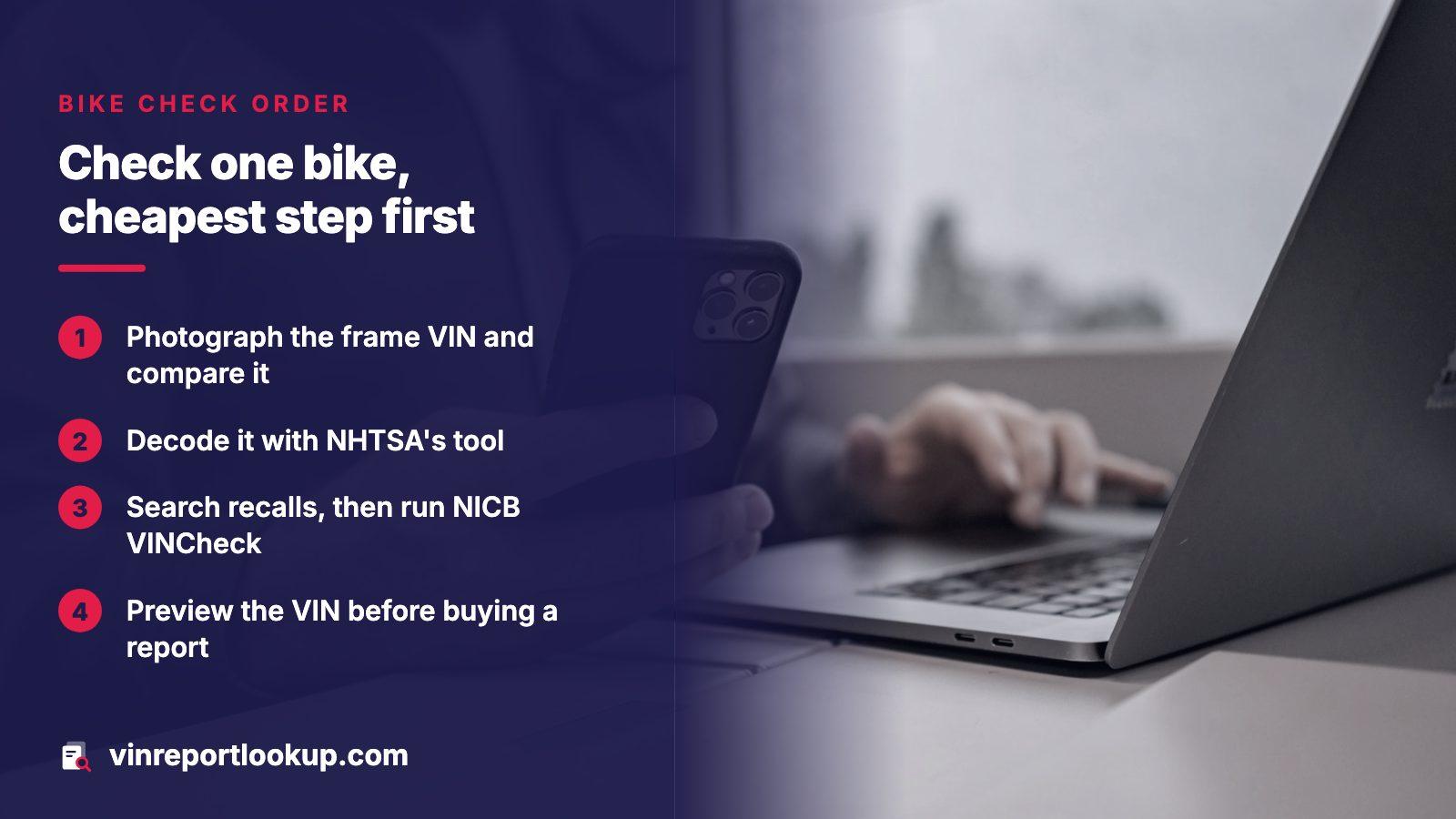
- Photograph the VIN on the frame and compare every character against the title. A modern VIN runs to seventeen characters, puts its check digit ninth and skips the letters I, O and Q.
- Decode it with NHTSA's tool and hold the answer against the ad. A motorcycle's descriptor block must reveal the maker, bike type, model line, engine and horsepower, so a decode that contradicts the listing earns a question.
- Search recalls by make, model and year, then have a dealer confirm them against the VIN.
- Run NICB's VINCheck for theft, salvage and flood flags.
- Preview the VIN here, and buy the report only for a bike you would still want after a test ride.
Why the VIN beats the model year: one Street Glide, five campaigns
NHTSA's recall data for the 2014 Harley-Davidson FLHX returns five campaigns, covering clutch parts, a brake line and one more equipment item. Several reach only bikes built inside a date window. The ABS brake-line campaign covers touring models built from July 1, 2013, through May 7, 2014, and one clutch campaign covers bikes built between May 3 and October 14, 2013.
A model year label can hide two bikes on opposite sides of a campaign. An ad that says only 2014 Street Glide cannot tell you which side yours is on; the VIN and build date can. The recall tally in the VINReportLookup preview is meant for this question, and a dealer's confirmation settles it.
Where the report ends and the test ride begins
Reports log title events, losses and recalls, not how a bike shifts, brakes or sounds. The Justice Department's FAQ names repair history as data its title system lacks, and the FTC recommends an independent inspection for hidden damage, since no history report stands in for one.
From an NHTSA owner complaint
Within two weeks of buying a used 2008 Honda Gold Wing showing 23,000 miles, an owner was doing 80 mph on the interstate when the gearbox began clanking and fifth gear stopped working. A powersports shop took the engine apart, found faulty shift forks and ordered over $1000 in parts. The owner noted how dangerous it could have been in heavy traffic.
A fault like that rarely shows up in a title or loss record, so the inspection follows the report instead of replacing it. Let the report rule out bikes on paperwork, then spend what you saved on a mechanic's look at the survivor.
Your next step: preview the VIN, then decide
Run the VIN of the bike you are seriously considering through the decoder, the recall search and the NICB screen, then enter it in the VINReportLookup preview. If it shows title records, auction entries or open recalls, the full report is worth its single payment.
If the preview shows little, do not read that as a clean bill of health. Rely on the seller's title, a dealer's recall check and the inspection. A VIN with no data falls under the refund policy, and you have spent nothing so far.
Where this information comes from
- NMVTIS: for consumers — the indicators in a federal title report, the coverage limits and the false-negative warning
- NMVTIS: frequently asked questions — motorcycles listed among covered vehicles, what a report holds, and the dated fee range
- NMVTIS: approved data providers — who may sell title records to the public and who sells to businesses only
- FTC: used cars — history reports, inspections, open recalls and the NICB lookup
- eCFR: 49 CFR Part 565, VIN requirements — VIN length, check digit, letters and what a motorcycle VIN must encode
- NHTSA: recalls by vehicle, 2014 Harley-Davidson FLHX — campaigns limited to build-date windows
- NHTSA owner complaint 10282040 — owner experience, paraphrased
Sources and photos: Facts checked against the sources above in November 2026. Photos by Steve Smith, Anastasiia Nelen and Annika Wischnewsky on Unsplash; diagrams by VINReportLookup.
Keep reading
- Best VIN check: how to choose a report and what each one includesThe same comparison for cars and trucks, with the four tiers laid out.
- Carfax alternatives: what each VIN report option covers and costsHow the premium options compare and where each one fits.
- Vehicle history report cost: what each kind charges and coversWhy report prices move and how to read a checkout total.
- Sample reportA finished report, tab by tab, before you spend anything.
Frequently asked questions
Is there a free motorcycle VIN check?
In part. NHTSA's decoder and recall data cost nothing, and NICB's VINCheck screens for theft, salvage and flood flags, though none of that is a title history. VINReportLookup adds a free preview of your VIN. The full report is a separate purchase, made once.
Can I get a Carfax or AutoCheck report on a motorcycle?
The federal list shows Carfax limiting its title data to business customers in California, and Experian, tied to AutoCheck, is business-only too. The FTC says both can add accident and repair entries. Neither page mentions motorcycles, so ask each company whether your VIN is covered.
Do motorcycle VINs work like car VINs?
In structure, yes: seventeen characters on a modern bike, a check digit in ninth position, no I, O or Q. The difference sits in the middle, where a motorcycle VIN must reveal the bike type, engine and horsepower.
Why did my motorcycle VIN check come back empty?
Thin coverage is the usual cause: the Justice Department says states may not have reported a vehicle yet, and reporting on bikes varies. Recheck the VIN for typos, which the check digit exists to catch, then confirm the title with the state.
Is a clean motorcycle VIN check enough to buy the bike?
No. The Justice Department warns that a no-flag answer can be wrong, since the database holds an estimated 87 percent of vehicles and states label damage differently. Pair the report with a title in the seller's name, a recall lookup and a mechanic's inspection.
Now check the car itself
The guide explains what to look for. The report shows what this VIN has on record.