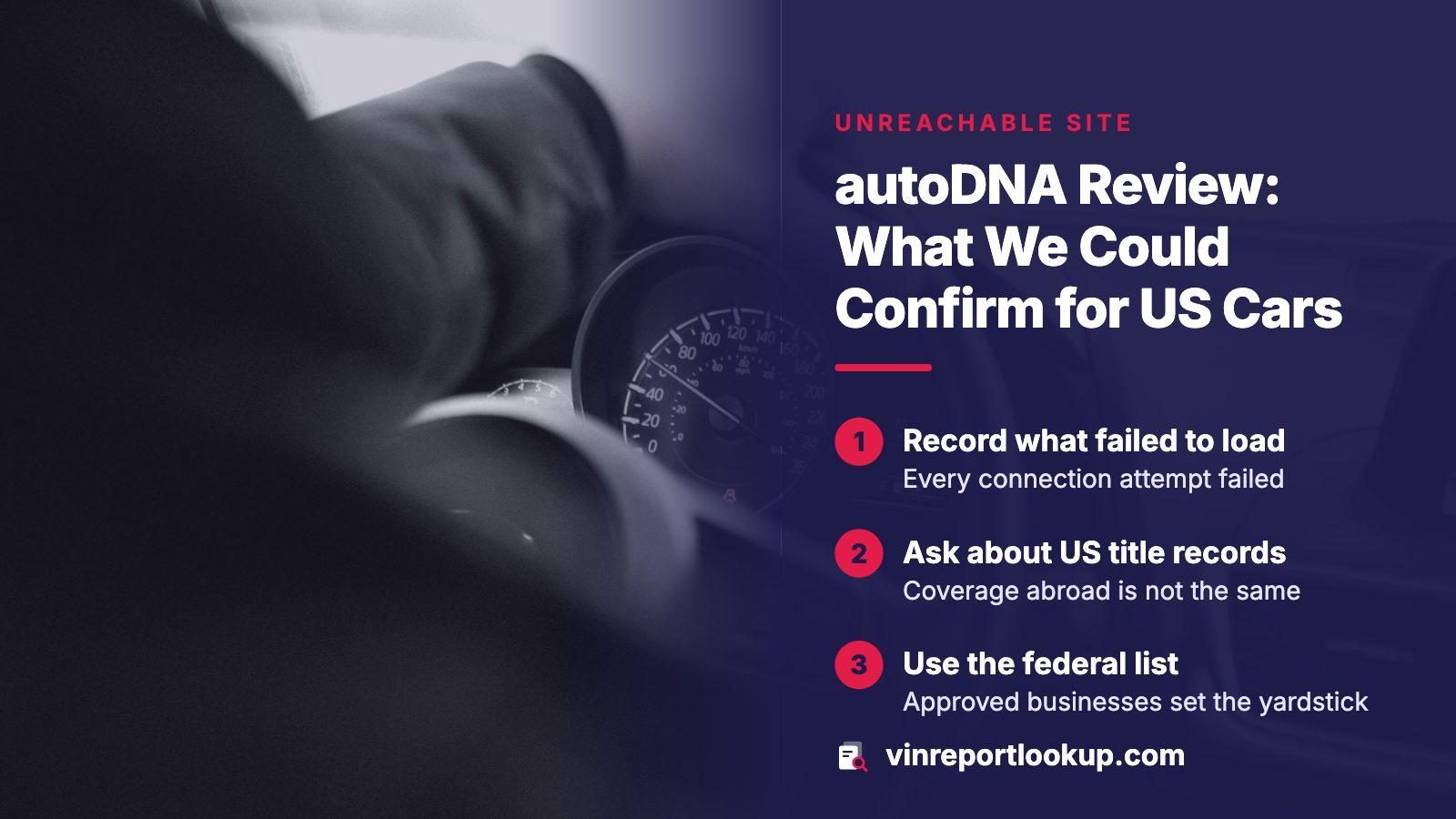
THE SHORT ANSWER
We could not load autoDNA's website with any tool we use, so we cannot tell you what it costs, which countries it covers or whether it holds US title records. Before buying any report, ask where the US data comes from, whether billing is one payment or a plan, and what the seller says about errors. A federal check and free recall lookups cost nothing to run first.
- autoDNA pages read
- None; every connection attempt failed
- Price and plan terms
- Not confirmed
- Federal title system
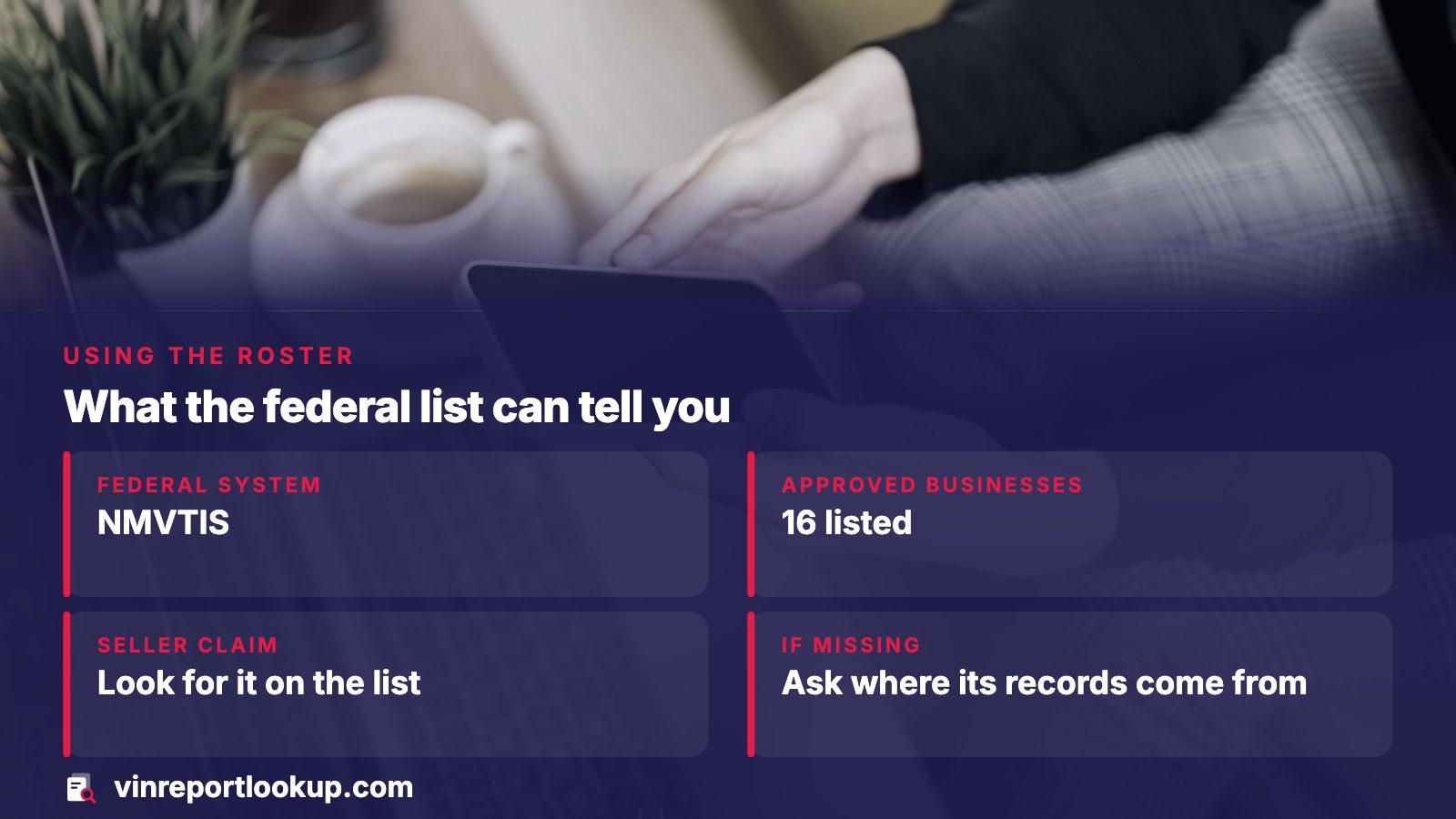
- NMVTIS, with 16 approved businesses listed
- Free first step
- NHTSA recall data by make, model and year
What we tried, and what came back
A review is only worth reading if the writer opened the thing being reviewed. We tried autoDNA's main address, the www version, and its Polish and US-labelled addresses. We used a plain fetch tool, plain command-line requests and a browser pane. Each one was refused or failed to connect, and we did not try to get around that with mirrors or cached copies.
What that means for this page
Nothing below describes autoDNA's price, report layout, data sources, refund terms or countries. If another site gives you those details, check them on autoDNA's own pages at the time you buy, because we cannot vouch for them.
We would rather publish a short, honest page than fill the gap with guesses. A buyer deciding on a used truck this weekend gets more from a checklist that works for every seller than from a rumour about one.
The question a US buyer should ask first
Vehicle history is local. A car sold new in Ohio, retitled in Texas and auctioned after a flood leaves records in American state systems and American insurer files. A report seller that built its name on another continent may be excellent there and thin here, or the reverse. The seller's own site should say which records it holds for the United States.
So ask it plainly: for a car titled in a US state, which title, damage and odometer sources feed the report? A vague answer such as trusted databases tells you little. A named source, or a statement that it reads from the federal title system, tells you a lot more.
Using the federal title system as a yardstick
The federal government keeps one shared title database for the whole country, and the Justice Department runs a public site about it. Its stated aims are shielding buyers from title fraud and dangerous cars, and stopping stolen vehicles from re-entering the market. A business that feeds the database needs a reporting ID first, then has to submit the data it is required to.
The site's list of approved businesses names 16 of them. Twelve primary providers serve both the public and commercial customers, and six serve commercial customers only. Eight affiliated sites sit on the same page, and the list is alphabetical with no preference implied.
- If a seller says its US title data comes from NMVTIS, look for it on that official list.
- If it is not on the list, ask how it gets title and brand records instead.
- Treat the descriptions on the list as each vendor's own marketing; the page says what a consumer report holds is set out in a separate disclaimer document.
Five questions to put to any report seller
- Which US sources feed title brands, damage and odometer entries for my car?
- Is this one payment, or does it start a plan that renews on its own?
- What exactly does the free part show, and what sits behind the paywall?
- What do the terms say if the report misses a record that exists?
- Can I see a sample report for a vehicle like mine before paying?
Write the answers down, even if it is only a note on your phone. If the seller's site does not answer one of them in plain language, count that as an answer too. We apply the same five to any service we cover, including our own.
Reading a report seller's pitch like a skeptic
Sales pages lean on the same moves: a big number of sources scanned, a count of happy customers, a bold claim about how often a report catches a problem. None of it is checkable from the page. The signals that are checkable are boring ones, such as named data providers, a published refund rule and a sample you can open without an account.
| On the seller's page | How much weight it deserves |
|---|---|
| A named US data source | High, because you can verify it |
| A refund rule that matches the checkout screen | High, because it limits your downside |
| A sample report you can open | Medium, it shows layout, not accuracy |
| Counts of sources or customers | Low, no method is shown |
| Review badges and star ratings | Low, short and unspecific |
Free checks to run before you pay anyone
NHTSA publishes recall data through an open interface that answers by make, model and model year. Ask it about a 2008 Honda Accord and 9 campaigns come back, each with a campaign number, a report date, the component and a summary. That is a quick way to learn which open items to ask a dealer about.
NHTSA also runs a decoder for the 17-character VIN. It reads the characters against the information makers have filed on how they assign them, so a decode is only as accurate as those filings, and the agency gives no guarantee. Add the model year when you decode, and treat a mismatch with the seller's listing as a reason to ask questions.
What the free tools do not do
Recall data and a decode say nothing about title brands, accident damage or odometer rollbacks. Those come from title and insurer records, which is where a paid report earns its fee or does not.
Where a one-time US report fits
If your comparison comes down to a service you cannot verify against a plan you can read, the readable one usually wins. VINReportLookup shows a free preview for your VIN, then charges once for the full report. There is no subscription to cancel afterwards, and the price sits on the pricing page rather than in a pop-up.
That is not a claim that it beats autoDNA, which we could not examine. It is a claim about what you can check today: the terms, the preview and the sample are all open before you pay.
What to do next
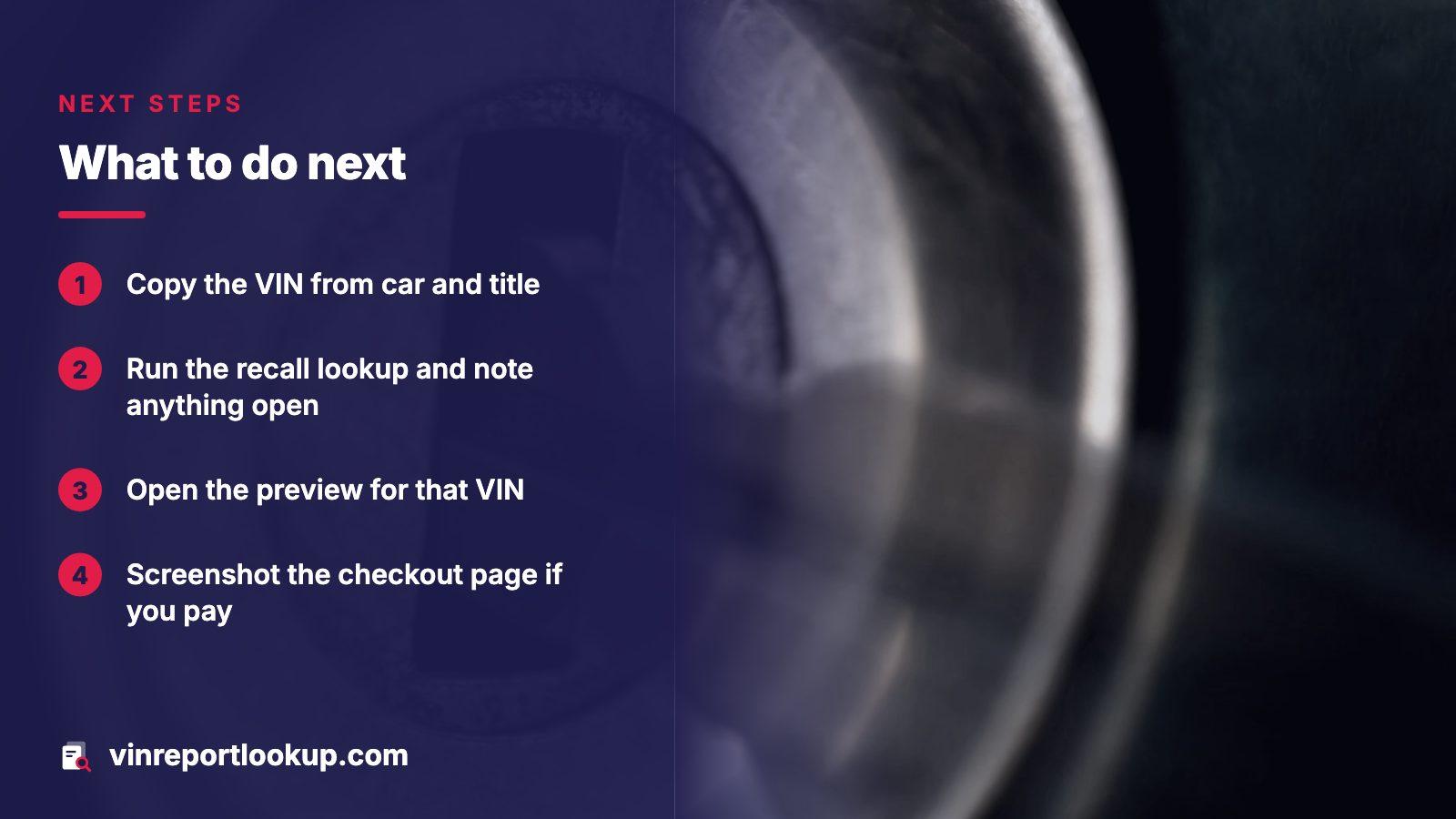
- Copy the VIN from the car and from the title, and confirm the two match.
- Run the free recall lookup and note anything open.
- Open the preview for that VIN and see what the seller says it will show.
- If you pay for any report, screenshot the checkout page so you have the terms as shown.
Then compare the report against what the seller told you and what the car shows in person. A history report narrows your questions; it does not replace a mechanic's inspection.
Where this information comes from
- Bureau of Justice Assistance: NMVTIS vehicle history site — the federal title system's stated purpose and reporting-entity requirements
- Bureau of Justice Assistance: Research Vehicle History — the list of approved businesses and its caveats
- NHTSA: vPIC VIN decoding API — how decoding works and where its data comes from
- NHTSA: recalls by vehicle API — the free recall lookup by make, model and year
Sources and photos: Facts checked against the sources above in November 2026. Photos by Miles Loewen, Derek Nelson and Jakub Żerdzicki on Unsplash; diagrams by VINReportLookup.
Keep reading
- Vehicle history report providers: who sells VIN reports and how they differThe wider field of report sellers and how they differ.
- CarJudge review: what its own pages show, what they leave out, and the alternativeAnother overseas-based seller, read from its own pages.
- Car history report subscription: when a plan pays and when to skip itHow renewing plans compare with paying once.
- Sample reportSee a report layout before you pay.
Frequently asked questions
Is autoDNA legit?
We cannot say. Its website would not open for us, and we do not rely on review sites, so we have no sourced basis for a verdict either way. Check its own pages for named US data sources, billing terms and a refund rule before paying, and pay by credit card so you can dispute a charge.
How much does an autoDNA report cost?
We do not know. We could not read its pricing page, and a figure from a third-party site may be out of date or in another currency. Look at the checkout screen, confirm whether it is a single payment or a plan, and screenshot it.
Does autoDNA cover US vehicles?
That is the key question, and we could not confirm it. Ask the seller which US title, damage and odometer sources it uses. A good answer names them. The federal title system lists approved providers on a public page you can compare against.
What is a safer way to compare report services?
Use the same questions for each: US data source, one payment or a plan, what the free part shows, what happens if a record is missed, and whether a sample exists. Prefer the seller whose answers you can verify on its own pages.
Can I check a car for free before buying a report?
Yes, in part. NHTSA's recall data and VIN decoder cost nothing and tell you about open recalls and what the VIN says the car is. They do not show title brands, accident damage or odometer history, which is what a paid report is for.
Now check the car itself
The guide explains what to look for. The report shows what this VIN has on record.