THE SHORT ANSWER
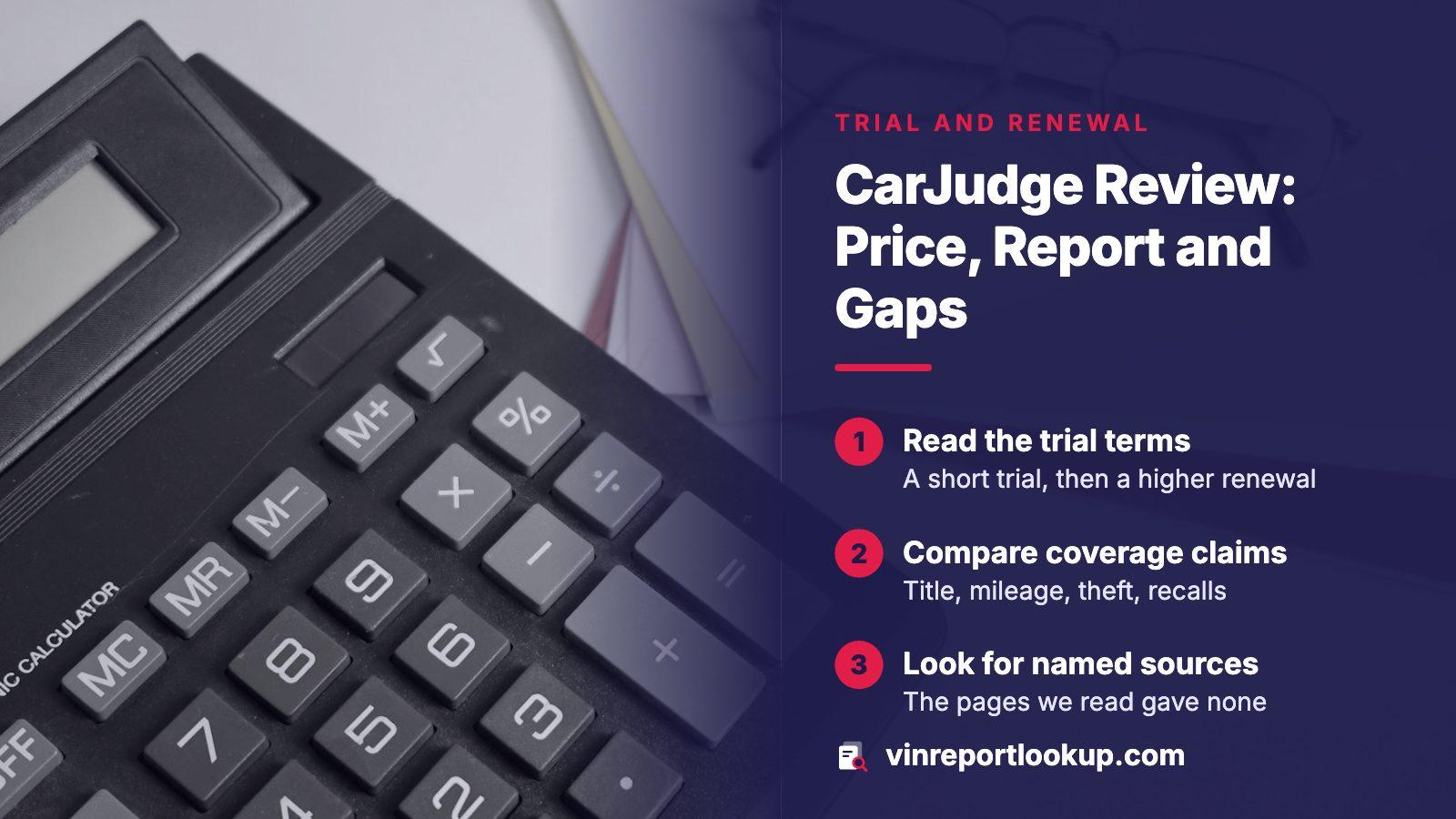
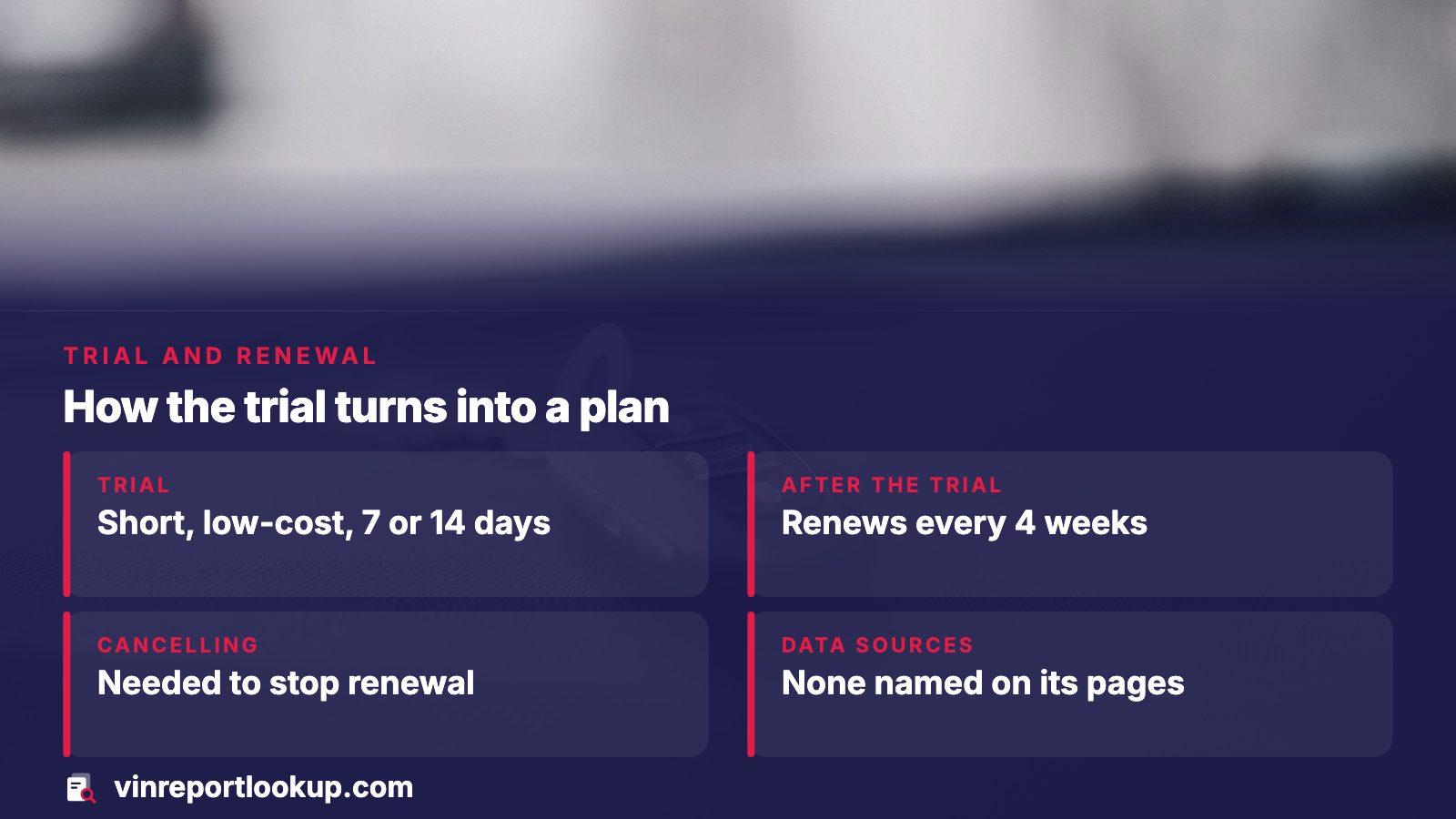
CarJudge opens with a low-cost trial of 7 or 14 days, then renews every 4 weeks at a higher amount unless you cancel. Its report covers title status, mileage, theft, recalls and market value, but its pages do not name the databases behind US records, and its terms disclaim accuracy. Judge it on the plan, not the slogans.
- Trial plans
- 7 days for EUR 2.90 or 14 days for EUR 5.99
- After the trial
- EUR 29.95 every 4 weeks, 4 reports
- Data sources named
- None on the pages we read
- Accuracy promise
- Terms say completeness is not guaranteed
What CarJudge is, going by its own site
CarJudge is run by Atrium Vision Sarl of Lausanne, Switzerland, according to the footer of its pricing page. The home page pitches a fast check: enter a VIN, or a plate in supported countries, and get a report in about a minute, opening with a one-line verdict and eight colour-coded categories.
Notice the audience. The site talks about a scan of 800 sources, theft checks across 23 countries and cover in more than 30 countries. That is a European-first pitch. A US buyer should ask how much of that reach applies to an American car with an American title history, and the pages we read do not answer that.
What we did and did not do
We read the home page, pricing page, terms and sample report without creating an account. We did not buy a report, so nothing here describes how a paid US report actually turns out.
How the trial and renewal work
The plan structure matters more than the headline figure. The terms list two trials: a 7-day trial for EUR 2.90 with 2 reports, and a 14-day trial for EUR 5.99 with 5 reports. Both renew on their own into a plan of EUR 29.95 every 4 weeks, which gives 4 new reports each cycle. Unused reports do not carry over.
| Item | What the terms say |
|---|---|
| 7-day trial | EUR 2.90, 2 reports |
| 14-day trial | EUR 5.99, 5 reports |
| Renewal | EUR 29.95 every 4 weeks, 4 reports |
| Extra single report | EUR 19.99, needs an active subscription |
| Extra 4-report package | EUR 39.99, needs an active subscription |
The pricing page adds that billing happens in your local currency based on where you live, so a US card may see a different figure than the euro amounts we read. We could not confirm the dollar equivalent.
What the report is meant to cover
The home page lists chapters rather than a data dictionary: title status with salvage, flood, buy-back and rebuilt brands, accidents and damage, odometer history, recalls, theft, emissions zones, market value and a European crash-test rating. The emissions and crash-test items lean toward European buyers.
The sample report walks through a 2012 BMW 535i that scores badly (Unfavorable). It shows a theft flag, a rollback flag, a salvage title and an open recall, plus a mileage table that lists a Maryland DMV title entry beside service shop readings. That is useful as a picture of layout, though one hand-picked sample says little about a typical car.
- Title and brand status
- Odometer readings listed by source and date
- Theft checks across several countries
- Recall status
- A market value range
- Specs and a safety rating
The question the pages do not answer
A history report stands or falls on where its records originate. On the US side, title records flow through NMVTIS, a Justice Department database built so buyers are not caught by title fraud or unsafe cars. Its consumer site is where you can look up which companies are approved to sell that data.
CarJudge's terms refer to trusted data sources and the home page says availability depends on the car's history, but neither names a US supplier. We found no statement that its US title data comes from NMVTIS. That is a gap, not proof of a problem, and you can close it by asking support before paying.
Ask this before you pay
Write to the contact address on the site and ask which sources feed US title and accident records. A seller of a record-based product should be able to answer in one line.
What the terms say about accuracy
The terms state that the service strives for accuracy but does not guarantee that data is complete or correct. They also put full responsibility for any decision on the buyer, describe the reports as informational, say a report should not be the sole basis for a purchase, and limit liability for losses. The sample report repeats that its summary is automatic and may be incomplete.
None of this is unusual, since every provider hedges. It does mean the one-line verdict and the percentage score are a convenience, not a finding. A buyer who treats a green verdict as clearance is using it the wrong way.
The home page also claims a quarter of reports expose a defect the seller left out. No method is shown, so we treat it as a marketing line. The site links 4,256 reviews on a third-party platform, and the excerpts we saw were short and general, so we did not count them as evidence about accuracy.
What to know about leaving
Cancellation runs through account settings or by email to support, and access continues to the end of the paid period. The terms rule out prorated refunds mid-cycle, and the 14-day refund promise on the pricing page sits next to a withdrawal rule in the terms that only applies if no report was opened. Those two statements do not read identically.
We cover the steps, the card dispute route and the timing in a separate guide to cancelling. The short version: set a reminder before the trial ends, and keep your confirmation email.
Who a subscription suits, and who it does not
A plan of 4 reports per cycle makes sense for someone comparing many cars across a few weeks, or a buyer importing from Europe where the cross-border pitch matters. For a person checking one or two American cars, a recurring charge is extra work, because you have to remember to stop it.
- Comparing many listings in a month: a plan with several reports can fit
- Buying one car: a single payment avoids the cancellation step
- Buying an import: ask about coverage for that country first
- Buying from a US seller: ask where US records come from

Running a one-time report instead
This site runs the other way round. You enter the VIN, see a free preview of what was matched, and pay once for the full report if you want it. There is no recurring plan to cancel. Current packs for one, 3, 5 or 10 reports are listed on the pricing page.
That structure does not make our report better by itself, and you should judge it by the same test: what records it shows, where they come from, and whether the preview matches your car. If you want to see how a report is laid out first, the sample report is the quickest way.
Verdict
CarJudge may suit a buyer who wants many reports in a short window and is comfortable with a plan that renews. The weak points for a US purchase are the unnamed data sources, the euro-based pricing we saw, the broad accuracy disclaimers and the recurring charge. Before buying any report, compare the plan terms and pull your own recall list from NHTSA, which is free.
Where this information comes from
- CarJudge: terms and conditions — trial and renewal amounts, accuracy disclaimers and refund limits
- CarJudge: pricing — plan lineup, local-currency billing and the 14-day refund line
- CarJudge: sample report — what the report layout and its disclaimer look like
- Justice Department: NMVTIS for consumers — the federal title system and its stated consumer purpose
Sources and photos: Facts checked against the sources above in November 2026. Photos by Cht Gsml, Iain and Bence Balla-Schottner on Unsplash; diagrams by VINReportLookup.
Keep reading
- How to cancel a CarJudge subscription before the 4-week renewalStep by step on stopping the renewal and disputing a charge.
- Car history report subscription: when a plan pays and when to skip itHow recurring report plans compare with paying once.
- Vehicle history report providers: who sells VIN reports and how they differThe wider field of report sellers and how they differ.
- Sample reportSee a report layout before you pay.
Frequently asked questions
How much does CarJudge cost?
Its pages list a 7-day trial for EUR 2.90 and a 14-day trial for EUR 5.99, both renewing at EUR 29.95 every 4 weeks. Extra reports cost more and need an active plan. The pricing page says billing follows your country of residence, so check the final amount at checkout.
Is CarJudge a subscription?
Yes. The trial renews automatically as a recurring plan unless you cancel, which the terms say you can do from account settings or by emailing support. Access then lasts until the paid period ends. Put the renewal date in your calendar when you sign up.
Does CarJudge use NMVTIS data?
We could not confirm it. The pages we read talk about trusted sources without naming any US supplier. To check, ask support which databases feed US title and accident records, or look at the federal NMVTIS consumer site for its list of approved providers.
Can I get a refund from CarJudge?
The pricing page promises a full refund within the first 14 days if you are not satisfied. The terms say no refund after a cycle starts, except the EU withdrawal right, which needs that no reports were opened. Ask support in writing before relying on it.
Is a CarJudge report enough before buying a car?
No single report is. Its own terms say not to use it as the sole basis for a purchase. Pair any history report with an NHTSA recall lookup, a pre-purchase inspection and the state title record for the car in front of you.
Now check the car itself
The guide explains what to look for. The report shows what this VIN has on record.