THE SHORT ANSWER
California's Bureau of Automotive Repair lets anyone look up a car's smog history by VIN or plate, with test dates, stations, results and mileage. Illinois, Arizona, Ohio and Oregon run programs of their own, and states without testing keep no log. A vehicle history report does not include emissions logs; it covers title, damage and mileage records. Pull the state record first, then use a report to confirm the odometer figures.
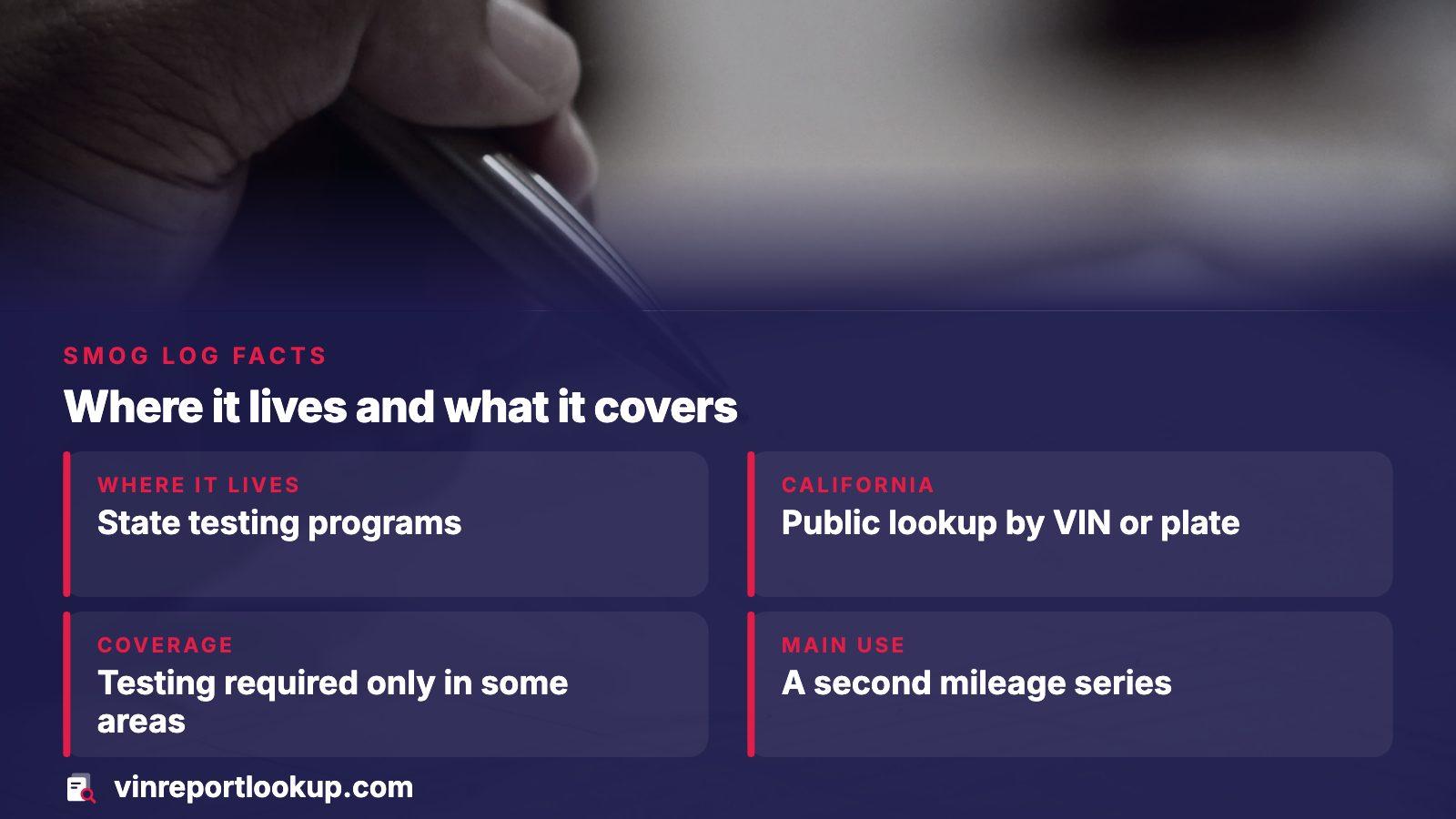
- Where it lives
- State testing programs, not commercial history reports
- California
- A public lookup by VIN or plate, with mileage at each test
- Coverage
- Testing is required in areas, so many cars have no log at all
- Best use
- A second mileage series to compare with a VIN report
Two kinds of record, kept in different places
Buyers often ask one history report to answer everything, then find that some facts never pass through it. Emissions tests are the clearest case. Their results belong to a state program, while a commercial report is built around other records. Before you spend anything, sort your questions by where the answers sit.
| Your question | Where the answer sits |
|---|---|
| Did it pass its emissions tests, and when? | The state program's lookup, where one is published |
| Do the logged mileage readings rise in order? | The smog log and the report's odometer readings, side by side |
| Is the title branded, or has it been through a salvage auction? | A vehicle history report |
| Is the registration current? | The state's own registration records |
Pulling the log in California
California is the easy case. The Bureau of Automotive Repair posts Smog Check results online for vehicles in its program, and a VIN or plate is enough to bring up the history: each test date, the station, the outcome and the odometer reading taken that day. No account is needed. Many cars sold in other states lived in California once, so run it whenever a used car's earlier life is vague.
- Read the VIN off the car and confirm it matches the listing and the registration card.
- Enter it, or the plate, on the Bureau's Smog Check history page.
- Copy out every date, station, result and mileage figure before you leave the page.
California also puts the burden on the seller, who is generally expected to hand over a current passing result. A log that shows trouble gives you grounds to ask for the repair first. Some vehicles are exempt, so confirm the rule for yours with the Bureau.
Other states: what to expect
Elsewhere the picture is patchy. Programs are tied to metro areas, and each one publishes what it chooses.
- Illinois: the Air Team program covers the Chicago area and publishes results and schedules.
- Arizona: the Department of Environmental Quality handles Phoenix and Tucson and shows records and test status.
- Ohio: E-Check runs in seven counties around Cleveland and Akron, and results can be verified through it.
- Oregon: DEQ tests in the Portland and Medford zones, where passing is tied to renewing registration.
None of this guarantees a portal will return a full history for a given VIN. Check the program page, and remember that the rules that count belong to the state where the car was registered, not the state where you are standing.
What to look for once you have the log
A single failed test tells you little. The order of events around it matters more, and the category stored on each record, whether initial test, first retest or later retest, is how you see that order. Without it, a fail followed by a quick pass would read as one clean pass.
- A fail, then a pass a few days later: a repair took place. Ask which parts were replaced and request the paperwork.
- A string of retests: the first fix did not take. Find out what finally worked.
- A listing posted right after a fail: the owner chose to sell rather than repair.
- A gross polluter flag: California's label for a car that failed by a wide margin, usually meaning long neglect of exhaust parts.
- Scores that barely clear the limit: where a portal shows scores as well as the verdict, a thin margin on an older car warns of the next fail.
Treat each item as a question with a date attached, not as proof of a defect.
Checking the smog mileage against a paid report
Every test record carries an odometer reading taken by someone with nothing to gain from the sale. That gives you a mileage series the seller did not write. A VIN history report supplies a second series, because it lists odometer readings alongside title brands and the damage record.
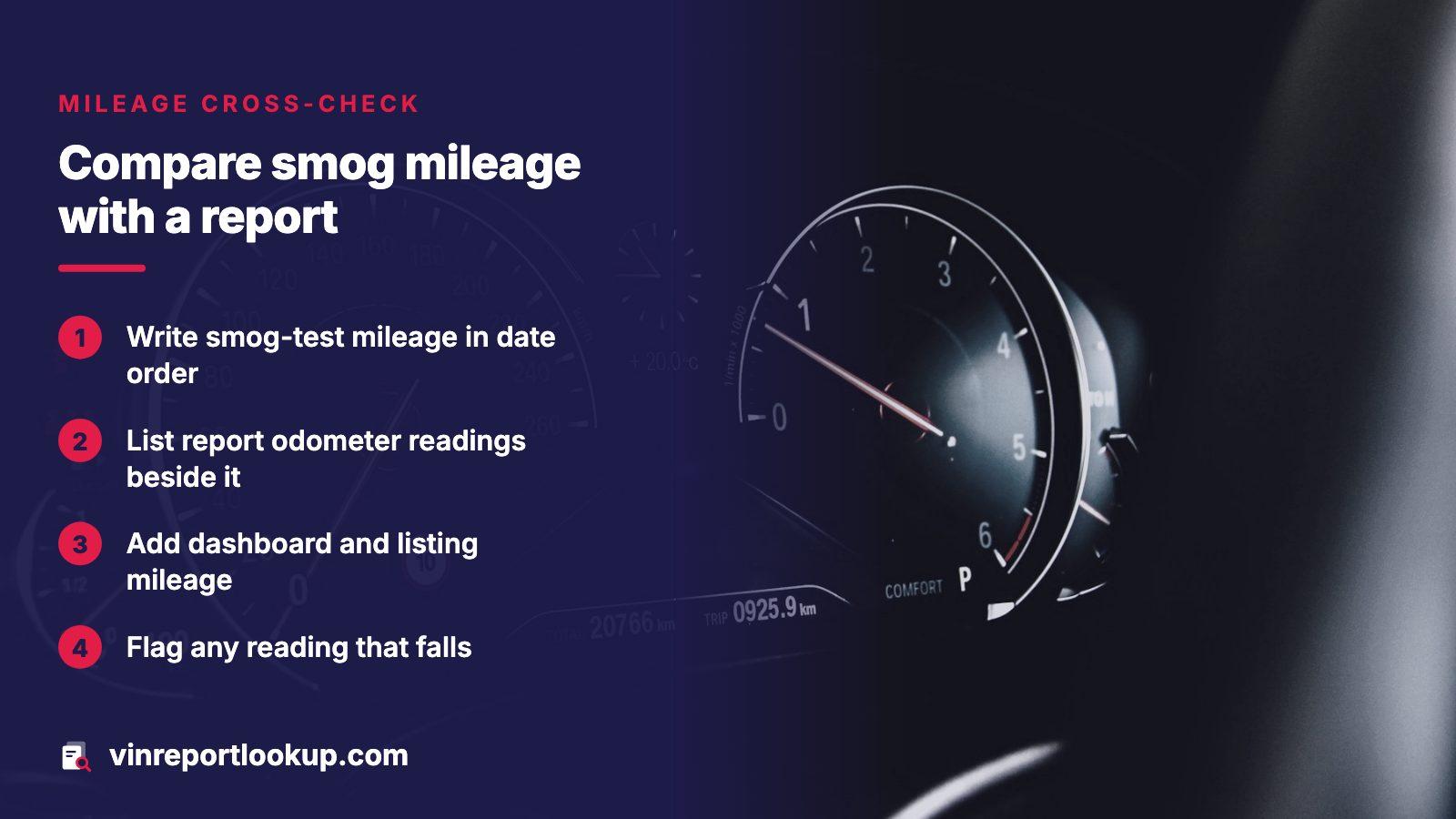
- Write the smog-test mileage in date order.
- Write the report's odometer readings in date order beside it.
- Add today's dashboard reading and the number in the listing.
- Flag any reading that falls below an earlier one, and any long stretch where the car seems to have hardly moved.
A lower reading later is the finding
Mileage that drops between dates fits a rolled-back odometer. Get the seller's explanation in writing, or move on to another car.
When the two series agree, two independent records fit the seller's story, which is worth more than either alone.
If the lookup finds nothing
An empty result usually reflects where the car lived. Testing is required in areas, not on vehicles: the federal rule picks places that miss air quality standards, judged by classification and population, and states can add more. A car earns a smog history by being registered in one of those places.
- No records ever: it was registered outside every testing area.
- Records that start midway: the car arrived in a program area, so the first entry dates its arrival.
- Records that stop: it relocated, grew too old for testing, or was retired.
- Fewer tests than years owned: some programs test every other year.
Registration is the other clue. In a testing state, renewal depends on a pass, so expired tags can mean a car that has not passed. Ask for a current passing result before you pay, rather than a promise to deal with it after the sale.
When a paid report is worth adding
Start with what costs nothing: the state lookup, then the preview of a VIN report, which is free and shows whether a full report holds anything you need. The state log answers the emissions question. A report answers a different set: title brands, damage and accident records, mileage readings, photos from salvage auctions, liens and impounds, theft records, insurance records, market value, factory specs, open recalls, and ownership and use type.
You pay once for a VINReportLookup report. Nothing renews, and packs of three, five or ten are available for buyers checking several cars; the pricing page has the details. Buy it when the smog log is clean enough to keep the car on your shortlist and you want the title, damage and mileage record before you pay the seller.
Where this information comes from
- GovInfo: 40 CFR 51.365, I/M program data collection — The federal list of what each emissions test record must hold, including the odometer reading, the test category and the OBD trouble codes.
- GovInfo: 40 CFR 51.350, where I/M programs are required — Explains why testing is tied to areas by air quality classification and population, which is why many cars have no log.
- California Bureau of Automotive Repair — The state agency behind the public Smog Check history lookup by VIN or plate.
- EPA: Vehicle emissions inspection and maintenance — Background on the federal framework that state testing programs follow.
- Illinois EPA: Vehicle emissions testing — The Chicago-area program, an example of a state page that publishes test information.
Sources and photos: Facts checked against the sources above in November 2026. Photos by Dain Lindo, Viktor Theo and Masjid MABA on Unsplash; diagrams by VINReportLookup.
Keep reading
- Sample reportSee the odometer and title sections you would compare against a smog log.
- Best VIN check: how to choose a report and what each one includesA comparison of VIN check options before you pick one.
- Vehicle history report cost: what each kind charges and coversWhy history reports are priced so differently and what each price buys.
- PricingOptions for one report or a pack, after the preview.
Frequently asked questions
Does looking up smog check history cost anything?
In California the state lookup carries no fee, and the VIN or plate is all you need. Other testing states publish what their program allows, and some only confirm status. A paid history report is a separate product built from title, damage and mileage records, so do not expect it to stand in for the state's emissions log.
Does a failed smog test mean I should walk away?
Not by itself. A fail followed by a pass days later usually means a repair, so ask what was replaced and request the invoice. Walk away when failures repeat across years, the seller cannot explain them, or the mileage readings on the test records run out of order. Put every question to the seller with a date and mileage attached.
Does a vehicle history report include smog results?
No. A report is built from title brands, accident and damage records, mileage readings, salvage and auction photos, liens, impounds, theft records, insurance records, recalls, market value, factory specs and ownership and use type. Emissions test logs are not part of it, so pull the state record separately and compare the mileage.
Why is there no smog record for the car I am buying?
Most often it was registered outside every testing area, since programs cover places rather than vehicles. It may also have aged out of testing. An empty result is still a clue about where the car has lived, and it means the rest of its history has to come from elsewhere.
What is a gross polluter flag?
It is California's label for a vehicle that failed with emissions far beyond the limits. Owners of flagged cars must repair them and may be sent to designated stations for follow-up testing. On a used car it points to long neglect of the converter, sensors or tune items, so price the repairs before you agree on a number.
Now check the car itself
The guide explains what to look for. The report shows what this VIN has on record.