THE SHORT ANSWER
Only GoodCar is open to a private buyer for the federal title record: the Justice Department lists it for public customers, while Carfax sits in a commercial group. Carfax's own pages refused to open for us, so we cannot state its price. GoodCar's chart puts one Carfax report at $44.99 and its own 7-day trial at $1.95, and its second page disagrees.
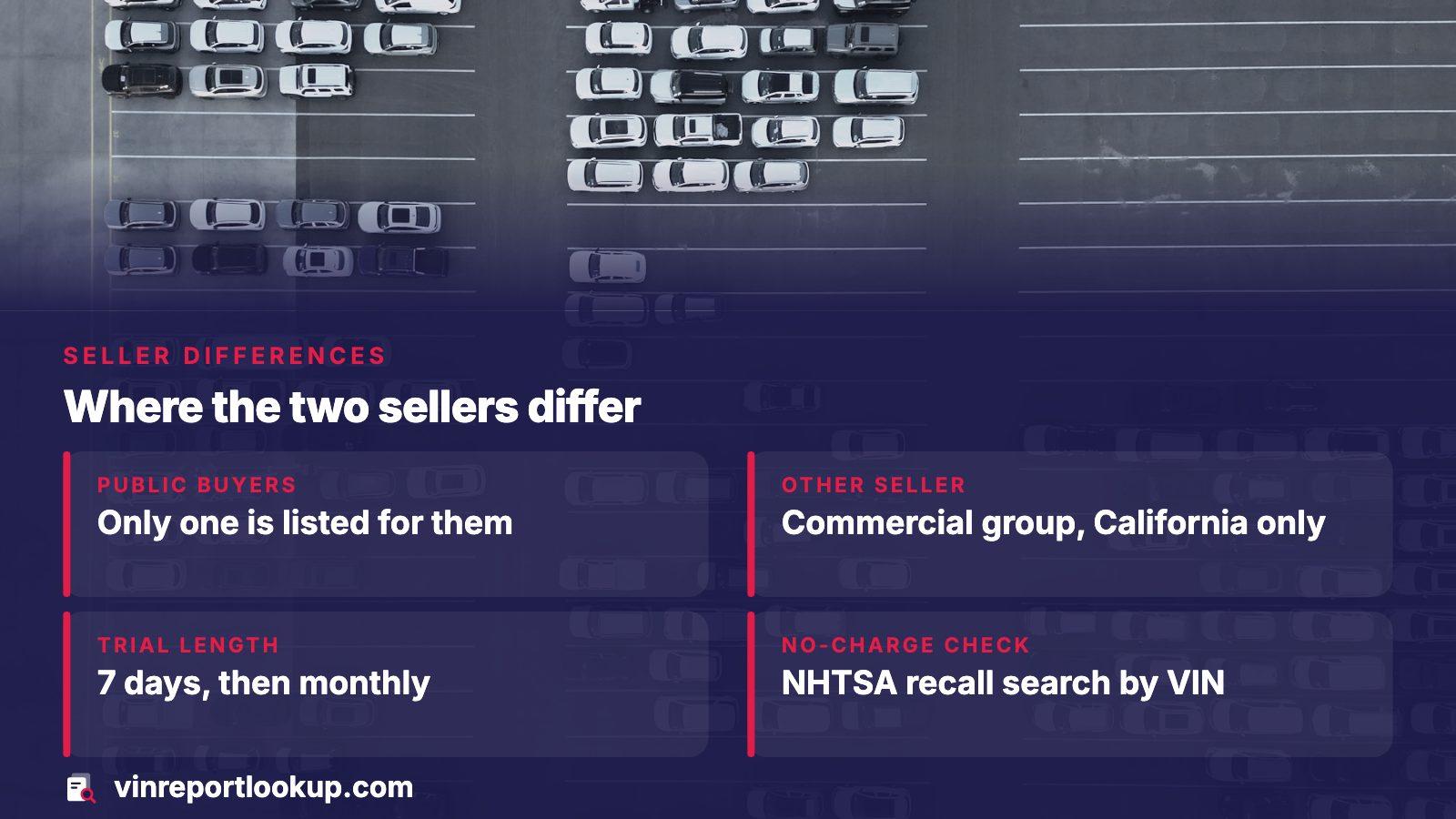
- Federal title record for the public
- GoodCar is listed; Carfax is commercial only, in California only
- GoodCar's stated plan
- 7-day trial, then $29.95 a month until canceled
- Carfax price we could confirm
- None; its site blocked our requests
- No-charge check
- NHTSA recall search by VIN
Two sellers, and not the same customer
Most pages that set these two names side by side treat them as interchangeable ways to get a history report. The Justice Department's public roster of NMVTIS data providers does not. GoodCar sits in its group for businesses and the public alike. Carfax is under a heading for commercial customers only, and the note beside it limits the NMVTIS feed to commercial buyers in California.
That does not make a Carfax report useless. It means the federal title record, the government-backed layer, is not something Carfax passes to a private buyer. The same roster page says a consumer can not obtain NMVTIS reports through Carfax, DMVDesk or Experian, since their customers are dealerships. Whatever else Carfax puts in a report, this part of the comparison is decided before price enters it.
What we could read on each side
Only one of the two companies let us read its pages. GoodCar's home page, FAQ, terms and VIN check page all opened. Carfax's site returned an access block on every attempt, so the right-hand column below is built from federal pages and from GoodCar's own claims, and it says so.
| Question | GoodCar | Carfax |
|---|---|---|
| Sells the federal title record to the public | Yes, per the Justice Department roster | No, commercial customers only |
| How you pay | Trial, subscription, or a one-time single report or package | Not confirmed, pages would not open |
| Price shown | $1.95 or $2.95 for a 7-day trial, then $29.95 a month | $44.99 or $44.95 for one report, but only as GoodCar's claim |
| Search by plate | Yes, VIN or plate | Not confirmed |
| Support | Phone, email and chat, all day and night | Not confirmed |
What GoodCar says its report covers
GoodCar's sample result is laid out as ten headings: recalls, sales history, crash test ratings, junk and salvage, problem checks, total loss, specifications, awards, title records and pricing. Its FAQ goes further and says reports include a complete accident history, odometer readings, theft reports and market values.
Read that against GoodCar's own terms. They state that the company does not create original reports, collects data from public sources, and does not guarantee that anything shown is accurate or complete. Several headings, such as crash test ratings and awards, describe a model line rather than the car in your driveway. Title records, total loss and salvage entries are the parts that belong to one VIN.
Sort the headings before you pay
Mark each tile as either about this exact car or about the model. Only the first group can change what you offer the seller.
The price comparison has two weak points
GoodCar's home page chart shows its 7-day unlimited trial at $1.95 beside $44.99 for a single Carfax report. Its VIN check page shows the trial at $2.95 beside $44.95. Same company, two pages, two sets of figures. That is a reason to treat any single number from either page as a snapshot rather than a quote.
The second weak point is that the Carfax figure comes from a competitor's marketing chart. We could not open a Carfax page to check it, so we will not repeat it as Carfax's price. The one ongoing price GoodCar's FAQ states outside a chart is the recurring one, $29.95 a month for unlimited lookups, after the trial, until you stop it.
- Trial price: differs between two GoodCar pages
- Monthly price after the trial: $29.95 on the FAQ
- Carfax single report: claimed by GoodCar, not read on a Carfax page
- Rates can change, and each renewal bills the then-current rate under the terms
How a GoodCar trial becomes a monthly charge
GoodCar's terms describe a paid trial as billed immediately. The subscription then begins on the Next Billing Date printed on your order confirmation and renews every thirty days. GoodCar promises a heads-up email no later than five days before each renewal, and whatever remains of a paid month is not refunded. The Federal Trade Commission's trial guidance agrees from the buyer's side: a trial that asks for a fee is not really free, and a cancel date belongs on your calendar.
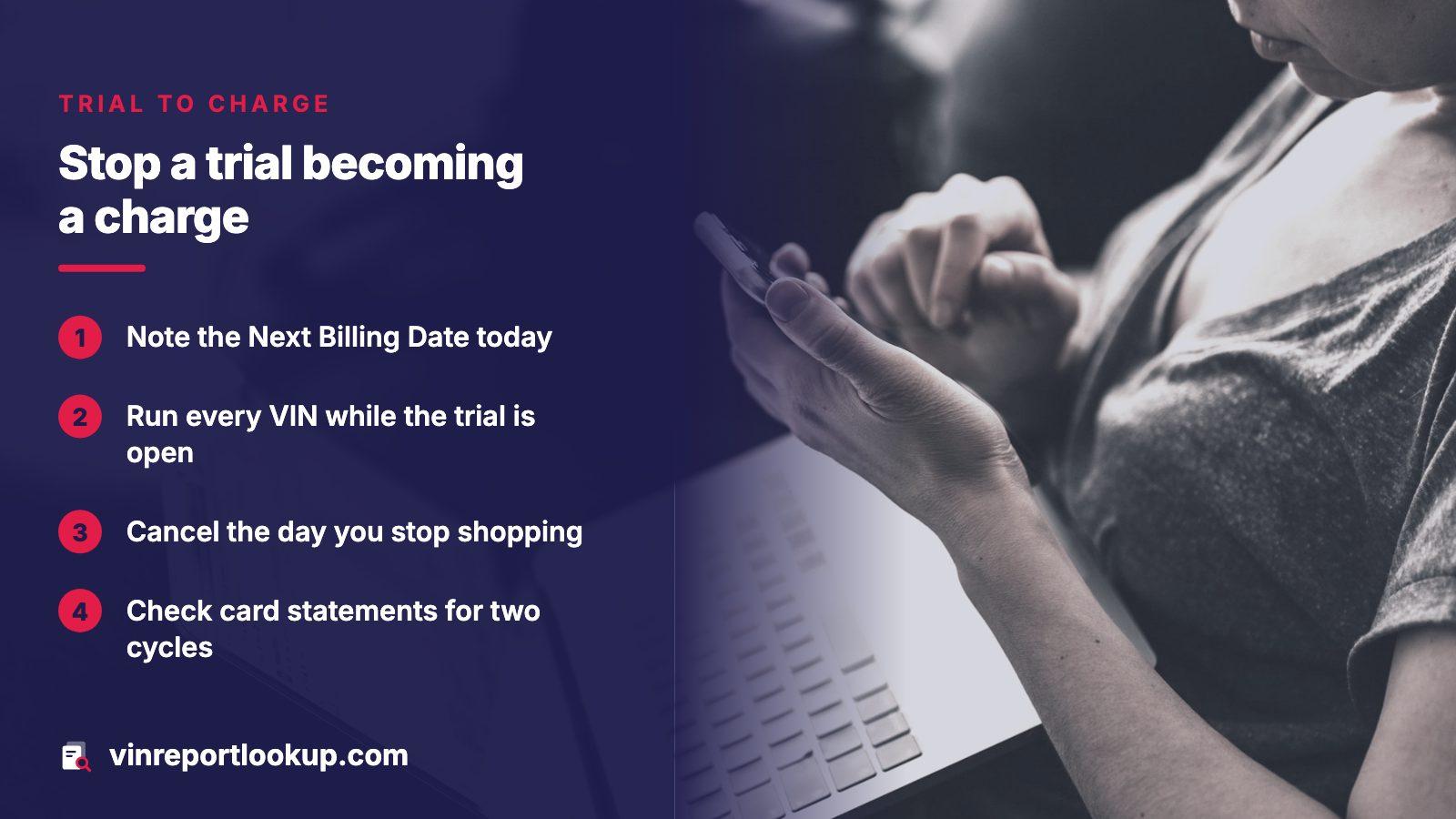
- Find the Next Billing Date on the order confirmation and put it in your calendar that day.
- Run every VIN you care about while the trial is open, since lookups are unlimited during it.
- Cancel the same day you stop shopping: through your account page, by phone or by email.
- Keep the confirmation, and check your card statement for the next two cycles.
- If a charge still lands, call the card company and report it, as the FTC advises.
Cancelling takes effect at once under the terms, and one-time purchases stay available afterward. The same terms mention a single report or a one-time package, so a subscription is not the only route.
Picking between them
- You want the federal title, brand and salvage record as a private buyer: use a provider the Justice Department lists for the public, which includes GoodCar.
- You are checking several cars in one week: a trial with unlimited lookups can cost less than separate purchases, provided you cancel on time.
- You are checking one car: look at single-report options before accepting a plan that renews.
- You want a Carfax report specifically: confirm its price and contents on Carfax's own pages, since we could not.
Whichever route you take, decide the number of VINs first. That one number matters more to the final bill than any difference in the report headings.
A one-payment alternative to weigh
VINReportLookup sells reports by VIN on a different model: you enter the VIN, see a free preview, then decide whether to buy. There is one payment, whether you take a single report or a larger pack, and no renewal follows it. What each costs is on the pricing page, and only the preview is free.
That suits a buyer with one or two cars on a shortlist who wants no renewal date at all. Someone working through a dozen listings may prefer a larger bundle or a trial elsewhere, and the pricing page makes that arithmetic easy. Take the VIN off the car, run the preview, then price each option against your real count.
Where this information comes from
- DOJ NMVTIS page listing every approved data provider — Shows which sellers take public customers and which are commercial only.
- DOJ guide to reading a federal title report — Names the indicators a federal report covers and defines a brand.
- DOJ checklist for buying a used car — Inspection advice and the pointer to the free NICB database.
- GoodCar: terms of service — Trial billing, renewal timing, cancellation routes and the accuracy disclaimer.
- GoodCar help center: billing and data questions — Stated plan price, contents claim and data sources.
- GoodCar: VIN check page — The second trial price and Carfax figure it shows.
- FTC advice on trials that renew automatically — Checks to make before you sign up for a trial.
Sources and photos: Facts checked against the sources above in November 2026. Photos by Abolfazl Ranjbar, Michal Biernat and Iain on Unsplash; diagrams by VINReportLookup.
Keep reading
- Carfax alternatives: what each VIN report option covers and costsWhere else to get a history report if Carfax does not suit you.
- Carfax vs NMVTIS: what each report shows and which to buySide-by-side look at the government title record and a Carfax report.
- How to cancel a GoodCar subscription before the next charge hitsThe cancellation routes in more detail, if you already signed up.
- PricingHow one-time report and pack pricing works here.
Frequently asked questions
Is GoodCar a real NMVTIS provider?
The Justice Department's roster lists GoodCar.com among approved providers that serve both commercial and public customers, and GoodCar's own FAQ says the same. The roster lists providers alphabetically and states no preference among them, so being listed shows approval, not that one report beats another.
Why can't I get a federal title report from Carfax?
The Justice Department says a consumer cannot obtain NMVTIS reports through Carfax, DMVDesk or Experian, since their customers are dealerships. It files Carfax under commercial-only providers, with its NMVTIS data going to commercial buyers in California alone.
What does GoodCar cost after the trial?
GoodCar's FAQ gives $29.95 monthly for unlimited reports after a 7-day trial, until you cancel. The terms say each renewal bills the then-current rate, and the unused remainder of a month is not refunded. Its home and VIN check pages show different trial prices, so confirm at checkout.
Does GoodCar guarantee its reports are complete?
No. Its terms say the company does not generate original reports, gathers information from public sources, and does not guarantee accuracy or completeness. For recalls, the terms point you to the vehicle maker. Use any report as a single input alongside an inspection.
What is the cheapest way to check recalls on either car?
NHTSA's recall page lets you search by VIN at no charge and shows any unrepaired recall. It will not list a recall that has already been repaired. No paid report is needed for that single question, though it answers nothing about title brands or odometer history.
Now check the car itself
The guide explains what to look for. The report shows what this VIN has on record.