THE SHORT ANSWER
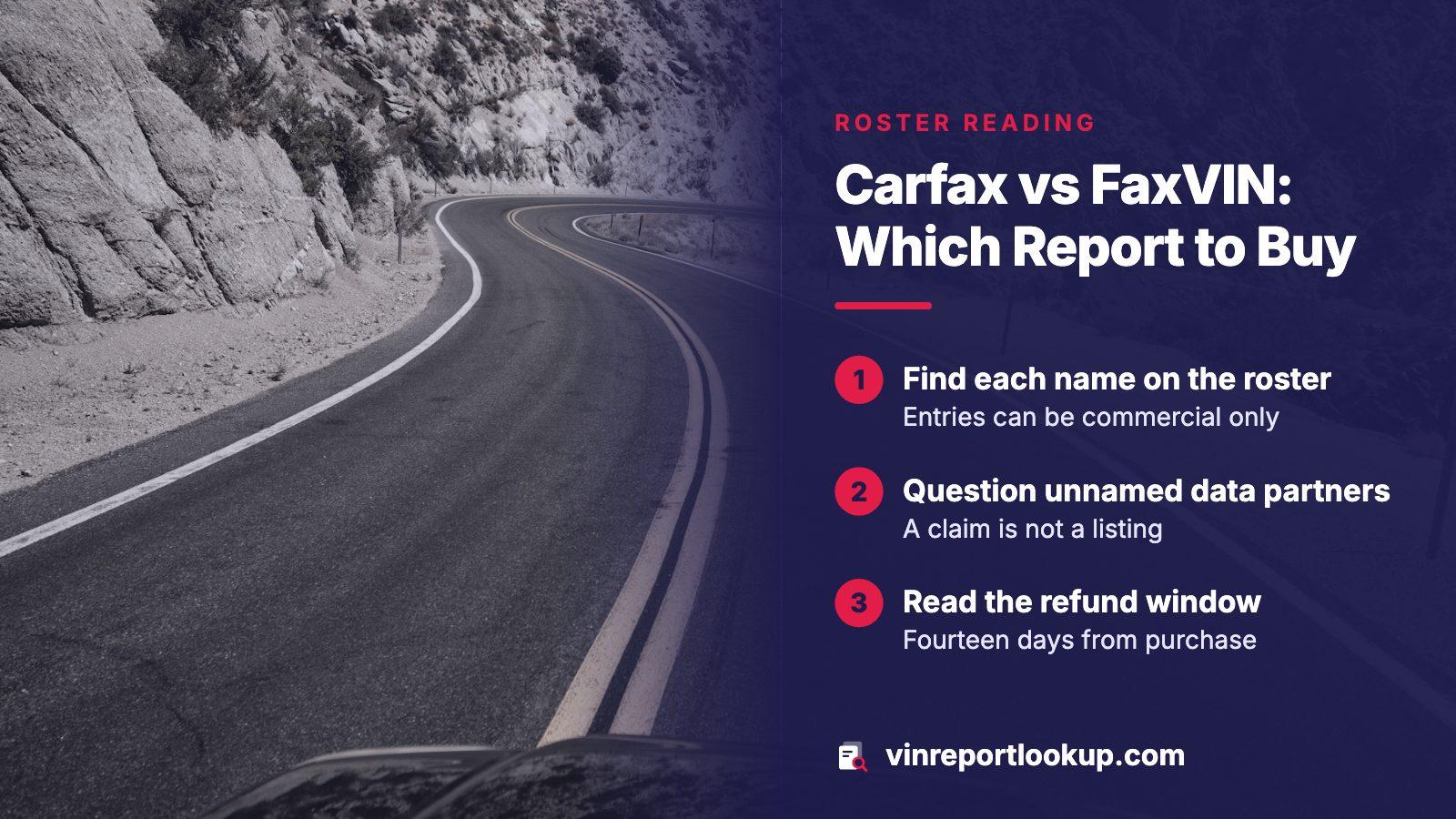
Neither name settles the question alone. The Justice Department roster limits Carfax's federal title feed to commercial customers in California, and it shows no FaxVIN entry, though FaxVIN says its title data arrives through an approved provider it does not name. FaxVIN prints no price and offers a refund window. Read each seller's current terms, then run a free preview on the VIN.
- Carfax on the federal roster
- Commercial customers only, California only
- FaxVIN on the federal roster
- No entry under its own name; it cites an unnamed approved provider
- FaxVIN refund window
- 14 days from purchase
- Carfax price and guarantee
- Not confirmed: its site refused access
What opened and what did not
A fair comparison starts with how much of each company could be read. Carfax's website answered both a plain request and a browser visit with a block page, so nothing on this page quotes its price, report layout or guarantee. FaxVIN's home page, refund policy, title-data disclaimer and plate page all loaded, and the Justice Department and FTC pages opened too.
| Question | Carfax | FaxVIN |
|---|---|---|
| Federal title data for the public | Roster note: commercial customers in California only | No roster entry; says it buys through an unnamed approved provider |
| Price | Read it on Carfax's own order page | None printed on the pages that opened |
| Refund terms | Not read; check before paying | Request within 14 days; credit or card refund |
| Plate entry | Not confirmed | Plate plus state matches to a VIN |
| What the FTC says | Named as a source that sometimes adds accident and repair entries | Not named |
Where each name sits on the federal roster
The Justice Department publishes the companies approved to sell records from the national title system, split into sellers open to everyone and sellers for businesses only. Carfax is filed in the business group, with a note that its feed goes to commercial customers in California only. A separate notice says consumers cannot receive these reports from Carfax, because it supplies dealerships.
That wording concerns one product, the government-sourced title report. It does not say Carfax's own consumer reports are unavailable, and this research could not open Carfax to read what those hold.
Searching the roster for FaxVIN turns up nothing, whether as an approved provider or as a website owned by one. Its disclaimer, last updated February 24, 2026, says title and brand fields come through an approved provider. The page names no provider, so you cannot match the claim against the list yourself.
Reading the roster result fairly
Absence from a list proves less than it seems. A reseller can legitimately buy title data from an approved firm, and FaxVIN says that is its arrangement. What the roster lets you test is the claim, and here the claim cannot be tested because no provider is named.
A question worth sending to support
Ask which approved provider supplies the title fields and whether the report marks which entries come from it. FaxVIN's own disclaimer says non-title data is labeled, so a clear answer should be easy to give. Keep the reply with your receipt.
Neither result says the reports are wrong. It tells you how much weight to put on the title section until you have seen a sample on your own VIN.
What a paid report can and cannot show
FaxVIN's pages describe a report covering odometer readings, brands, liens, accidents, recalls, service entries, prior rental or taxi use and theft. It also publishes timing estimates: service entries within 1 to 7 days, police accident reports in 7 to 21 days, title transfers in 15 to 45 days and total losses up to 30 days. Treat those as its own figures.
The government's side is blunter. The federal record is short, centered on title, brands, odometer and insurer total-loss decisions, and a clean result can still hide earlier damage if nobody declared the car a loss. Brand names also differ by state, so a salvage car in one state can look unremarkable in another.
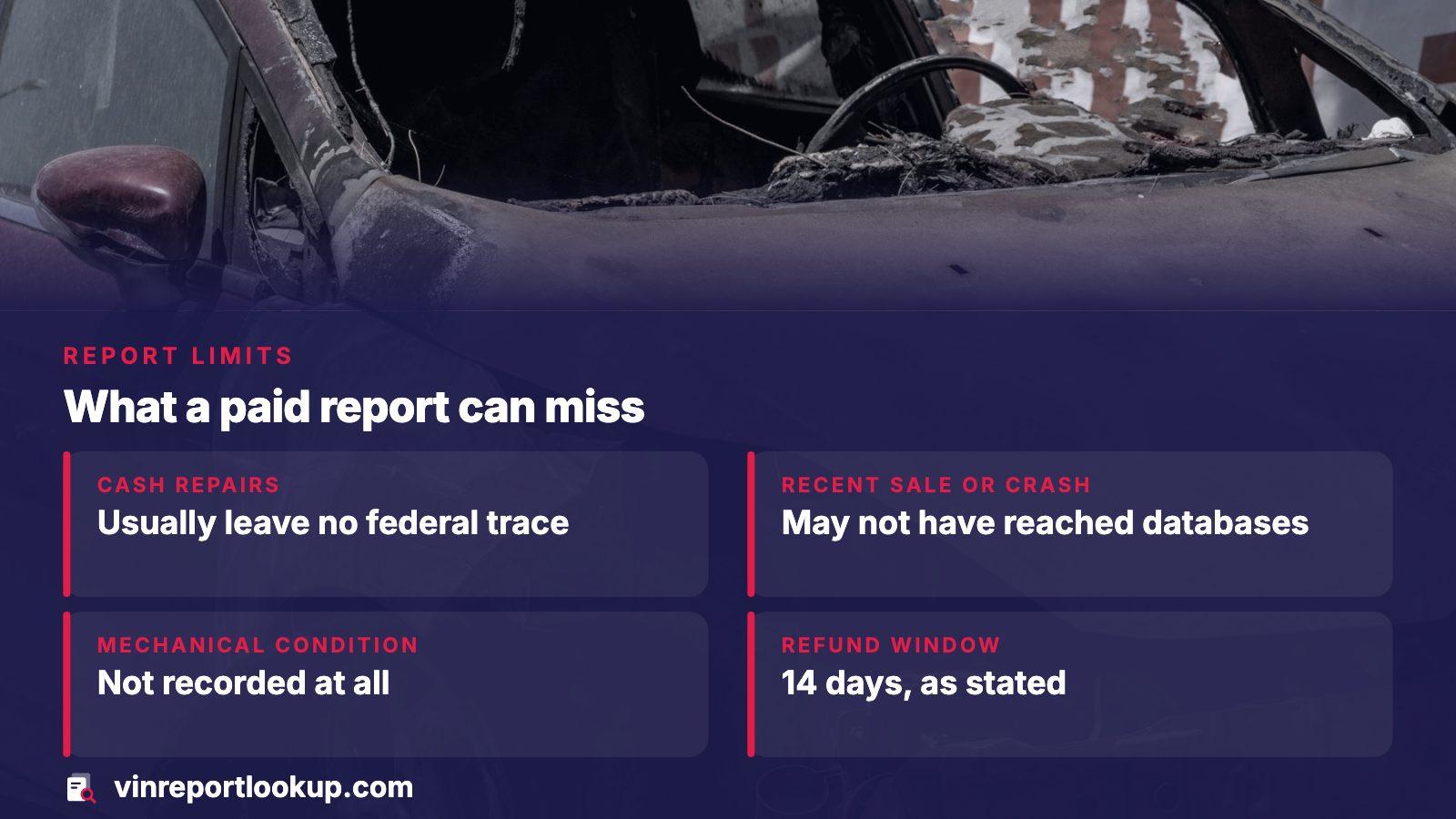
- Repairs paid for in cash usually leave no federal trace.
- A recent sale or crash may not have reached any database yet.
- Mechanical condition is not recorded at all.
Money terms to read before the card comes out
FaxVIN's refund policy, effective February 25, 2026, gives you 14 days to ask. A fix may follow if the report never arrived and you still had no access a day after writing to support, if it held no history entries beyond decoded specs, or if you paid twice for one VIN. Other requests are judged one by one.
Decisions are promised within 48 hours, excluding weekends and holidays, and money returned to a card may need as long as 10 business days. If your bank has already reversed the charge, FaxVIN will not refund it a second time. Contact support first, since an open dispute generally pauses its processing.
No price appeared on its pages, and Carfax's price could not be read. Get both from the checkout screen, with the total shown, before you enter card details.
The plate lookup and what it cannot do
FaxVIN lets you start from a plate and state, then links the plate to a VIN and returns make, model and year as a basic result. Its own page warns that the state must be the one that issued the plate and that paper temporary tags often fail to link to any VIN.
The same page is plain about privacy: under the federal Driver's Privacy Protection Act, an ordinary person cannot obtain an owner's name or address from a plate, and its lookup will not name an owner. Any service promising otherwise is promising something it should not deliver. With the car in front of you, match the number stamped on it against the seller's title or registration.
Do the free checks before buying any report
The FTC points buyers to two lookups that cost nothing. NHTSA lists open safety recalls for any VIN you enter, while the National Insurance Crime Bureau reports whether a car was flooded, stolen without being recovered, or called salvage. Both take a minute and may end the deal before a report purchase is needed.
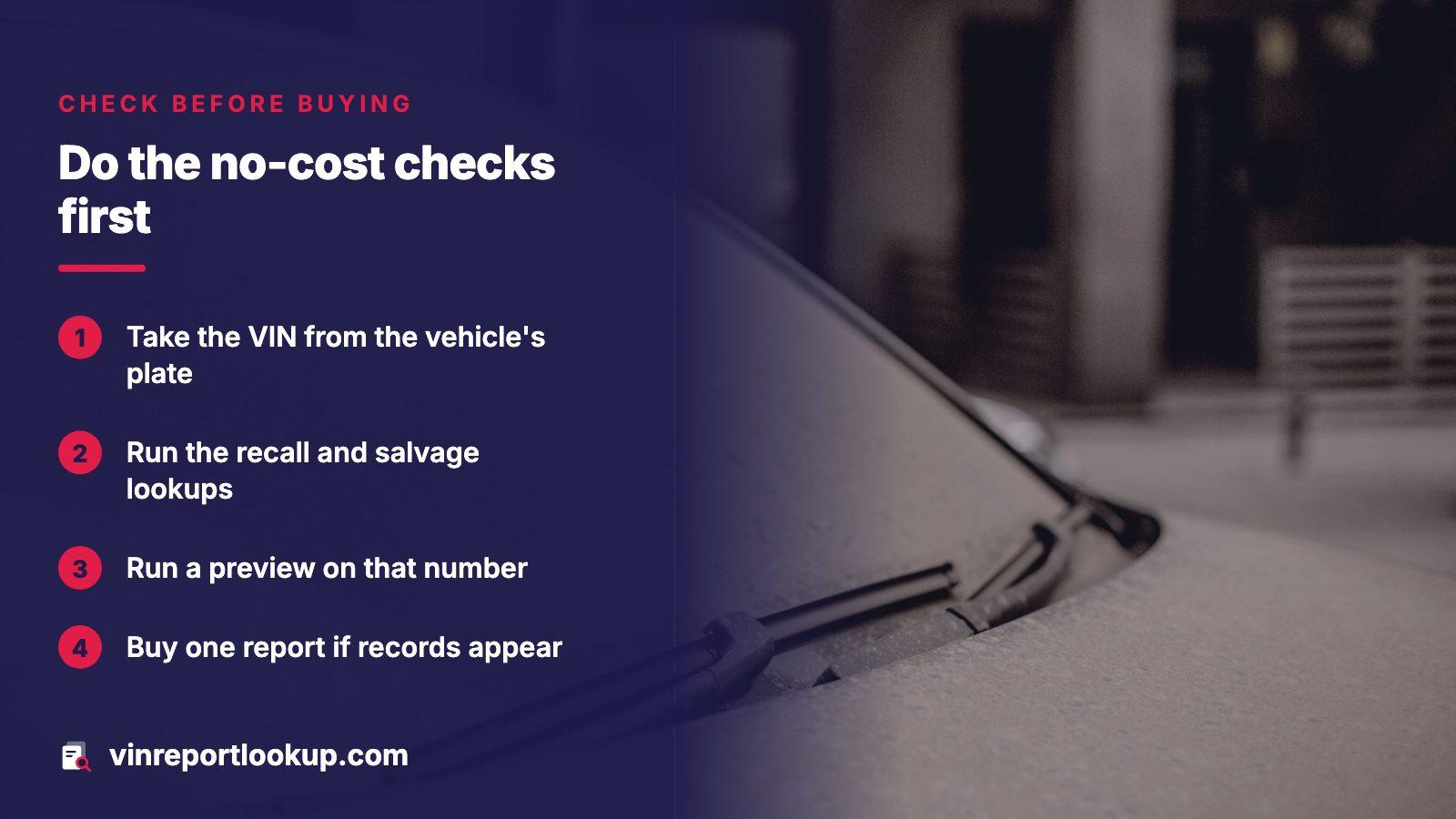
- Take the VIN from the vehicle's own plate, and compare it with the ad.
- Run the recall and salvage lookups.
- Run a VINReportLookup preview and see which record types turn up for that number.
- Buy one report only if the preview shows records worth reading.
Nothing is charged for the preview. The full report is paid once and does not renew, and today's prices are on the pricing page.
What a report cannot replace
Whichever company you pick, the FTC notes that these reports can show crashes and flooding yet rarely mention worn or broken parts. Its advice is to hire an outside mechanic, get the findings on paper, naming the make, model and VIN, and bring the repair estimates to the price talk.
A seller who refuses an outside inspection, the FTC says, is a reason to shop elsewhere. The Buyers Guide that dealers post inside every used car also nudges you to request a history report, so asking is routine.
Where this information comes from
- Bureau of Justice Assistance: approved NMVTIS data providers — Where Carfax is filed, the dealership-only notice, and the absence of a FaxVIN entry.
- Bureau of Justice Assistance: NMVTIS for consumers — What the federal search shows and how state brand rules differ.
- FTC: Used cars — Which reports sometimes add accident and repair entries, plus the no-cost recall and salvage lookups.
- FTC: Buying a used car from a dealer — Inspection advice and the Buyers Guide rule.
- FaxVIN: NMVTIS disclaimer — How the company says it obtains title data, and what that data leaves out.
- FaxVIN: refund policy — Request window, qualifying cases and processing times.
- FaxVIN: license plate lookup — Plate entry rules, privacy statement and data timing estimates.
Sources and photos: Facts checked against the sources above in November 2026. Photos by Will Truettner, JavyGo and engin akyurt on Unsplash; diagrams by VINReportLookup.
Keep reading
- FaxVIN alternatives: where else to buy a VIN report, and what to compareOther ways to buy a report if FaxVIN's open questions bother you.
- Carfax vs NMVTIS: what each report shows and which to buyWhat the federal title record holds that a Carfax report may not.
- Carfax review: is the report worth buying, and what else to compareA closer look at what could and could not be confirmed about Carfax.
- PricingCurrent cost of one report or a larger pack once the preview has run.
Frequently asked questions
Is FaxVIN related to Carfax?
Nothing on the pages that opened links them. FaxVIN's own pages describe a separate company with its own refund policy and disclaimers, and the federal roster lists Carfax under its own entry. The similar sound of the names appears to be coincidence, so judge each company on its own terms.
Does FaxVIN show up on the Justice Department provider list?
Not under its own name when the roster was read on November 7, 2026. FaxVIN's disclaimer says it obtains title data through an approved provider but does not name which one. Ask support for the provider's name if the source of the title section matters to your decision.
Can either service tell me who owns a car from its plate?
No. Owner details held in motor-vehicle records are restricted by the federal Driver's Privacy Protection Act, and FaxVIN's own plate page says its lookup will not identify an owner. A plate can at best lead to a VIN, which is the number the history check actually needs.
How long do I have to ask FaxVIN for a refund?
Its policy, effective February 25, 2026, gives 14 days from purchase. Qualifying cases include a report never delivered, one with no history entries, or a duplicate purchase. Anything else is decided case by case, so keep your transaction ID and write to support promptly.
Should I pay for a report or just get an inspection?
Do both, in that order. A report is cheap compared with an inspection and can rule out a car on title or damage grounds. Mechanical faults are typically absent from reports, according to the FTC, so a mechanic's written findings still matter on any car you plan to buy.
Now check the car itself
The guide explains what to look for. The report shows what this VIN has on record.