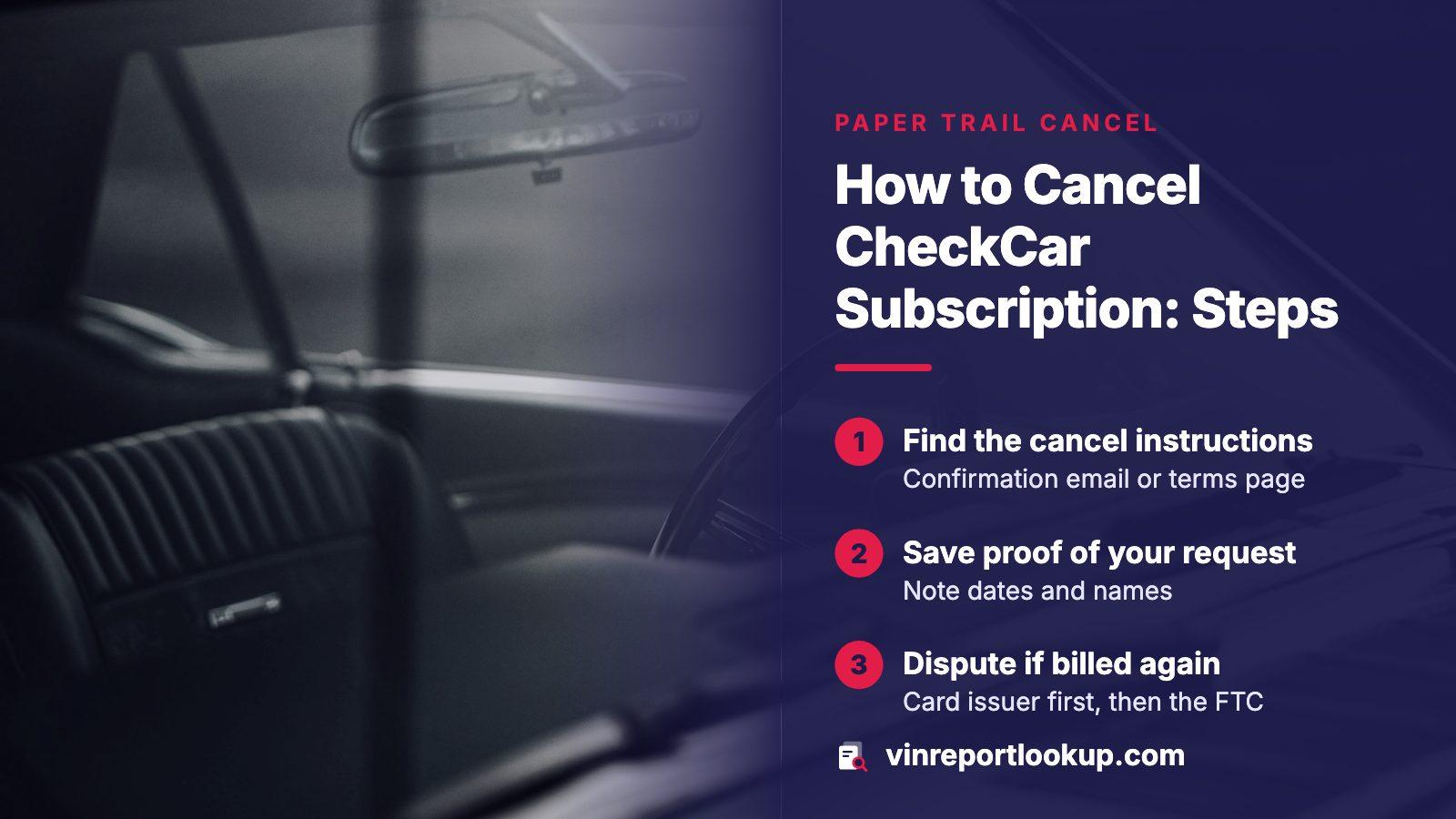
THE SHORT ANSWER
Find the cancellation instructions in your sign-up confirmation email or on the company's terms page, follow them, and keep a dated record of the request. Then watch your card statement. If a charge arrives after you cancelled, dispute it with your card issuer, and tell your bank to stop further payments to that company if needed.
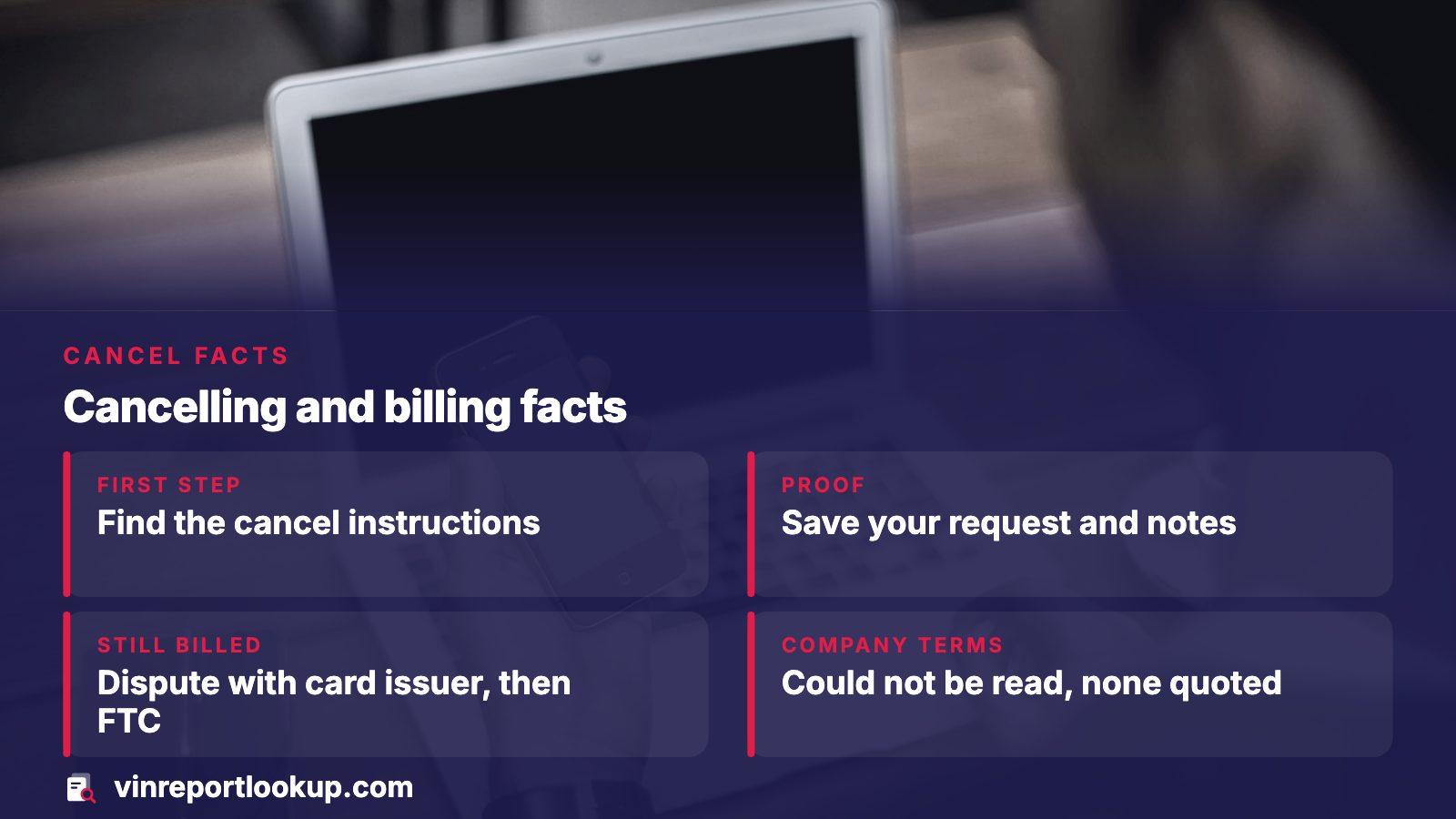
- First step
- Locate the cancel instructions in the confirmation email or terms
- Proof
- Save your request and jot down any phone conversation
- Still billed
- Dispute with the card issuer, then report to the FTC
- Our page
- CheckCar's own terms could not be read, so none are quoted
Where our reading of CheckCar stops
When we tried to open CheckCar's website to read its terms, every request landed on a bot-check screen, and we do not get around those. That means we cannot tell you its trial length, its renewal price, or the exact button or email address it uses for cancellations. Anyone who gives you those details without having read them is guessing.
What we can give you is the method that works for a subscription of any kind, taken from pages run by the FTC and the CFPB. It starts with your own paperwork, because the company is required to tell you how to cancel, and that explanation is the document that matters most.
Treat the company's wording as the rule
If CheckCar's confirmation email or terms name a cancel route, use that one first. Anything on this page about timing or refunds is general consumer guidance, not a statement of what CheckCar does.
Start with the paperwork you already have
The FTC's first instruction is to find how the company says to cancel, then do exactly that. For a report site, the likeliest places are the email that arrived right after your first payment, the account or billing page if you created a login, and the terms linked at the bottom of the checkout page.
- Search your inbox for the order confirmation and any later renewal reminder.
- Note the trial end date, the renewal date and the amount, if any of them are stated.
- Look at the card statement for the exact merchant name and amount that was charged.
- Save screenshots of every page you use, since pages change after you leave.
The FTC also tells shoppers to put the cancellation deadline on a calendar. A short cheap first payment that quietly turns into a recurring plan is the pattern its warnings describe, so the date matters more than the first price.
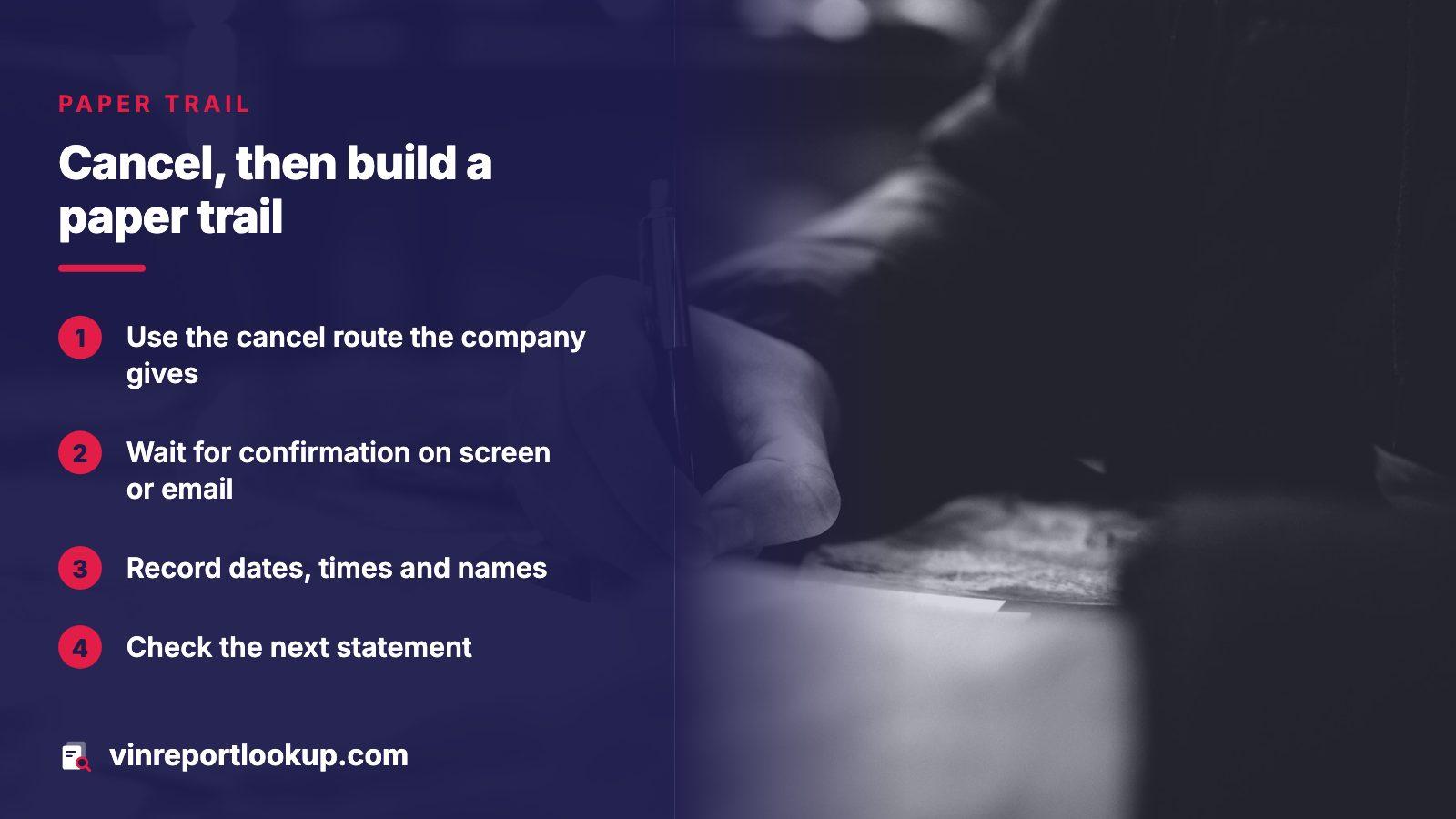
Cancel, then build a paper trail
- Use the cancel route the company gives, whether that is an account setting, a form or a support email.
- Wait for a confirmation on screen or by email, and do not close the page until you have it.
- Keep the request itself and write down the date, time and name of anyone you spoke to.
- Check the next statement for any extra or continued charge.
The FTC's list says much the same: follow the company's instructions, hold a copy of the request plus notes on any call, and look over later statements. If the confirmation never arrives, treat the cancellation as unfinished and ask again in writing.
Why a cheap report can turn into a plan
The FTC cautions that a box already ticked at checkout may give consent to ongoing billing, add-on products or passing along your information. It also says a fee for something advertised as free means the offer is not really free, and that charges after a trial can be higher than expected.
If you signed up for a report and later saw a second charge, reread the checkout screen you remember and the confirmation email. Look for a trial wording, a renewal line or a ticked box you never touched. Then compare the amount on your statement with what those pages say.
A renewal notice is not a bill
The FTC says a genuine renewal reminder should not ask for card details. If a message asks you to enter them, contact the company using a number you already trust, not the one in the message.
If the charge keeps coming after you cancelled
Begin with a dispute filed through whoever issued your credit or debit card. Per the FTC, that can be done in your card account online or by phone using the number printed on the card, and you should say why the charge is wrong. Send a letter too, addressed to the card company's disputes department, and think about certified mail so you hold a delivery receipt.
Attach or cite your records: the cancel request, the confirmation, the dates and the statement lines. The FTC does not give a dispute deadline in days on that page, so check your card issuer's own terms and act soon rather than waiting for another cycle.
A billing complaint can also go to the FTC through its ReportFraud site, and to the attorney general of your state. Those reports do not return your money, but they put the problem on an official record.
Stopping payments from your bank account
If the money comes straight out of a bank account rather than a credit card, the CFPB describes two calls. First tell the company you are revoking its permission to withdraw, and make clear if you are ending the service altogether or just switching payment method. Then tell your bank or credit union that you revoked it, and follow both calls with writing.
| Step | What to do | Why |
|---|---|---|
| Company | Revoke permission, then confirm in writing | Creates a dated record |
| Bank | Say you revoked authorization, then confirm in writing | Lets the bank block the next withdrawal |
| Stop order | Ask whether a stop payment order helps | Usually carries a bank fee |
| Contract | Cancel the service itself too | Stopping payment alone may not end it |
Federal rules on preauthorized transfers let you stop one by telling your bank no later than 3 business days ahead of the withdrawal date. The bank may ask for written confirmation of a phone request within 14 days, and without it the phone request stops being binding.
When one car is all you need, skip the plan
Most people who end up cancelling a report subscription only wanted to check a single vehicle before paying a seller. A recurring plan fits someone checking cars every week, and it rarely fits a one-off purchase.
Here, nothing recurs. You type the VIN, glance at the preview, and only then decide on the paid report. It is one charge, with multi-report packs for shoppers lining up more than one vehicle. The pricing page shows the current options. The preview itself costs nothing, so it is a low-risk way to judge the car.
Do not let the cancellation distract from the car
If you were mid-purchase when the billing trouble started, the underlying question is still open: what has this car been through. Brands on the title, odometer jumps and unrepaired recalls are what change an offer.
Settle the billing first, then put the VIN through a check ahead of paying the seller anything. Our sample report lays out every section so you can see the level of detail beforehand.
Where this information comes from
- FTC: free trials, auto-renewals and negative option subscriptions — reading terms, cancelling, keeping proof and filing a card dispute
- FTC: free trial scams — warning signs when cancelling is harder than signing up
- CFPB: how to stop automatic payments from a bank account — revoking permission, notifying the bank and stop payment orders
- CFPB: Regulation E, preauthorized transfers — notice timing and written confirmation for stopping a transfer
Sources and photos: Facts checked against the sources above in November 2026. Photos by Dylan Michaud, Owen Michael Grech and Alejandro Escamilla on Unsplash; diagrams by VINReportLookup.
Keep reading
- Car history report subscription: when a plan pays and when to skip itWhether a monthly plan ever suits a single car
- How to cancel a GoodCar subscription before the next charge hitsThe same cancellation steps for a different service
- Vehicle history report scams: how to spot a fake report seller before you payTelling a billing trap from an honest report seller
- PricingHow a one-time report is priced here
Frequently asked questions
How do I cancel a CheckCar subscription?
Use the route in your confirmation email or on the company's terms page, since we could not read CheckCar's own pages. Get a confirmation, save a copy of the request, and check your next card statement. Should another charge show up, raise a dispute with the card issuer.
Will cancelling get my money back?
Not automatically. Refund rules are set by the company's terms, which we could not read for CheckCar. If a charge came after you cancelled, a dispute with your card issuer is the route the FTC describes, backed by your records.
Can I just block the card?
That may stop payments, but it does not end the contract, and the CFPB notes the service itself may carry on. Cancel with the company first, and use your bank's stop process as a backup.
Who do I report a billing problem to?
The FTC takes reports at ReportFraud.ftc.gov, and your state attorney general also accepts them. Neither replaces a dispute with your card issuer, so file that as well and keep every record of your cancellation attempts.
Does a VIN report here come with a subscription?
No. You can run the preview without paying, and a full report is bought once, either alone or as a multi-report pack, with nothing set to renew. Current options are on the pricing page.
Now check the car itself
The guide explains what to look for. The report shows what this VIN has on record.